 4140 Steel Brinell Hardness: Know the Numbers Before You Machine or Heat Treat!
If you’re working with 4140 alloy steel, chances are you’re dealing with heat treatment, machining, or quality control—and that means hardness matters a lot. One of the most common ways to evaluate it? The Brinell hardness test.
So let’s dive deep into the 4140 steel Brinell hardness range, what affects it, and how to choose the right condition for your application. 🧐📏
📌 What Is Brinell Hardness, and Why Use It for 4140?
The Brinell Hardness Number (BHN) measures the resistance of a material to indentation using a hardened steel or tungsten carbide ball. For steels like 4140, this test gives a reliable idea of surface hardness—especially when you want to compare heat-treated vs annealed conditions.
But here’s the catch: hardness values vary a lot depending on how the 4140 is processed.
📊 4140 Steel Hardness Chart (Brinell Values by Condition)
Here’s a helpful reference table showing typical Brinell hardness value for 4140 steel in different heat treatment conditions:
| Condition | Brinell Hardness (BHN) | Notes |
|---|---|---|
| 4140 Annealed Brinell Hardness | 197 – 217 BHN | Soft, machinable |
| Normalized | 207 – 235 BHN | Slightly stronger |
| Brinell hardness of quenched and tempered 4140 | 241 – 321 BHN | Depends on tempering temperature |
| Induction Hardened Surface | 450+ BHN (localized) | Only surface, not core |
| Nitrided Surface | Up to 600 HV (~55 HRC) | Converted scale |
So the 4140 steel Brinell hardness range is typically between 190 and 320 BHN, depending on treatment. Quenching and tempering give the best balance of strength and ductility.
🔥 Brinell Hardness of Quenched and Tempered 4140
When you Q&T (quench and temper) 4140, you supercharge its mechanical performance.
-
At low tempering temps (~400°C), hardness can reach 300–321 BHN
-
At high tempering temps (~650°C), you get ~240–270 BHN, but higher toughness
This sweet spot is what makes Q&T 4140 perfect for shafts, gears, and heavy-duty tools.
Real-life example? One of our clients in Vietnam used Q&T 4140 (280 BHN) for large drive axles. After 18 months, wear was still minimal—even under heavy torque and cyclic load.
🧊 What About Annealed 4140?
In its annealed state, 4140 steel Brinell hardness is around 197–217 BHN. This is soft enough for easy cutting and shaping, which is why it’s often preferred before machining.
Pro Tip: If you plan to machine and then harden later—start with 4140 annealed Brinell hardness stock. It’ll save your tooling and time! 🧰⏱️
🤔 Brinell vs Rockwell: What’s the Difference?
We get this question a lot: “What’s the difference between Brinell and Rockwell hardness in 4140 steel?”
Here’s a quick breakdown:
| Feature | Brinell Hardness (BHN) | Rockwell Hardness (HRC) |
|---|---|---|
| Indenter Type | Ball (10mm) | Cone (diamond) |
| Load | Heavy (500–3000 kgf) | Lighter (60–150 kgf) |
| Surface vs Bulk | Good for bulk readings | Good for surface hardness |
| Conversion | 197 BHN ≈ 91 HRB | 321 BHN ≈ ~35 HRC |
Both are useful—but Brinell is preferred for checking forged or thick sections, while Rockwell is often used for surface readings on thinner parts or hardened zones.
🛠️ How to Increase Brinell Hardness of 4140 Steel
Want harder 4140? Here’s how to do it:
-
🔥 Quenching and Tempering: Ideal for through-hardening while preserving ductility.
-
⚡ Induction Hardening: Hardens only the surface (~450+ BHN) while keeping the core tough.
-
🧪 Nitriding: Adds a super-hard outer shell without distortion—especially useful for wear parts.
Always remember: heat treatment changes everything—mechanical properties, cost, and machinability.
🌍 Real-World Applications by Hardness Range
| BHN Range | Application |
|---|---|
| 190–220 | Machined parts, fixtures |
| 220–270 | Shafts, connecting rods |
| 270–320 | Gears, drive axles, wear plates |
| 400+ | Induction hardened pins, cams |
🧠 FAQs – 4140 Steel Brinell Hardness
Q1: What is the maximum Brinell hardness of 4140 steel?
👉 Typically ~320 BHN after Q&T. Higher values are possible with surface hardening.
Q2: Can I use Rockwell instead of Brinell for 4140?
👉 Yes, but make sure to use the proper conversion chart. They serve different testing needs.
Q3: Is Brinell hardness affected by steel size or shape?
👉 Only slightly—Brinell is great for large sections. For thin or small parts, use Rockwell.
Q4: Can I request specific hardness when buying 4140?
👉 Absolutely. At Otai, we supply 4140 in various conditions—just tell us your spec.
🏭 Why Otai Is Your Best Source for 4140 Steel
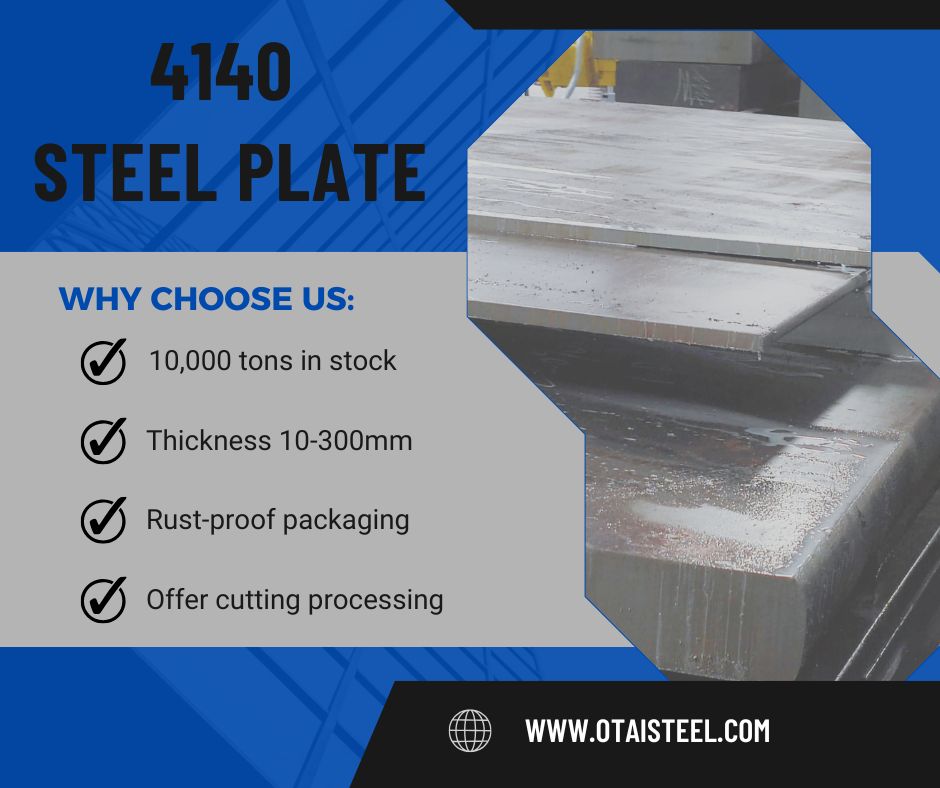
At Otai Special Steel, we don’t just stock 4140—we help you choose the right hardness level for your project. Whether you need annealed, Q&T, or pre-machined bars, we’ve got it covered:
- Over 10,000 tons of inventory
- Thickness from 6mm to 300mm
- Cut-to-length and heat treatment services
- Hardness testing (BHN, HRC) available
- SGS/third-party inspection support
- Export to 50+ countries, including EU and US markets
- Trusted by Thyssenkrupp, Borealis, Schlumberger and more
📧 Email us: jack@otaisteel.com
📱 WhatsApp: +8676923190193
💬 Ready to choose the perfect hardness for your 4140 steel? Contact us now—we’ll help you decide based on your use case, load conditions, and machining needs.