 4140 Steel vs 8620: Which One Should You Choose?
What’s the Real Difference Between 4140 Steel and 8620 Steel?
If you’re looking to buy alloy steel, you’ve probably heard of both 4140 and 8620. They’re both popular choices, but they aren’t the same. So, what’s the real difference?
4140 is a chromium-molybdenum alloy steel known for its great strength and toughness. It has a medium carbon content, which helps it handle heavy loads and impacts. On the other hand, 8620 is a nickel-chromium-molybdenum alloy steel with lower carbon but is famous for its excellent case-hardening ability.
Put simply: 4140 is great for parts that need solid strength throughout, while 8620 shines when you need a tough core with a hard, wear-resistant surface.
This difference in chemical composition gives each steel unique traits, making them suitable for different jobs. If you want to dig deeper, comparing the chemical makeup of 4140 steel vs 8620 reveals these clear distinctions.
Comparing Mechanical Properties: Which One is Stronger?
When choosing between 4140 and 8620 steel, strength and hardness often top the list. Let’s check out a quick comparison:
| Property | 4140 Steel (Quenched & Tempered) | 8620 Steel (Case Hardened) |
|---|---|---|
| Tensile Strength | 850 – 1000 MPa | 620 – 850 MPa |
| Yield Strength | ~655 MPa | ~380 MPa (core) |
| Hardness (HRC) | 28 – 32 HRC | 55 – 62 HRC (surface) |
| Toughness | High | Good (core) |
| Elongation | ~25% | ~15% |
As you can see, 4140 steel is stronger overall in bulk, especially when fully heat treated. But 8620’s surface hardness can be much higher after carburizing, which is key for wear resistance on gears and shafts.
So, if you need solid strength inside and out, 4140 may be your pick. If you want a tough inner core with a hard, wear-resistant shell, 8620 is likely better.
Heat Treatment: How It Changes 4140 and 8620 Performance
Heat treatment plays a huge role in both steels’ performance.
-
4140 steel usually undergoes quenching and tempering, which makes the whole piece strong and tough. This process helps 4140 steel maintain high tensile strength and durability throughout the material.
-
8620 steel, however, shines with case hardening. This means it gets carburized—carbon is added to the surface—and then heat treated. The surface becomes very hard and wear-resistant, but the core stays tough and ductile.
This is why 8620 is common in applications where wear resistance on the surface is crucial but toughness inside is also needed.
Typical Applications: Where to Use 4140 and Where to Choose 8620
Choosing between 4140 and 8620 depends a lot on your application.
-
4140 steel is often used for machine parts, shafts, gears, and tools where uniform strength and toughness are required. For example, heavy-duty shafts and automotive components benefit from 4140’s strength.
-
8620 steel is widely chosen for gears, sprockets, and transmission parts where surface hardness prevents wear but the core needs to absorb shocks. Case hardened 8620 is standard for high-performance gearboxes.
For instance, one of our clients in the automotive industry uses 8620 steel for transmission gears to maximize wear life, while they prefer 4140 steel for crankshafts to handle high loads.
Cost and Availability: What Should You Expect?
Price matters, especially if you order large volumes.
Generally speaking:
| Material | Price Range | Stock Availability at Otai |
|---|---|---|
| 4140 Steel | Moderate | Large stock, thickness 6mm-300mm |
| 8620 Steel | Slightly higher | Good stock, mainly medium thickness |
4140 steel is usually more affordable and easier to find in a wide range of sizes. 8620, due to its special chemistry and processing, tends to be a bit pricier.
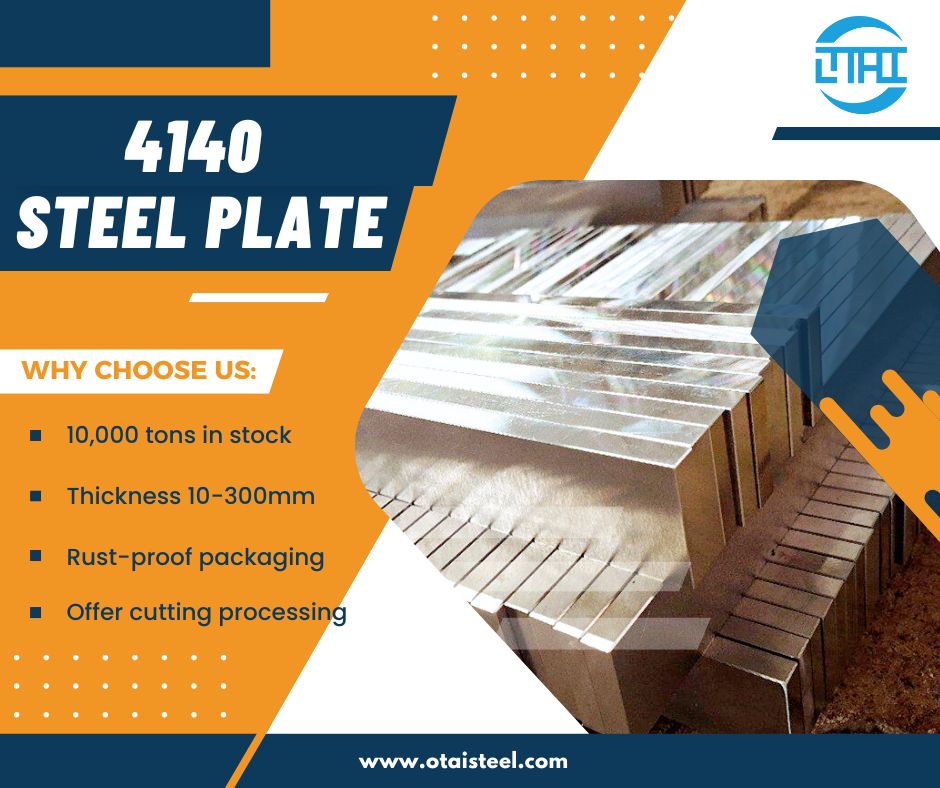
At Otai Steel, we keep over 10,000 tons of alloy steel inventory including both 4140 and 8620, ready for fast delivery and custom cutting.
Why Choose Otai Special Steel for Your 4140 and 8620 Steel Needs?
When you buy steel, quality and service matter a lot.
At Otai:
-
We offer source factory prices without middlemen.
-
Our stock covers thickness from 6mm up to 300mm in both 4140 and 8620 steels.
-
We provide precision cutting, heat treatment, and inspection services.
-
Each batch gets 100% ultrasonic testing and chemical analysis.
-
Packaging options include rust-proof wrapping and wooden crates.
-
We’ve supplied to global giants like Thyssenkrupp and Schlumberger for decades.
If you want strong, reliable steel for your next project—whether 4140 steel vs 8620 steel—contact us! We’ll help you pick the right grade and deliver on time.
FAQs about 4140 Steel vs 8620 Steel
1. What is the main difference between 4140 and 8620 steel?
4140 is a medium carbon alloy steel, great for uniform strength. 8620 is a low carbon alloy that can be case hardened for a hard surface and tough core.
2. Which steel is stronger, 4140 or 8620?
4140 is generally stronger overall, but 8620 has a harder surface after heat treatment.
3. Can I use 4140 steel instead of 8620 for gears?
It depends. 8620’s case hardening makes it better for wear resistance on gears.
4. Does Otai supply heat-treated 4140 and 8620?
Yes, we provide both raw and heat-treated materials per your specs.
5. What thickness ranges do you have for 4140 and 8620?
We stock 6mm to 300mm thicknesses for both grades, ready for cutting.
If you want to learn more or get a quote for 4140 steel vs 8620 steel, email me at jack@otaisteel.com or WhatsApp +8676923190193.
We’re here to help you get the best steel for your needs!