 4140 Steel Welding Procedure: Complete Guide for Strong and Reliable Welds
Welding 4140 alloy steel can be tricky if you want to achieve strong, crack-free joints. Because of its chromium-molybdenum composition and medium carbon content, this steel offers excellent strength and hardenability — but also a higher risk of cracking if welded without proper precautions.
In this guide, we’ll break down the 4140 steel welding procedure, from preheating to post-weld treatment, to help you get reliable results in both shop and field environments.
🔍 Understanding the Challenges of Welding 4140 Steel
4140 is a medium carbon, low alloy steel with approximately 0.38–0.43% carbon, 0.8–1.1% chromium, and 0.15–0.25% molybdenum. These elements make it strong and wear-resistant but also increase hardenability, meaning the weld area can form brittle martensite if cooled too quickly.
Common welding challenges include:
-
Cracking in the heat-affected zone (HAZ) due to high hardness.
-
Loss of toughness in the weld area without proper heat control.
-
Distortion in thin sections from excessive heat input.
🛠 Pre-Weld Preparation
The first step in a proper 4140 welding procedure is surface preparation.
-
Cleaning: Remove rust, oil, grease, and mill scale from both sides of the joint.
-
Edge Preparation: For thicker sections (>12 mm), bevel the edges to ensure full penetration.
-
Fit-Up: Maintain tight and consistent gaps to control heat distribution.
🌡 Preheating – The Key to Avoiding Cracks
Preheating 4140 steel before welding is one of the most important steps to reduce cracking risk.
Recommended preheat temperatures:
| Thickness (mm) | Preheat Temperature (°C) | Preheat Temperature (°F) |
|---|---|---|
| < 12 | 150–200 | 300–400 |
| 12–25 | 200–250 | 400–480 |
| > 25 | 250–315 | 480–600 |
Preheating slows down the cooling rate, preventing martensite formation in the HAZ and reducing residual stresses.
⚙ Choosing the Right Filler Metal
For welding 4140 steel, filler selection depends on whether you want:
-
As-welded properties close to 4140 steel (for matching strength).
-
Ductile welds with reduced cracking risk (for dissimilar joints).
Common filler choices:
-
ER80S-D2 – Good match for strength, balanced ductility.
-
E10018-D2 – For higher strength requirements.
-
Low-hydrogen electrodes – Reduce hydrogen cracking risk.
🔥 Welding Technique
The welding process for 4140 alloy steel should be controlled to minimize heat concentration.
-
Use low-hydrogen welding processes (GTAW/TIG, GMAW/MIG, SMAW).
-
Keep interpass temperature around 200–300°C (390–570°F).
-
Avoid excessive weaving; use stringer beads for better control.
-
Allow short pauses between passes to avoid overheating.
🌬 Post-Weld Heat Treatment (PWHT)
PWHT is essential when following a 4140 steel welding procedure for critical applications. It helps:
-
Reduce residual stresses.
-
Improve toughness in the HAZ.
-
Refine microstructure.
Typical PWHT cycle:
-
Heat to 595–675°C (1100–1250°F).
-
Hold for 1 hour per inch of thickness.
-
Cool slowly in still air or furnace.
📈 Mechanical Properties After Welding
With proper welding and PWHT, 4140 welded joints can retain a high percentage of their original mechanical properties:
| Property | As-Welded | PWHT Condition |
|---|---|---|
| Tensile Strength (MPa) | 750–850 | 850–950 |
| Yield Strength (MPa) | 600–700 | 700–800 |
| Hardness (HB) | 230–260 | 220–240 |
🏭 Industrial Applications of Welded 4140 Steel
Because of its high strength and wear resistance, welded 4140 components are widely used in:
-
Heavy machinery repair – Shafts, axles, and gear housings.
-
Oil & gas equipment – Drill collars and high-pressure pipework.
-
Construction – Crane booms and lifting arms.
-
Automotive – Roll cages, chassis reinforcements, and suspension arms.
💡 Practical Tips for Welding 4140 Steel
-
Always follow a low-hydrogen welding process to minimize cracking.
-
Use preheat and post-weld slow cooling for thick sections.
-
Match filler strength to application needs — overmatching can cause brittle welds.
-
For highly critical parts, consider full stress relief PWHT.
-
Use controlled welding parameters to avoid overheating the base material.
🌍 Company Advantages – Otai Special Steel
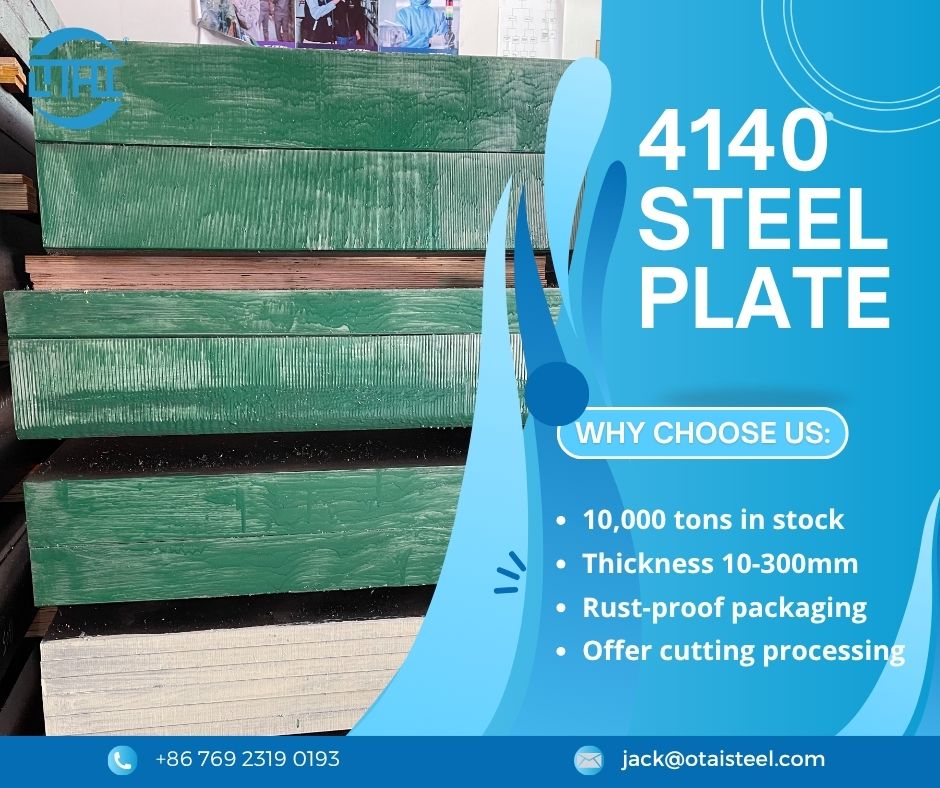
At Otai Special Steel, we not only supply premium 4140 alloy steel but also provide technical welding guidance to ensure your projects succeed. With over 10,000 tons of stock in thicknesses from 6 mm to 300 mm, we offer:
-
Custom cutting for your exact dimensions.
-
Heat treatment services including preheating and PWHT.
-
Welding filler material recommendations for 4140 steel.
-
Quality certifications like UT, chemical analysis, and third-party inspection.
❓ FAQ
1. Why is preheating so important for welding 4140 steel?
It slows down cooling, reducing the risk of cracking in the heat-affected zone.
2. Can 4140 steel be welded without PWHT?
Yes, for non-critical parts, but PWHT improves toughness and reduces stress.
3. Which welding process works best for 4140 steel?
Low-hydrogen processes like TIG, MIG, and SMAW are preferred for strong, clean welds.