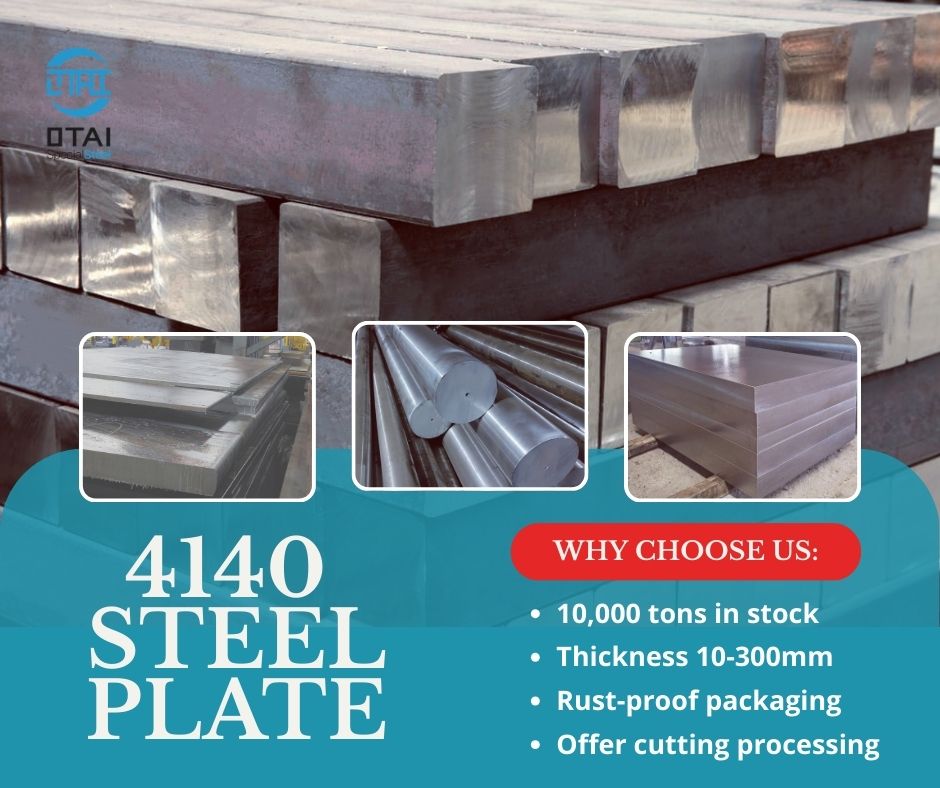
 4140 Steel vs 4340 Steel: Key Differences You Need to Know
When it comes to selecting high-strength alloy steels for demanding engineering applications, 4140 steel and 4340 steel are two of the most discussed options. Both belong to the same family of chromium-molybdenum steels, but they have distinct differences in chemical composition, mechanical properties, and performance under extreme conditions.
If you’re designing critical components like shafts, gears, aerospace parts, or heavy-duty machinery, understanding the differences between these steels will help you make an informed choice. Let’s break it down step by step.
🧪 1. Chemical Composition – The Core Difference
The key variation between 4140 and 4340 steels lies in the addition of nickel in 4340, which dramatically changes its toughness and hardenability.
| Element | 4140 Steel (wt%) | 4340 Steel (wt%) |
|---|---|---|
| Carbon (C) | 0.38 – 0.43 | 0.38 – 0.43 |
| Chromium (Cr) | 0.80 – 1.10 | 0.70 – 0.90 |
| Molybdenum (Mo) | 0.15 – 0.25 | 0.20 – 0.30 |
| Manganese (Mn) | 0.75 – 1.00 | 0.60 – 0.80 |
| Nickel (Ni) | — | 1.65 – 2.00 |
| Silicon (Si) | 0.15 – 0.35 | 0.15 – 0.35 |
Key takeaway:
The nickel content in 4340 gives it superior toughness and impact resistance, especially at low temperatures, making it ideal for aerospace and defense applications.
⚙ 2. Mechanical Properties – Strength vs. Toughness
Both steels can be heat-treated to achieve excellent mechanical properties, but their strengths differ depending on the application.
| Property | 4140 Steel | 4340 Steel |
|---|---|---|
| Tensile Strength (quenched & tempered) | 850 – 1000 MPa | 930 – 1080 MPa |
| Yield Strength | 655 – 830 MPa | 745 – 980 MPa |
| Rockwell Hardness (HRC) | 28 – 32 (typical) | 30 – 36 (typical) |
| Elongation at Break (%) | 20 – 25 | 18 – 22 |
| Charpy Impact Toughness | Good | Excellent (especially in low temperatures) |
Key takeaway:
-
4140 steel offers excellent strength and wear resistance, making it ideal for general machinery and tooling.
-
4340 steel excels in impact resistance and fatigue strength, making it more suitable for high-stress aerospace and military parts.
🔥 3. Heat Treatment Response
Both steels respond well to annealing, quenching, and tempering, but 4340 has better deep hardenability due to its nickel content.
-
4140 Steel: Best hardness after quenching is around HRC 50–55, with good dimensional stability.
-
4340 Steel: Can reach HRC 55–60 while retaining better toughness, even in thicker sections.
This means 4340 is more reliable for large cross-section parts that need through-hardening.
🛠 4. Machinability
-
4140 Steel: Machinability rating of about 65% compared to 1212 free-cutting steel. Easy to machine in annealed condition.
-
4340 Steel: Slightly harder to machine (55–60% machinability) due to higher hardness potential, but still workable with proper tooling and cooling.
If you need complex machining, 4140 may be more economical due to faster cutting speeds and less tool wear.
🧲 5. Applications – Where Each Steel Shines
4140 Steel Common Uses:
-
Gears and sprockets
-
Shafts and axles
-
Machine tool spindles
-
Hydraulic cylinders
-
Forged crankshafts
4340 Steel Common Uses:
-
Aircraft landing gear
-
Heavy-duty drive shafts
-
Military vehicles
-
Oilfield drilling equipment
-
High-performance automotive racing parts
💰 6. Cost Considerations
Generally, 4340 steel is more expensive due to:
-
Higher alloy content (especially nickel)
-
Enhanced mechanical performance
-
Wider use in critical aerospace and defense industries
For general-purpose applications where extreme toughness is not necessary, 4140 steel is the more cost-effective choice.
📊 7. Quick Comparison Table
| Feature | 4140 Steel | 4340 Steel |
|---|---|---|
| Main Alloying Elements | Cr, Mo | Cr, Mo, Ni |
| Strength | High | Very High |
| Toughness | Good | Excellent |
| Hardenability | Good | Superior |
| Fatigue Resistance | High | Very High |
| Machinability | Better | Slightly Lower |
| Cost | Lower | Higher |
🧠 8. 4140 steel vs 4340 steel: Choosing the Right Steel
Your choice between 4140 and 4340 should depend on:
-
Required toughness: If extreme impact resistance is needed, 4340 is the clear winner.
-
Part size: For thicker parts requiring through-hardening, 4340 is preferable.
-
Budget constraints: If cost is a factor and extreme toughness isn’t required, 4140 is more economical.
-
Service environment: 4340 performs better in low-temperature and high-impact environments.
🌟 Company Advantages – Why Choose Otai Special Steel
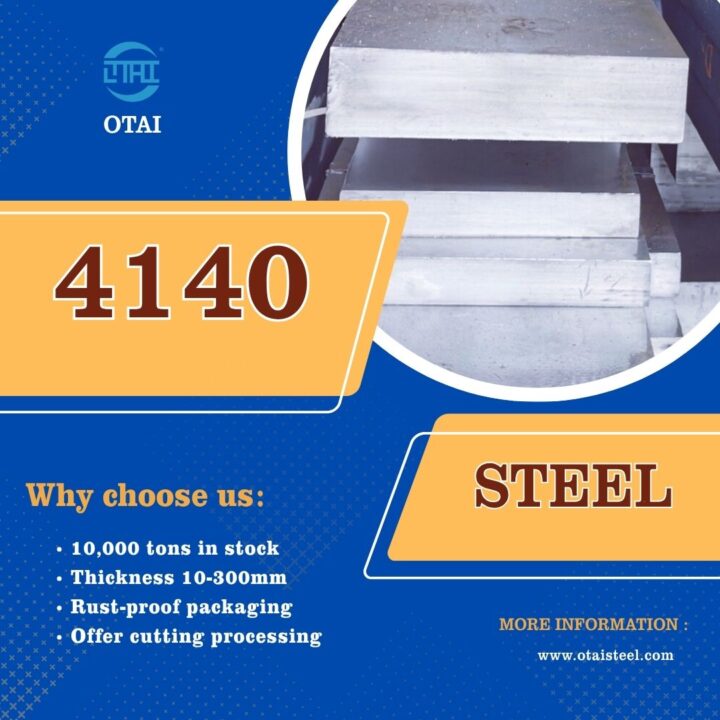
At Otai Special Steel, we stock over 10,000 tons of alloy steels, including both 4140 and 4340 grades, available in a wide range of sizes from 6mm to 300mm thickness.
Our services include:
-
Customized cutting to precise dimensions
-
Heat treatment to achieve your desired hardness
-
Ultrasonic testing (UT) for internal defect inspection
-
Chemical composition analysis
-
Third-party inspections (SGS, BV)
-
Fast delivery worldwide
We have supplied top international companies such as Thyssenkrupp, Schlumberger, and Borealis, ensuring reliable quality and stable supply.
❓ FAQ
Q1: Which steel is stronger, 4140 or 4340?
4340 steel has higher tensile and yield strength than 4140, especially after heat treatment.
Q2: Is 4340 more expensive than 4140?
Yes, mainly due to its higher nickel content and superior performance in extreme conditions.
Q3: Can I replace 4340 with 4140?
Only if the application does not require extreme toughness or deep hardenability.
Q4: Which steel is easier to machine?
4140 is generally easier and more cost-effective to machine.