4140 Steel Definition: How Chromium and Molybdenum Affect Performance
📑 Table of Contents
- 🔍 What Is 4140 Steel?
- 🧪 How Chromium and Molybdenum Affect 4140 Steel
- 📊 4140 Steel Chemical Composition
- ⚙️ Mechanical Properties and Performance
- 🔥 Heat Treatment and Hardness
- 🏭 Common Industrial Applications
- 🔄 4140 Steel Compared with Other Grades
- 📦 What Buyers Should Check Before Purchasing 4140 Steel
- 🏢 Why Source 4140 Steel from Otai Special Steel?
- ❓ Frequently Asked Questions
4140 steel is a chromium-molybdenum alloy steel widely used for mechanical components that require a combination of strength, toughness, fatigue resistance, and heat-treatment flexibility. Its performance comes from more than its carbon content. Chromium improves hardenability, while molybdenum supports hardenability and helps the steel retain useful mechanical properties during heat treatment.
For engineers and industrial buyers, understanding the definition of 4140 steel helps clarify whether this grade suits a particular component. However, the designation alone does not guarantee a specific hardness, tensile strength, or condition of supply. Those characteristics depend on the actual chemical composition, manufacturing route, section size, and heat-treatment process.
This article explains what AISI 4140 steel is, how chromium and molybdenum influence its behavior, and what buyers should verify when comparing material specifications and supplier quotations.
🔍 What Is 4140 Steel?
4140 steel is a medium-carbon chromium-molybdenum alloy steel classified within the AISI/SAE 4xxx series. The four-digit designation identifies a family of alloy steels with defined chemistry requirements. In 4140, carbon contributes to strength and the ability to harden, while chromium and molybdenum help the material respond to heat treatment.
Unlike plain carbon steel, 4140 contains deliberate alloying additions that improve its response to hardening. This combination makes it useful for components that must carry mechanical loads without relying solely on a very high carbon content. Depending on its condition, the material can support machining, quenching and tempering, and certain surface-hardening processes.
Is 4140 steel a tool steel?
4140 is generally classified as an alloy engineering steel rather than a conventional cold-work or hot-work tool steel. Manufacturers use it for machine parts, shafts, industrial components, and other load-bearing applications. Tool steels such as A2 and D2 are designed for different combinations of wear resistance, hardness retention, and tooling performance.
Although 4140 can achieve substantial hardness through heat treatment, that does not make it a direct substitute for every tool steel. The correct choice depends on the component’s working conditions, including contact stress, impact, wear, temperature, and required service life.
What does the AISI 4140 designation tell buyers?
The designation identifies the intended steel grade, but it does not independently specify every purchasing requirement. Buyers still need to establish the applicable standard, product form, dimensions, delivery condition, mechanical properties, and inspection requirements.
For example, annealed 4140 and quenched-and-tempered 4140 may share the same grade designation but offer different hardness levels and machining characteristics. A purchase order should therefore identify both the grade and the required supply condition.
🧪 How Chromium and Molybdenum Affect 4140 Steel
Chromium and molybdenum are two of the principal alloying elements that distinguish 4140 from plain carbon steel. Their effects depend on the complete composition and processing history, so neither element should be evaluated in isolation.
Chromium: improving hardenability
Chromium increases the hardenability of 4140 steel. Hardenability describes how deeply a steel can develop a hardened microstructure under a specified cooling process. It is not the same as maximum hardness: carbon content and heat-treatment conditions strongly influence the hardness a steel can reach, while hardenability concerns the depth and distribution of hardening.
This distinction matters when manufacturers process thick plates or large components. The surface of a part cools differently from its center during quenching. Chromium helps 4140 respond to hardening beyond a very thin surface layer, although the result still depends on section size, quenching conditions, and the steel’s actual composition.
Chromium also contributes to strength and wear-related performance through its influence on microstructure and heat-treatment response. However, 4140 is not stainless steel. Its chromium content is far below the level normally required to provide stainless steel’s characteristic corrosion resistance. Buyers should not specify 4140 as a corrosion-resistant replacement for stainless steel without a separate engineering assessment.
Molybdenum: supporting hardenability and tempering response
Molybdenum also improves hardenability and contributes to the steel’s response during tempering. It helps manufacturers obtain useful strength and toughness combinations in quenched-and-tempered material. This is one reason 4140 is suitable for many components exposed to substantial mechanical loads.
Molybdenum can also help reduce susceptibility to certain tempering-related problems in alloy steels. Its effect depends on the chemistry, temperature range, and processing conditions; it does not eliminate the need for a controlled heat-treatment procedure.
Why the combination matters
Chromium and molybdenum work alongside carbon and other alloying elements. Carbon provides much of the potential for hardness, while chromium and molybdenum help the steel develop useful hardened structures through an appropriate section. The final result comes from the interaction between composition, austenitizing, quenching, and tempering.
For procurement, this means the 4140 designation is a useful starting point, not a complete performance guarantee. The buyer should match the grade and condition to the component’s actual strength, toughness, hardness, and dimensional requirements.
📊 4140 Steel Chemical Composition
The chemical composition of 4140 determines its response to manufacturing and heat treatment. Carbon, chromium, and molybdenum receive particular attention, but manganese, silicon, phosphorus, sulfur, and other specified elements also influence material quality and processing behavior.
The table below provides commonly cited composition ranges for AISI/SAE 4140. Buyers must confirm the exact limits in the applicable standard and edition specified in the purchase contract. Different standards, product specifications, or customer requirements may impose additional conditions.
| Element | Commonly cited range or limit (wt.%) | Main contribution |
|---|---|---|
| Carbon (C) | 0.38–0.43 | Strength and potential hardness after heat treatment. |
| Chromium (Cr) | 0.80–1.10 | Hardenability and heat-treatment response. |
| Molybdenum (Mo) | 0.15–0.25 | Hardenability and tempering response. |
| Manganese (Mn) | 0.75–1.00 | Hardenability and strength. |
| Silicon (Si) | 0.15–0.35 | Deoxidation and strength contribution. |
| Phosphorus (P) | Common maximum around 0.035 | Controlled as an impurity because excessive levels can affect toughness. |
| Sulfur (S) | Common maximum around 0.040 | Controlled because it can influence machinability and transverse properties. |
Composition note: These figures are commonly cited reference limits, not a substitute for the governing standard. They are also not a mill’s typical analysis or the actual chemistry of a supplied heat. A typical analysis describes representative production chemistry; a material test certificate (MTC) reports the actual results for the relevant heat or lot.
Why buyers should review the material test certificate
Two suppliers may both quote AISI 4140 while offering material from different producers and heats. The actual chemistry can vary within the permitted limits. Such variation does not automatically indicate a quality problem, but it reinforces the need to assess the certificate against the applicable specification.
When the application has strict mechanical requirements, buyers should confirm more than the grade name. Check heat identification, chemical results, delivery condition, and any specified mechanical or nondestructive testing. If a customer requires a narrower composition range than the governing standard, state that requirement before production or shipment.
⚙️ Mechanical Properties and Performance
The mechanical properties of 4140 depend strongly on the condition in which the steel is supplied. Annealed material generally offers lower hardness and easier machining, while quenched-and-tempered material can provide higher strength with a controlled balance of toughness and ductility.
For that reason, there is no single tensile strength or hardness value that applies to every product sold as 4140. The dimensions, heat-treatment procedure, specimen location, and applicable product specification all affect the reported results.
| Property | What it tells the buyer | What to confirm |
|---|---|---|
| Tensile strength | The maximum engineering stress reached during a tensile test. | Required value, test standard, and supply condition. |
| Yield strength | Resistance to the onset of permanent deformation under the specified test method. | Minimum requirement and specimen details. |
| Hardness | Resistance to localized indentation. | Hardness scale, measurement location, and acceptance range. |
| Elongation | Ductility measured during a tensile test. | Required minimum and test-piece dimensions. |
| Impact toughness | Energy absorbed during impact under defined test conditions. | Test temperature, specimen orientation, and required energy. |
Strength and toughness must be balanced
Higher hardness and strength can benefit components that carry heavy loads, but increasing hardness does not automatically improve every performance characteristic. Depending on the treatment and application, excessive hardness may reduce ductility or increase sensitivity to stress concentrations.
For a shaft under cyclic loading, fatigue performance and surface condition may matter as much as the nominal tensile strength. For a component exposed to impact, toughness may be a priority. Buyers should therefore use the design requirements to establish the acceptance criteria rather than selecting the highest available hardness.
Section size affects actual performance
During quenching, the surface and center of a thick component cool at different rates. The material may consequently develop different microstructures and hardness levels across the section. Chromium and molybdenum improve hardenability, but they cannot guarantee identical properties throughout every possible thickness.
When ordering large sections, confirm whether the specified properties apply to the full cross-section, a representative test specimen, or a particular location. For critical components, the inspection plan should reflect the actual geometry and service requirements.
🔥 Heat Treatment and Hardness
Heat treatment allows manufacturers to adjust the properties of 4140 for different applications. The main routes include annealing, normalizing, quenching, tempering, and selected surface-hardening processes. Each route serves a different purpose, so the buyer should specify the required delivery condition instead of requesting heat-treated steel without further details.
Annealed 4140 steel
Annealing generally reduces hardness and helps improve machinability. It can suit components that require extensive material removal before a later hardening operation. The actual hardness depends on the material specification and the producer’s processing route, so buyers should request the applicable value or range when machining performance is important.
Quenched-and-tempered 4140 steel
Quenching develops a hardened structure, while tempering adjusts hardness and helps improve toughness. The final properties depend on the austenitizing temperature, holding time, cooling method, tempering conditions, and section size. A supplier’s heat-treatment data should therefore be treated as process guidance, not a guarantee for every geometry.
Some technical references describe quenching temperatures in the approximate range of 830–875°C for 4140, often followed by oil quenching. Tempering can take place over a broad temperature range, depending on the desired strength and hardness. These are indicative ranges only; the applicable producer’s procedure and the required properties must determine the actual cycle.
Surface hardening
Induction hardening or nitriding may be considered when a component needs particular surface characteristics while retaining different properties in its core. These processes are not interchangeable with through-hardening. Buyers should specify the required surface hardness, effective case depth where applicable, core properties, and dimensional tolerances.
What to verify in a heat-treatment specification
- The required supply condition and whether further treatment is planned.
- The target hardness range and the method used to measure it.
- Mechanical properties that must be guaranteed by testing.
- Section dimensions and the location of test specimens.
- Dimensional tolerances and any allowance for post-treatment machining.
- Inspection records and acceptance criteria for the finished material.
For applications with tight tolerances or high loading, it is worth discussing the complete manufacturing sequence with the steel supplier and heat-treatment provider before ordering. This helps align material condition, machining operations, and final inspection.
🏭 Common Industrial Applications
4140 steel serves a broad range of mechanical applications because it combines useful strength, toughness, and heat-treatment flexibility. The correct condition still depends on the loading pattern, manufacturing method, and required service life.
Shafts and power-transmission components
Shafts, axles, couplings, and similar components may use 4140 when the design requires strength and resistance to repeated loading. The buyer should evaluate fatigue requirements, surface finish, stress concentrations, and the properties of the actual section. Quenched-and-tempered material may be appropriate, but the specified condition must match the design calculation.
Industrial machinery and hydraulic components
Machinery parts, pins, spindles, and selected hydraulic components may benefit from 4140’s combination of strength and toughness. Actual suitability depends on the operating pressure, impact loads, wear conditions, and any corrosion exposure. Where corrosion is a significant design concern, a suitable coating, surface treatment, or alternative material may be necessary.
Automotive and heavy-equipment components
Selected automotive, agricultural, and heavy-equipment components use 4140 for demanding mechanical duties. Heat treatment and dimensional control can be especially important when the part experiences repeated loads or must fit precisely with other components. The grade name alone does not confirm suitability for a safety-critical application; the relevant engineering specification and validation process remain essential.
Machined parts and industrial tooling components
4140 can also suit fixtures, machine parts, and certain tooling components that need greater strength than many general-purpose carbon steels provide. However, applications dominated by severe abrasive wear, hot-work exposure, or very high tool hardness may require a dedicated tool steel instead.
When comparing materials, consider the complete cost of production: raw material, cutting, machining, heat treatment, finishing, inspection, and expected service life. A lower purchase price may not produce the lowest finished-component cost if the selected condition increases machining time or requires additional processing.
🔄 4140 Steel Compared with Other Grades
Buyers often compare 4140 with other alloy steels because several grades share similar applications. However, similar uses do not prove that two grades are interchangeable. Their chemical composition, governing standards, heat-treatment response, and guaranteed properties may differ.
| Grade | General description | Buyer consideration |
|---|---|---|
| AISI 4140 | Medium-carbon chromium-molybdenum alloy steel. | Confirm the applicable standard, condition, dimensions, and mechanical requirements. |
| 42CrMo4 | European chromium-molybdenum alloy steel grade. | Often considered a comparable grade, but verify the governing standard and actual properties. |
| SCM440 | Japanese chromium-molybdenum alloy steel grade. | Check the applicable JIS specification and purchase requirements before substitution. |
| AISI 1045 | Medium-carbon steel without the same chromium-molybdenum alloying system. | Compare hardenability, section size, required strength, and total processing cost. |
Are 4140, 42CrMo4, and SCM440 equivalent?
These grades are often considered comparable for certain engineering applications, but they should not be treated as identical in every purchasing situation. Their specifications may differ in chemistry limits, product requirements, and guaranteed mechanical properties. The appropriate comparison must use the actual standard and edition stated in the order.
For a replacement decision, compare the chemical composition limits, delivery condition, tensile and yield requirements, hardness, section size, and test documentation. If the part is safety-critical or highly loaded, obtain engineering approval before substituting one grade for another.
When is 1045 a suitable alternative?
AISI 1045 may be a cost-effective option for some components that do not require the same hardenability as 4140. However, it lacks the same chromium-molybdenum alloying system, so it may not deliver equivalent through-hardening performance in larger sections.
The decision should reflect the actual service requirements rather than a simple price comparison. If the application depends on strength throughout a thick section or requires a particular combination of strength and toughness, assess the proposed alternative carefully before approving it.
📦 What Buyers Should Check Before Purchasing 4140 Steel
A complete purchase specification reduces the risk of receiving material that meets the grade designation but does not suit the intended manufacturing process. Before requesting quotations, define the dimensions, quantity, delivery condition, mechanical requirements, and inspection level.
1. Confirm the product form and dimensions
Specify whether the project requires plate or another product form, together with the thickness, width, length, tolerances, and quantity. If the supplier will cut the material to size, define the cut dimensions and acceptable tolerances. Confirm current availability for the exact size rather than assuming every nominal dimension is in stock.
2. Specify the delivery condition
State whether the material should arrive annealed, quenched and tempered, or in another agreed condition. If the component will undergo additional heat treatment after machining, explain the manufacturing sequence. This information helps the supplier recommend a suitable supply condition and avoids ambiguity in the quotation.
3. Review the certificate and testing scope
Request the material test certificate and verify that it corresponds to the supplied lot. Depending on the contract, the required documentation may include actual heat chemistry, hardness results, tensile properties, traceability, and additional inspection records. If ultrasonic testing or third-party inspection is mandatory, agree on the standard, scope, acceptance criteria, and timing before shipment.
4. Compare quotations on the same basis
Check that suppliers quote the same grade, standard, dimensions, delivery condition, inspection requirements, and packaging scope. Include cutting, machining, treatment, certification, freight, and expected material waste when comparing total cost. A quotation with a lower unit price may not be the more economical option if it excludes required services.
5. Confirm export preparation and delivery timing
For international orders, agree on corrosion protection, bundling, wooden packaging where needed, marking, and shipping documents. The purchase order should identify the required delivery date and explain which documents must accompany the shipment. Clear written requirements help reduce delays and misunderstandings between the buyer and supplier.
For product information, review Otai’s official AISI 4140 alloy steel plate page. Confirm the required dimensions, condition, tolerance, quantity, and current availability with the supplier before placing an order.
🏢 Why Source 4140 Steel from Otai Special Steel?
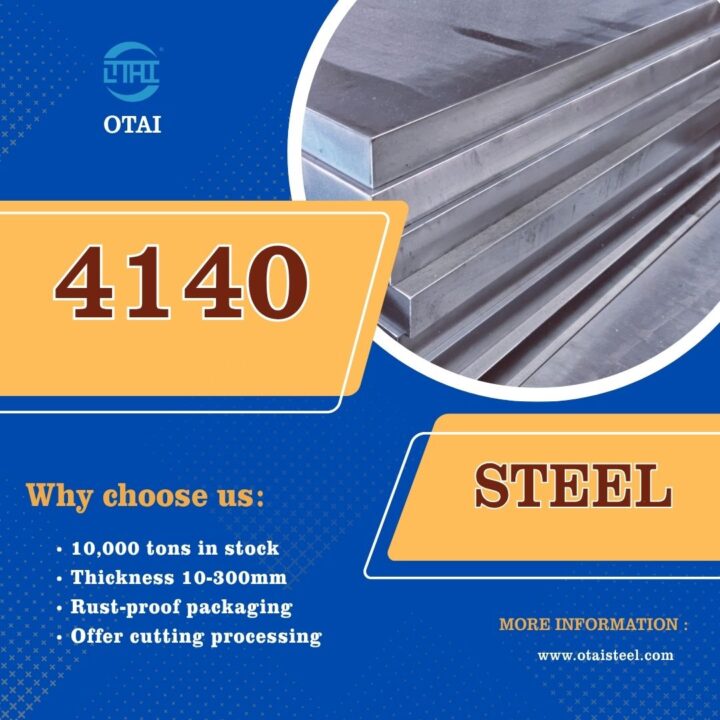
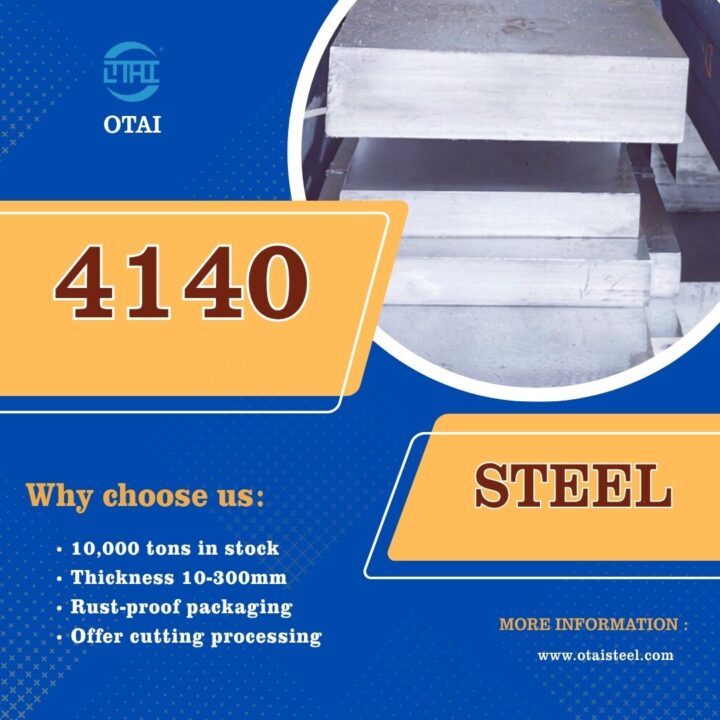
- 4140 plate inventory: reference thickness range of 4–380 mm for 4140 plate and 13–200 mm for 4140 quenched-and-tempered plate. Confirm current stock, exact dimensions, quantity, and delivery condition before ordering.
- International supply experience: Otai has exported to more than 54 countries since 1999.
- Cutting capacity: 20 saw-cutting machines support preparation of material to agreed dimensions.
- Additional processing: cutting, precision cutting, CNC machining, and grinding can be discussed according to project requirements.
- Quality documentation: material certificates and traceability can be coordinated according to the agreed order requirements.
- Additional inspection options: ultrasonic testing and third-party inspection can be arranged when required and confirmed in advance.
- Export packaging: corrosion protection, strapping, and wooden packaging can be arranged according to shipment needs.
- One-stop service: buyers can discuss material selection, dimensions, processing, inspection, and packaging with the supplier to simplify purchasing coordination.
When requesting a quotation, provide the grade, plate thickness, length and width, quantity, required condition, hardness or mechanical-property targets, and inspection documents. These details help Otai evaluate the request and prepare a quotation based on the project’s actual requirements.
❓ Frequently Asked Questions
1. What is 4140 steel in simple terms?
4140 is a medium-carbon chromium-molybdenum alloy steel used for mechanical components that require strength, toughness, and heat-treatment flexibility. Its final properties depend on the material condition, section size, and processing route.
2. What do chromium and molybdenum do in 4140 steel?
Chromium and molybdenum improve hardenability and influence the response to heat treatment. They help the steel develop useful mechanical properties through an appropriate section, but the actual result still depends on carbon content, quenching, tempering, and component size.
3. Is 4140 steel stainless steel?
No. Although 4140 contains chromium, its chromium content is not high enough to provide the corrosion resistance associated with stainless steel. Depending on the environment, 4140 may require protective coatings or another corrosion-control method.
4. Is 4140 steel suitable for high-strength components?
It can be suitable for many high-strength mechanical components when the grade, heat treatment, dimensions, and mechanical properties match the design requirements. Buyers should verify the specified strength, toughness, hardness, and inspection results rather than relying on the grade designation alone.
5. What should buyers request when purchasing 4140 steel plate?
Specify the applicable grade and standard, dimensions, quantity, delivery condition, required hardness or mechanical properties, and material certification. Confirm current stock, cutting tolerances, traceability, any required nondestructive testing, packaging, and delivery terms before approving the order.