 4140 Steel Composition: A Complete Guide for Engineers and Buyers
When engineers search for 4140 steel composition, they want to understand the precise chemical makeup that gives this alloy steel its outstanding strength, toughness, and versatility. As one of the most popular chromium-molybdenum steels, 4140 is widely used in automotive, oil & gas, aerospace, and heavy machinery.
In this guide, we’ll break down everything you need to know about the chemical composition of AISI 4140, compare it with international equivalents, and explain why its balanced chemistry makes it a go-to choice for high-stress components.
🧪 What is the 4140 Steel Composition?
The core strength of 4140 lies in its chemical balance. It’s a chromium-molybdenum low alloy steel with carbon content carefully controlled to optimize toughness and hardenability.
| Element | Percentage (%) | Role in Properties |
|---|---|---|
| Carbon (C) | 0.38 – 0.43 | Increases hardness & strength |
| Manganese (Mn) | 0.75 – 1.00 | Improves toughness & wear resistance |
| Chromium (Cr) | 0.80 – 1.10 | Enhances hardenability & corrosion resistance |
| Molybdenum (Mo) | 0.15 – 0.25 | Provides high-temperature strength & creep resistance |
| Silicon (Si) | 0.20 – 0.35 | Improves strength & shock resistance |
| Phosphorus (P) | ≤ 0.035 | Kept low to prevent brittleness |
| Sulfur (S) | ≤ 0.040 | Controlled for machinability |
This balance explains why 4140 steel chemical composition is suitable for parts that demand both high fatigue strength and shock resistance.
🔩 Mechanical Properties Linked to 4140 Steel Composition
The chemistry of 4140 directly affects its performance after different heat treatments.
| Property | Annealed Condition | Quenched & Tempered |
|---|---|---|
| Tensile Strength | 655 MPa | 850 – 1080 MPa |
| Yield Strength | 415 MPa | 600 – 930 MPa |
| Hardness | 197 HB | 28 – 32 HRC |
| Elongation | 20 – 25% | 12 – 16% |
| Impact Toughness | High | Moderate to high |
Thanks to its carbon and chromium content, 4140 achieves excellent hardness without losing ductility, making it ideal for heavy-duty shafts, gears, and high-strength fasteners.
🌍 International Standards and Equivalents
Since steel is traded globally, knowing the equivalents of 4140 steel composition in different standards is crucial.
| Standard | Equivalent Grade | Notes |
|---|---|---|
| AISI / SAE (USA) | 4140 | Base grade |
| DIN (Germany) | 42CrMo4 | Widely used in Europe |
| EN (Europe) | EN 1.7225 | European norm |
| JIS (Japan) | SCM440 | Automotive industry standard |
| GB (China) | 42CrMo | Chinese equivalent |
| BS (UK) | 708M40 | British designation |
This makes sourcing easier, as 42CrMo4 composition and SCM440 composition are nearly identical to AISI 4140.
⚙️ How the Composition Influences Applications
The 4140 alloy steel composition allows it to perform in highly stressed conditions where other steels might fail. Some examples include:
-
🚗 Automotive Industry – crankshafts, connecting rods, and gears require high fatigue resistance.
-
⛽ Oil & Gas Equipment – drill collars, tool joints, and downhole components need high toughness and wear resistance.
-
🛫 Aerospace Components – landing gear and structural parts rely on strength-to-weight ratio.
-
🏗️ Construction & Machinery – shafts, spindles, and high-strength bolts benefit from the alloy’s hardenability.
-
🔧 Tooling Applications – dies, fixtures, and molds where surface hardness is critical.
The chromium and molybdenum in the 4140 steel chemical composition ensure excellent wear resistance and high-temperature stability.
🔍 Heat Treatment Behavior of 4140 Steel
One major advantage of 4140 is its responsiveness to heat treatment, thanks to its balanced chemical composition:
-
Annealing – Improves machinability, hardness reduced to ~197 HB.
-
Normalizing – Refines grain structure, enhances toughness.
-
Quenching & Tempering – Achieves 28–32 HRC hardness with strong fatigue resistance.
-
Nitriding – Surface hardness up to 600–650 HV while maintaining core toughness.
Because of this, many industries select AISI 4140 composition for parts that need both core toughness and a wear-resistant surface.
🏆 Company Advantages – Why Choose Otai Special Steel
-
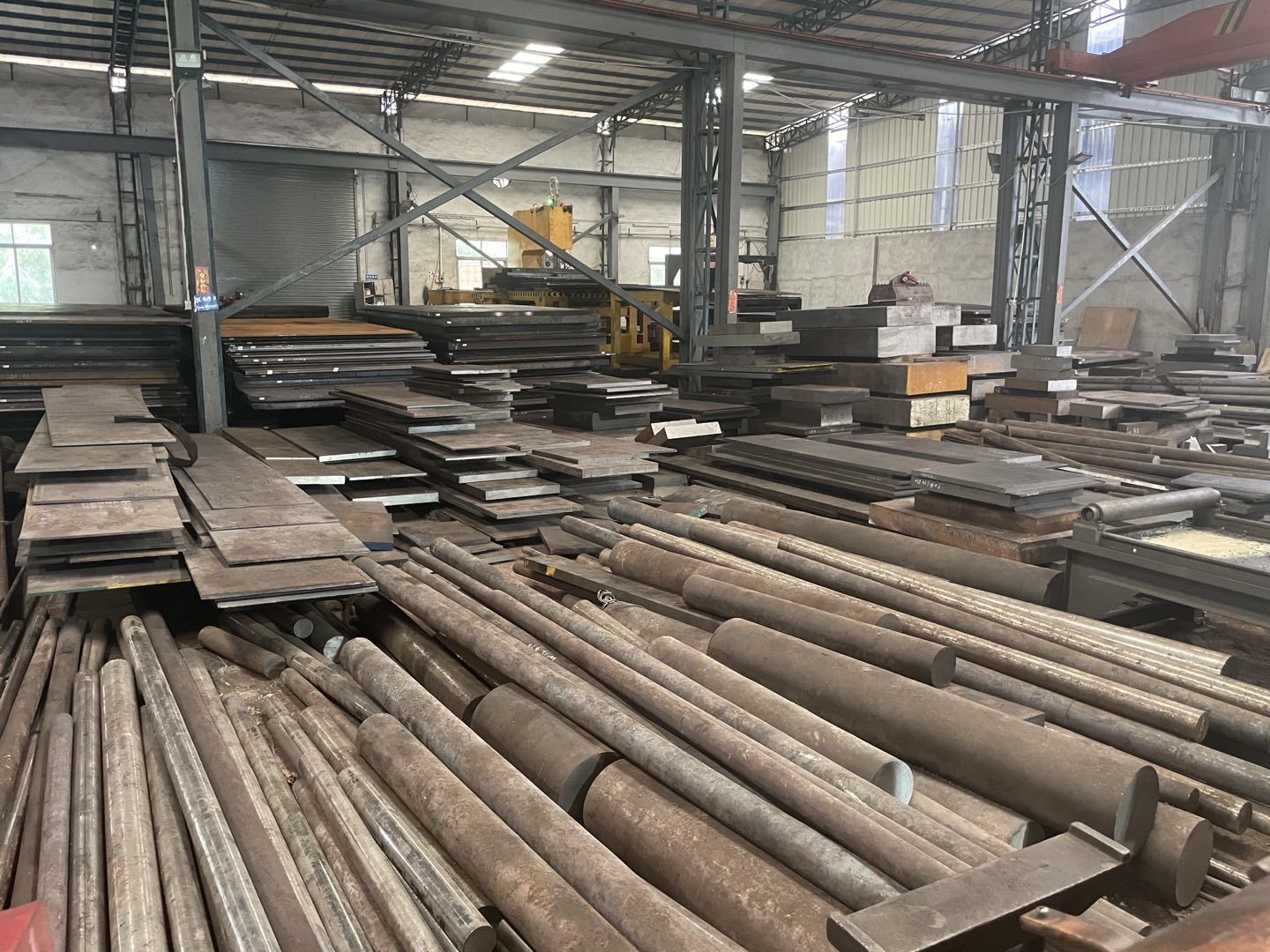
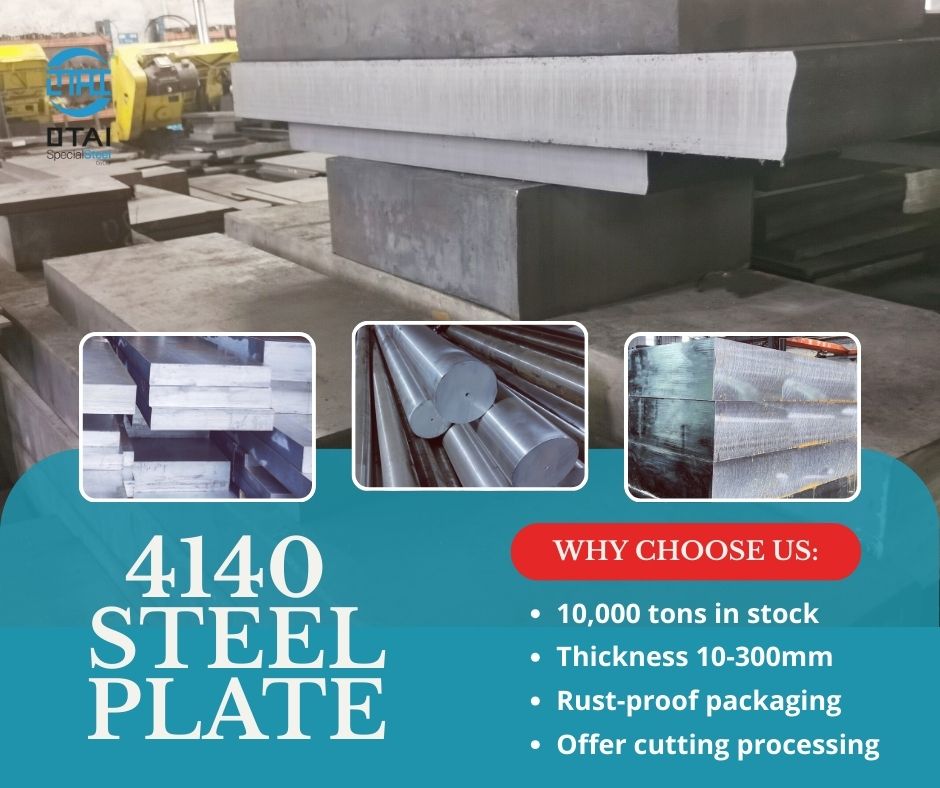
Large Stock Availability: Over 10,000 tons of alloy steel plates and bars in stock, including all 4140 steel equivalents.
-
Value-Added Services: Precision cutting, heat treatment, and custom machining to save time and cost.
-
Strict Quality Assurance: UT testing, chemical analysis, and third-party inspections (SGS, TUV).
-
Trusted by Global Leaders: Long-term supplier for companies like Thyssenkrupp and Schlumberger.
-
Competitive Pricing: Stable supply with cost-effective solutions for buyers worldwide.
❓ FAQ
Q1: What elements make 4140 steel special compared to carbon steel?
The addition of chromium and molybdenum gives 4140 higher hardenability, toughness, and wear resistance.
Q2: Is 42CrMo4 composition identical to 4140 steel?
Yes, 42CrMo4 chemical composition is nearly identical, making it a true equivalent.
Q3: Does 4140 steel weld well?
Yes, but preheating and post-weld heat treatment are recommended to avoid cracking due to its carbon content.
Q4: Can 4140 be surface hardened?
Yes, nitriding or induction hardening can improve surface hardness while maintaining core strength.
Q5: What industries use 4140 steel the most?
Automotive, oil & gas, aerospace, and heavy machinery are the largest consumers.