Uses for 4140 Steel: Is 4140 Steel Right for Your Application?
📑 Table of Contents
- 🔎 What Is 4140 Steel Used For?
- ⚙️ Why Manufacturers Choose 4140 Steel
- 🏗️ 4140 Steel Uses in Shafts, Gears, and Power Transmission
- 🚜 Uses in Heavy Equipment, Oil and Gas, and Industrial Machinery
- 🔩 Uses for 4140 Steel in Bolts, Studs, and High-Strength Components
- 🔥 How Heat Treatment Affects 4140 Steel Applications
- 📊 4140 Steel Properties and Application Requirements
- 🔄 When to Choose 4140 Steel or an Alternative Grade
- 🛒 How to Buy 4140 Steel for Industrial Applications
- 🏭 Company Advantages: Otai Special Steel
- ❓ Frequently Asked Questions
4140 steel is a chromium-molybdenum alloy steel widely used for mechanical components that need a combination of strength, toughness, and hardenability. Manufacturers select it for shafts, gears, machine parts, high-strength fasteners, and other components that must withstand demanding mechanical loads.
However, 4140 steel is not automatically the best choice for every industrial application. Its performance depends on the component design, section size, heat-treatment condition, required hardness, and operating environment. A grade that works well for a high-load shaft may be unnecessary for a lightly loaded bracket or unsuitable for a component that requires corrosion resistance.
For buyers, the important question is not simply where manufacturers use 4140 steel. It is whether the grade, product form, and delivery condition match the actual application. Understanding these factors helps reduce material costs, avoid unnecessary processing, and improve purchasing decisions.
🔎 What Is 4140 Steel Used For?
AISI/SAE 4140 is a medium-carbon chromium-molybdenum alloy steel. Its alloying elements help it develop useful strength and hardenability through appropriate heat treatment. Consequently, manufacturers use it in components that experience torsion, bending, impact, contact stress, or repeated loading.
Common industrial applications
4140 steel appears in many industries because manufacturers can adjust its properties through heat treatment and select different product sizes for different manufacturing processes.
- Shafts and axles: components that transmit torque or support rotating loads.
- Gears and transmission parts: components that experience contact stress and repeated mechanical loading, subject to the required surface properties.
- Industrial machinery: machine components, connecting parts, and heavy-duty mechanical elements.
- Oil and gas equipment: selected pressure-containing or load-bearing components, when the applicable service and material specifications permit 4140.
- High-strength fasteners: bolts, studs, and similar parts designed for demanding mechanical service.
- Tooling and fixtures: selected holders, fixtures, and machine components that benefit from strength and wear resistance.
- Automotive and agricultural equipment: axles, pins, shafts, and other engineered components.
Why the application matters more than the name
These applications do not all require the same material condition. A shaft may need a specific core strength and fatigue performance, while a pin may need wear resistance at its surface. A fixture may prioritize dimensional stability and machinability instead.
Although 4140 can serve all these general purposes, the final design determines which properties matter most. Engineers must establish the required strength, hardness, toughness, dimensions, and service conditions before specifying the material.
Does every 4140 component need heat treatment?
No. Some parts can use 4140 in an annealed or other suitable supply condition, especially when machining requirements take priority. Other applications require quenching and tempering or an additional surface-hardening process.
The correct decision depends on the component’s loads and manufacturing route. Buyers should therefore specify the required delivery condition rather than assuming that every product sold as 4140 has the same mechanical properties.
⚙️ Why Manufacturers Choose 4140 Steel
Manufacturers choose 4140 because it offers a useful balance of mechanical properties, processing flexibility, and availability. It is not the strongest steel in every category, nor is it the most corrosion-resistant or easiest material to machine. Instead, its value comes from combining several useful characteristics in one alloy.
Strength and toughness
When properly processed, 4140 can achieve high tensile strength while retaining useful toughness. This balance makes it attractive for components that carry substantial loads and may experience shocks or changing stresses.
However, increasing hardness or strength does not always improve component performance. Excessive hardness can reduce toughness, while an unsuitable heat-treatment cycle may create distortion or residual stress. Engineers must select a condition that matches the actual loading and failure risks.
Hardenability for different section sizes
Chromium and molybdenum contribute to the hardenability of 4140. Compared with many plain-carbon steels, the alloy can develop useful hardness through a greater section depth under appropriate processing conditions.
Even so, a thick component may not develop the same hardness throughout its cross-section as a smaller part. Cooling conditions, quench severity, geometry, and the specified heat-treatment cycle all influence the final result. For critical components, verify the required properties at the relevant section size rather than relying on a generic material description.
Machining and manufacturing flexibility
Manufacturers can machine 4140 in suitable supply conditions and then apply heat treatment when the design requires higher strength. Depending on the product and process, this sequence can provide a practical balance between machining efficiency and finished-part performance.
Machining 4140 in a harder condition may require more robust tooling and different cutting parameters. If the component needs tight tolerances after heat treatment, the manufacturing plan should also account for distortion, grinding, and finishing operations.
Broad industrial availability
4140 is a widely recognized alloy-steel grade, so industrial buyers can often source it from multiple steel suppliers. Availability still varies by country, product form, dimensions, condition, and quantity.
For procurement teams, this broad recognition can simplify material identification and supplier comparisons. Nevertheless, the purchase specification must state the required standard, dimensions, condition, and inspection documents. A familiar grade name alone does not guarantee that two offers provide equivalent products.
🏗️ 4140 Steel Uses in Shafts, Gears, and Power Transmission
Shafts, axles, and transmission components are among the best-known applications for 4140 steel. These parts often carry torque, bending loads, or repeated stresses. Their performance depends on the material, component geometry, surface finish, and manufacturing quality.
Shafts and axles
A shaft transmits rotational power, while an axle may support rotating components or carry bending loads. Both can experience stress concentrations around keyways, shoulders, grooves, splines, and changes in diameter.
4140 can be suitable when the design requires a combination of strength and toughness. The correct supply condition depends on the shaft’s dimensions and loading. A high-load shaft may need quenched-and-tempered material, while a component intended for extensive machining may require a different starting condition.
For procurement, specify the finished or stock dimensions, the required mechanical properties, and any testing requirements. If the shaft has a large cross-section, ask how the supplier’s material condition and test results relate to the actual section size.
Gears and transmission parts
Gears experience repeated contact stresses and may also encounter bending stresses at the tooth root. 4140 can be used for certain gears and transmission components, particularly when the required balance of core strength and surface performance can be achieved through the selected processing route.
Not every gear application suits the same grade. Some designs require a hardened surface and a tough core, making case-hardening steels a more appropriate option. Other gears can use a through-hardening alloy steel, depending on the load, geometry, and wear requirements.
Before selecting 4140, determine whether the design requires induction hardening, carburizing, nitriding, or another surface treatment. These processes are not interchangeable, and their suitability depends on the material chemistry and component design.
Pins, couplings, and mechanical connectors
Mechanical pins, couplings, and connectors may experience shear, bending, impact, or repeated loading. 4140 can provide useful strength for these components, but the required properties differ according to their function.
A coupling that transmits torque may need different mechanical properties from a locating pin that experiences limited loading. In both cases, the designer should consider the load path, stress concentration, surface condition, and wear requirements.
For buyers, the practical lesson is to purchase against the component’s engineering requirements rather than selecting 4140 solely because it is commonly used for shafts and transmission parts.
🚜 Uses in Heavy Equipment, Oil and Gas, and Industrial Machinery
Heavy machinery and industrial equipment often require components that tolerate substantial mechanical loads, vibration, and repeated operation. 4140 is a candidate for many of these parts, provided that the design requirements and relevant industry specifications permit its use.
Construction and agricultural equipment
Construction and agricultural machines use pins, axles, shafts, joints, and other load-bearing components. Some of these parts experience impact loading, bending, torsion, and abrasive contact during service.
4140 may suit selected components that require strength and toughness. However, operating conditions vary considerably. A component exposed to mud, moisture, corrosive chemicals, or severe abrasion may need protective measures or a different material solution.
When purchasing material for heavy equipment, confirm the mechanical-property requirements, heat-treatment condition, dimensions, and expected service environment. For components that must resist fatigue, also consider surface finish and geometric stress concentrations.
Oil and gas equipment
4140 is used in certain oil and gas components, including selected mechanical parts and equipment elements that require high strength. Its suitability depends on the equipment design, operating pressure, temperature, corrosive environment, and governing specification.
Oil and gas service can involve additional requirements that ordinary alloy-steel designations do not cover. Sour-service environments, for example, may require specific material qualification, hardness controls, testing, and compliance with applicable industry standards.
Therefore, do not approve 4140 for a pressure-containing or safety-critical component solely because it has sufficient nominal strength. Confirm the complete equipment specification and service requirements first.
Industrial presses and machine components
Selected machine components, including shafts, holders, pins, and load-bearing elements, can benefit from 4140’s strength and heat-treatment flexibility. The material can be suitable where components need to withstand repeated mechanical loads without using a more specialized alloy.
However, a machine component that requires exceptional wear resistance, corrosion resistance, or high-temperature performance may need another grade or a surface-engineering solution. Material selection should reflect the dominant failure mode, not just the maximum load.
How buyers should assess demanding applications
For heavy-duty applications, compare the design requirements with the properties guaranteed for the actual material condition. Ask whether the component needs through-hardening, localized surface hardening, impact testing, ultrasonic testing, or other inspections.
These requirements affect both material selection and purchasing cost. Defining them before requesting a quotation helps suppliers provide a more accurate offer and reduces the risk of ordering material that needs unplanned processing later.
🔩 Uses for 4140 Steel in Bolts, Studs, and High-Strength Components
4140 can be used to manufacture selected high-strength fasteners, studs, pins, and other mechanical components. These products may require greater strength than ordinary low-carbon steel parts can provide. Nevertheless, the correct material depends on the fastener specification, load, service environment, and manufacturing process.
High-strength bolts and studs
Some bolts and studs require high tensile strength to maintain clamping force under demanding loads. Heat-treated 4140 may be a candidate for certain applications, provided it satisfies the relevant fastener specification and design requirements.
Fasteners require careful control of more than bulk material strength. Thread geometry, surface condition, heat treatment, hydrogen-related risks where relevant, and inspection requirements can all influence performance.
Buyers should not assume that 4140 automatically meets a particular bolt property class. Confirm the specified fastener standard, the required mechanical properties, and any applicable manufacturing or testing requirements.
Industrial pins and connecting components
Pins and connecting components may experience shear, bending, impact, and wear. A suitable 4140 condition can provide the necessary strength for some designs, while the final dimensions and surface finish influence performance in service.
Where the pin contacts another component, the designer should evaluate bearing stress and wear. Depending on the application, surface hardening or another material may be more appropriate than increasing the hardness of the entire component.
Fixtures, holders, and machine tooling
4140 also appears in selected fixtures, holders, and machine components. These parts may need enough strength to resist deformation while maintaining dimensional accuracy during use.
For a fixture that experiences repeated clamping loads, material strength and dimensional stability can be important. For a holder exposed to abrasion, surface hardness may carry greater weight. The required properties should determine the supply condition and finishing plan.
When a different grade may be more economical
Using 4140 for every high-strength component can increase costs without delivering a meaningful benefit. A lower-cost steel may satisfy the design if loads are modest, while a specialized grade may be necessary if corrosion, wear, or fatigue dominates performance.
Compare material price alongside machining time, heat-treatment cost, finishing requirements, and service life. This total-cost approach helps purchasing teams avoid paying for properties the component does not need or selecting a cheaper grade that creates additional processing costs.
🔥 How Heat Treatment Affects 4140 Steel Applications
Heat treatment is a major factor in determining which applications suit 4140 steel. The same grade can show substantially different hardness, strength, and toughness depending on its processing history. Buyers should therefore specify the required condition instead of relying on the designation alone.
Annealed condition
Annealed 4140 is generally softer and more suitable for many machining operations than a fully hardened condition. Manufacturers may choose this condition when they need to remove significant material before applying a final heat treatment.
Annealed material does not automatically provide the strength required for a finished high-load component. If the design depends on elevated strength or hardness, the manufacturing plan must account for the required subsequent processing and verification.
Quenched and tempered condition
Quenching and tempering can give 4140 a useful combination of strength and toughness. The quenching stage develops a hardened microstructure, while tempering adjusts the balance of hardness, strength, and toughness.
The resulting properties depend on the processing temperatures, section size, cooling conditions, and material specification. Consequently, a generic hardness value should not be treated as a guaranteed property for every 4140 product.
For industrial buyers, 4140 QT steel may be attractive when the supplied material needs to meet specified mechanical properties without relying entirely on a later heat-treatment operation. Confirm the actual condition, test results, and whether further processing is permitted.
Induction hardening and other surface treatments
Some shafts, pins, and wear-related components need a hard surface while retaining a tougher core. Induction hardening can be suitable for selected 4140 applications, depending on the component geometry and required hardened depth.
Surface treatments must be selected according to the material chemistry and design. Do not assume that carburizing, nitriding, and induction hardening will produce equivalent results. Each process has different requirements and effects.
Heat-treatment considerations for purchasing
Before ordering, clarify the following points:
- Required supply condition: annealed, quenched and tempered, or another specified condition.
- Target hardness and mechanical-property requirements.
- Component dimensions and section size.
- Whether further heat treatment will take place after delivery.
- Inspection and certification requirements.
- Dimensional tolerances and machining allowance after processing.
These details help the supplier quote the correct material and avoid confusion between standard 4140 and 4140 supplied in a specific heat-treated condition.
📊 4140 Steel Properties and Application Requirements
4140 steel is best evaluated by matching its properties to the component’s working conditions. A material data sheet can provide a useful starting point, but the values that matter for purchasing are those guaranteed by the applicable standard and supply condition.
Typical chemistry of AISI 4140
The following table gives commonly referenced AISI/SAE 4140 composition ranges. Always check the governing standard and its edition for the applicable limits. The actual heat analysis should be verified against the material test certificate (MTC).
| Element | Common reference range (% by mass) | Relevance to applications |
|---|---|---|
| Carbon (C) | 0.38–0.43 | Contributes to strength and attainable hardness. |
| Chromium (Cr) | 0.80–1.10 | Supports hardenability and heat-treatment response. |
| Molybdenum (Mo) | 0.15–0.25 | Contributes to hardenability and strength retention after tempering. |
| Manganese (Mn) | 0.75–1.00 | Supports hardenability and strength. |
| Silicon (Si) | 0.15–0.35 | Acts as a deoxidizer and contributes to strength. |
Note: These are commonly referenced specification ranges, not a statement of the actual chemistry of every 4140 product. The governing standard, product specification, and actual MTC take precedence. Do not confuse standard limits with a mill’s typical analysis.
Mechanical properties depend on the delivery condition
There is no single tensile strength, yield strength, or hardness value that applies to every 4140 product. A quenched-and-tempered bar, an annealed plate, and a finished component may have different properties because of their condition, dimensions, and processing history.
When comparing material offers, request the guaranteed mechanical properties for the specific product and condition. If the application requires impact toughness or properties through a thick section, confirm that the applicable test method and acceptance criteria cover those needs.
Match the key property to the failure risk
| Application requirement | What to evaluate |
|---|---|
| High torque or bending loads | Yield strength, tensile strength, toughness, and section size. |
| Repeated cyclic loading | Fatigue design, surface finish, stress concentrations, and heat treatment. |
| Surface wear | Hardness, wear mechanism, surface treatment, and contact conditions. |
| Impact loading | Toughness, impact-test requirements, and operating temperature. |
| Corrosive service | Environment, coatings, corrosion allowance, or a more suitable corrosion-resistant material. |
By linking material properties to the actual failure risk, engineering and purchasing teams can avoid specifying unnecessarily expensive conditions or overlooking critical performance requirements.
🔄 When to Choose 4140 Steel or an Alternative Grade
4140 is a versatile alloy steel, but it does not suit every component. Buyers should compare alternative grades when the application places greater emphasis on corrosion resistance, surface hardness, case hardening, machinability, cost, or a specific industry standard.
4140 vs. 1045 carbon steel
AISI 1045 is a medium-carbon steel that can suit shafts, pins, and machine parts with more moderate performance requirements. It may offer a lower material cost, depending on product form and market conditions.
However, 1045 generally does not provide the same hardenability as 4140. For larger sections or components that require a particular strength profile after heat treatment, 4140 may be a better candidate. Compare the required section size and guaranteed properties rather than choosing solely on price.
4140 vs. 4340 alloy steel
AISI 4340 is a nickel-chromium-molybdenum alloy steel. Its alloy system can provide advantages for certain demanding applications that require high strength and toughness, depending on heat treatment and section size.
4340 may be appropriate when the design requires performance beyond what the selected 4140 condition can reliably deliver. It may also cost more or require a different supply route. The engineering specification should determine whether the additional alloying and performance are justified.
4140 vs. 42CrMo4 and SCM440
42CrMo4 and SCM440 are commonly compared with AISI 4140 because they belong to a similar chromium-molybdenum alloy-steel family. They may be practical alternatives when sourcing across different standards or regions.
Nevertheless, do not treat the grade names as interchangeable without checking the chemistry, mechanical-property requirements, product form, and delivery condition. If the contract explicitly requires AISI 4140, confirm whether the buyer will accept another standard.
When a case-hardening steel may be better
Some gears and components need a wear-resistant surface and a comparatively tough core. A case-hardening grade such as 16MnCr5 may be worth evaluating for an application designed around carburizing or another suitable case-hardening process.
That does not make 16MnCr5 a direct substitute for 4140. The two grades serve different material-selection strategies, and the design must support the chosen process and performance requirements.
When 4140 may not be the right choice
- Corrosion resistance is the main priority: consider a suitable corrosion-resistant material or protective system.
- Very high surface wear resistance is essential: evaluate the required hardness, surface treatment, and wear mechanism.
- The part has modest loads: a less expensive grade may meet the design requirements.
- The design specifies case hardening: evaluate a suitable case-hardening steel rather than assuming 4140 is interchangeable.
- A regulated specification controls the material: use the grade and condition approved by the governing design or industry standard.
The right choice balances performance, manufacturability, availability, and total cost. If a proposed alternative changes the component’s performance or compliance, obtain engineering approval before purchasing.
🛒 How to Buy 4140 Steel for Industrial Applications
Choosing the correct grade is only one part of procurement. The supplier must also provide the appropriate product form, dimensions, delivery condition, and quality documentation. A clear purchase specification helps prevent misunderstandings and makes quotations easier to compare.
Specify the product form and dimensions
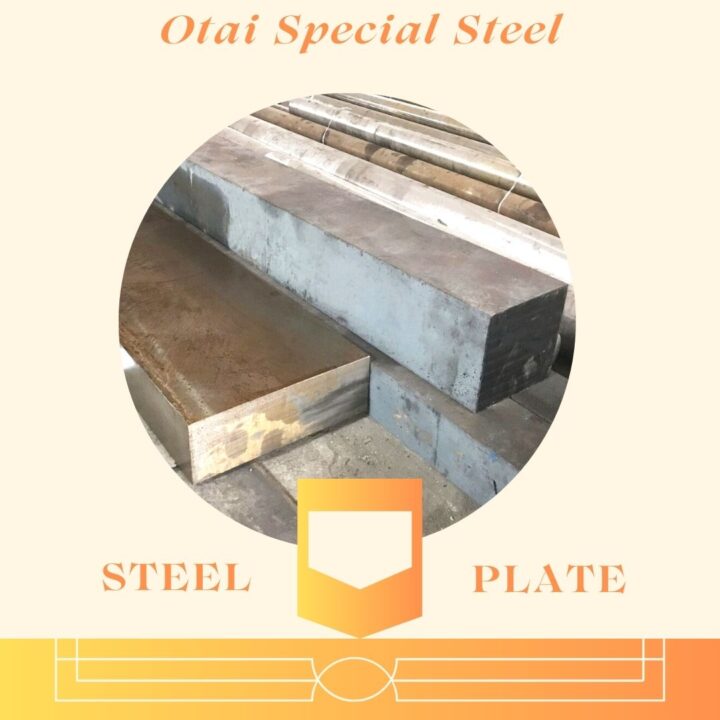
4140 steel is available in different product forms, including plate and round bar. The appropriate form depends on the finished component and the manufacturing process. For example, a large machined machine component may start from plate or another suitable stock form, while a shaft is often manufactured from round bar.
State the thickness or diameter, width, length, tolerances, quantity, and machining allowance. If the finished component has tight dimensional requirements, confirm whether the quotation includes cutting, precision machining, or grinding.
Confirm the grade, standard, and heat-treatment condition
Write the full material designation and applicable standard on the purchase order. If the component requires annealed or quenched-and-tempered material, state the condition explicitly and list the mechanical properties that the supplier must guarantee.
If you can accept 42CrMo4, SCM440, or another alternative, define the approval procedure before production. This allows the supplier to propose an alternative without assuming that a similar grade name automatically meets the original specification.
Request the required quality documents
Depending on the application, the order may require an MTC, chemical analysis, mechanical-test results, heat-treatment records, ultrasonic testing, dimensional inspection, or third-party inspection. Not every order needs every test, so the requirements should match the technical specification and risk level.
Confirm traceability requirements as well. If the material must remain traceable by heat number or batch, the supplier’s marking and documentation process should support that requirement throughout cutting and delivery.
Compare the total delivered cost
Material price is only one part of the final cost. Cutting, machining, heat treatment, inspection, packaging, shipping, and scrap allowance can all affect the total purchase value.
When comparing quotations, make sure each supplier prices the same grade, condition, dimensions, quantity, and service scope. A lower price for an untreated product is not directly comparable with a quotation for material supplied in a specified heat-treated condition.
Questions to ask your 4140 steel supplier
- Which standard and delivery condition does the quoted material meet?
- Are the requested dimensions available for the required quantity?
- Can you provide an MTC with actual heat chemistry and the required test results?
- Are cutting, CNC machining, grinding, or additional processing available?
- Can you arrange the specified inspection or third-party verification?
- What packaging, marking, and export documentation can you provide?
- If the exact grade is unavailable, can you submit a technically documented alternative for approval?
These questions help purchasing teams assess suppliers on more than unit price. They also reduce the risk of receiving a material that matches the grade name but fails to meet the dimensions, condition, or inspection requirements of the project.
🏭 Company Advantages: Otai Special Steel
Otai Special Steel supplies alloy steels and tool steels to international industrial buyers. For projects requiring 4140 steel, buyers can discuss product dimensions, supply condition, cutting services, inspection requirements, and export packaging according to the application.
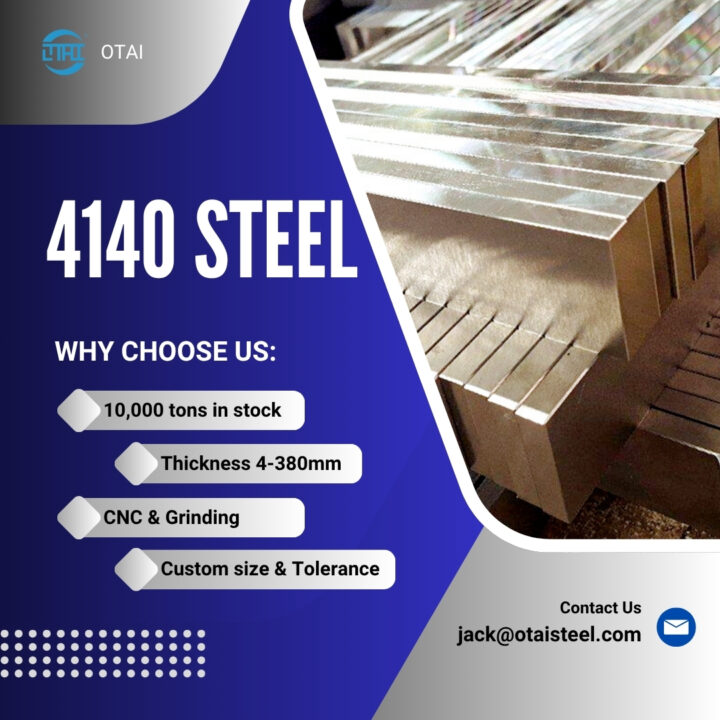
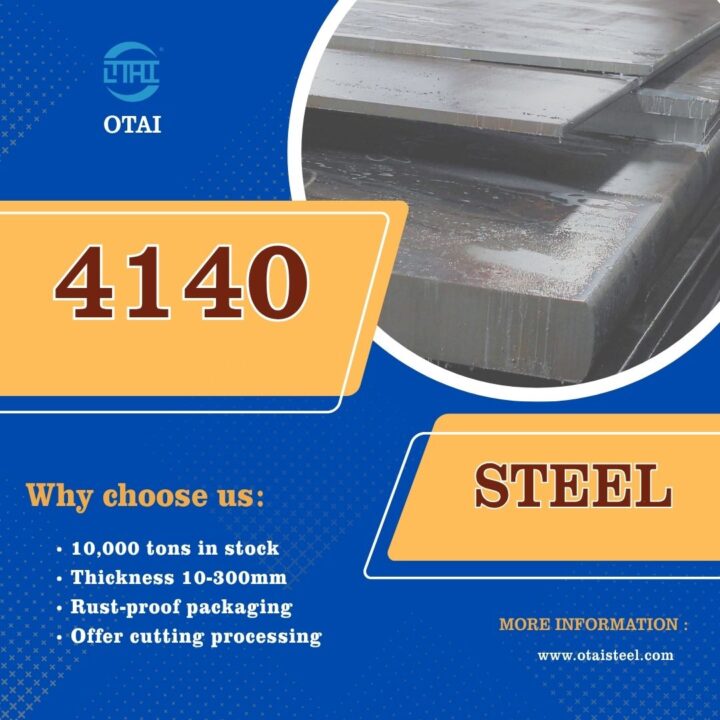
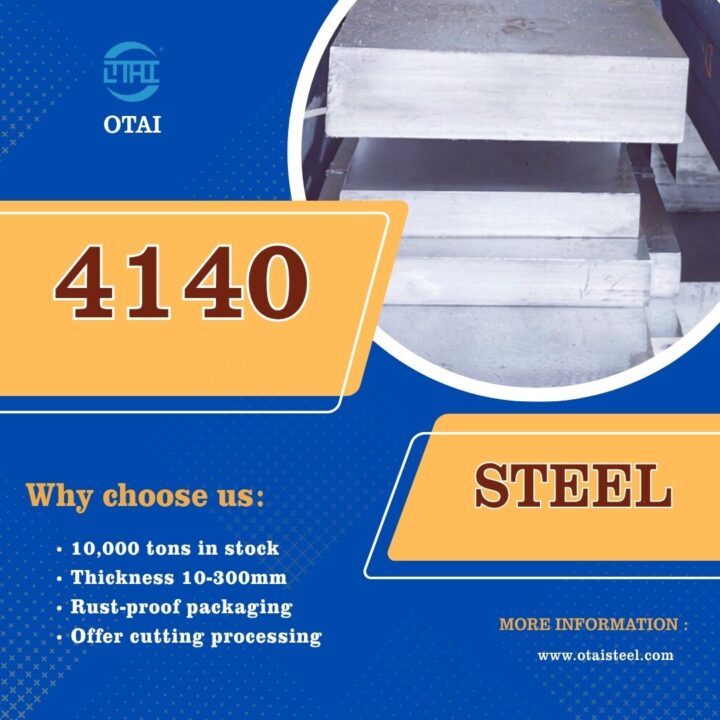
- 4140 steel plate supply: reference plate thickness range of 4–380 mm; 4140 QT plate reference thickness range of 13–200 mm. Confirm actual inventory, dimensions, condition, and quantity before placing an order.
- Stock resources: more than 10,000 tons of inventory across the company’s product range. This is total company inventory, not 4140 stock alone.
- Cutting capability: 20 saw-cutting machines to support material preparation to requested dimensions.
- Machining services: CNC machining and grinding options, subject to the project requirements.
- Customized dimensions and tolerances: support for discussing specific size and processing needs.
- Quality documentation: material certificates and agreed inspection requirements can be discussed before ordering.
- Inspection support: ultrasonic testing and third-party inspection can be arranged when specified and confirmed for the order.
- Export packaging: options include strapping, wooden cases, and anti-rust protection according to shipping requirements.
- International experience: exports to more than 54 countries since 1999.
- One-stop service: support for material supply and agreed cutting or machining requirements within one purchasing workflow.
To review the product range, visit the official AISI 4140 alloy steel plate product page.
When requesting a quotation, provide the grade, standard, dimensions, quantity, delivery condition, and quality-document requirements. If the application allows alternative grades, include the applicable acceptance criteria so the supplier can evaluate possible options before confirming the order.
❓ Frequently Asked Questions
1. What are the most common uses for 4140 steel?
Common uses include shafts, axles, selected gears, pins, couplings, industrial machinery components, high-strength fasteners, and certain oil and gas equipment parts. The appropriate application depends on the required mechanical properties, product condition, component design, and applicable industry specification.
2. Is 4140 steel good for high-stress applications?
Yes, 4140 can be suitable for many high-stress mechanical applications when the selected heat-treatment condition provides the required strength and toughness. However, the grade alone does not guarantee performance. Engineers must evaluate section size, fatigue loading, impact requirements, surface condition, and the relevant material specification.
3. Is 4140 steel suitable for gears?
4140 can suit certain gears and transmission components, especially when the required core properties and surface performance can be achieved through the selected processing route. Gears that require a specific case-hardening strategy may be better suited to a dedicated case-hardening steel. Confirm the design requirements before choosing the grade.
4. Should I buy annealed 4140 or 4140 QT steel?
Annealed 4140 may be useful when extensive machining is required before final heat treatment. Quenched-and-tempered 4140 may suit components that need specified strength and hardness in the supplied condition. The correct choice depends on the component design, machining route, final properties, and whether further heat treatment is planned.
5. What should I check before purchasing 4140 steel?
Confirm the grade and standard, product form, dimensions, quantity, supply condition, required mechanical properties, MTC, inspection requirements, and delivery details. If you are considering an alternative such as 42CrMo4 or SCM440, verify the applicable chemistry and mechanical requirements and obtain approval when the design or contract requires it.