4140 Steel Tensile Strength: How Does Heat Treatment Affect It?
📑 Table of Contents
- 🔍 Why Heat Treatment Matters to 4140 Steel Tensile Strength
- 🧪 4140 Steel Composition and Its Influence on Strength
- ⚙️ Tensile Strength vs. Yield Strength: What Is the Difference?
- 🔥 Tensile Strength of Annealed 4140 Steel
- 💪 Tensile Strength of Quenched and Tempered 4140 Steel
- 📊 How Quenching and Tempering Change Mechanical Properties
- 📏 How Section Size and Cooling Conditions Affect Final Strength
- 🏭 Choosing the Right 4140 Condition for Industrial Applications
- 🔎 How Buyers Can Verify Tensile Strength Before Purchasing
- 🏢 OTAI Company Advantages
- ❓ Frequently Asked Questions
4140 steel is a chromium-molybdenum alloy steel widely used for components that require a combination of strength, toughness, and wear resistance. However, its tensile strength does not remain constant across every product or supply condition. Heat treatment can change its microstructure and significantly influence the mechanical properties that manufacturers rely on.
For procurement teams, engineers, and manufacturers, understanding this relationship helps prevent material selection errors. A 4140 bar supplied in an annealed condition may offer better machinability, while a quenched and tempered product may provide the higher strength required for demanding mechanical components. Therefore, buyers should evaluate the requested tensile strength together with hardness, yield strength, elongation, product dimensions, and testing requirements.
This article explains how annealing, normalizing, quenching, and tempering affect 4140 steel tensile strength. It also discusses the practical information buyers should confirm before placing an order.
🔍 Why Heat Treatment Matters to 4140 Steel Tensile Strength
4140 steel does not have one universal tensile strength
A common mistake in material selection is to treat tensile strength as a fixed property of the steel grade. In reality, the AISI 4140 designation identifies a chemical composition range and material classification. It does not guarantee one mechanical strength value for every condition.
For example, annealed 4140 generally has lower tensile strength than a properly quenched and tempered product. The difference comes from the microstructure produced by each thermal process. Annealing creates a softer structure that supports machining and forming. Quenching produces a much harder structure, while subsequent tempering adjusts its strength and toughness.
Why buyers should specify the delivery condition
When requesting a quotation, buyers should not simply write “4140 steel” and expect every supplier to offer the same mechanical properties. Instead, they should identify the required condition, such as annealed, normalized, or quenched and tempered (Q&T).
They should also provide the required tensile strength range, product form, dimensions, and applicable standard. These details help suppliers select suitable material and determine whether additional heat treatment is necessary.
The key purchasing principle is simple: select 4140 steel according to its required final mechanical performance, not the grade name alone.
🧪 4140 Steel Composition and Its Influence on Strength
The role of chromium and molybdenum
4140 is a medium-carbon chromium-molybdenum alloy steel. Its alloying elements help it respond effectively to heat treatment and develop useful strength and hardenability. Carbon contributes significantly to hardness and strength, while chromium and molybdenum support hardening through the material section.
The following table gives a commonly specified composition range for AISI 4140. Buyers should always confirm the governing material standard and edition because permitted limits can vary with the specification.
| Element | Common Composition Range (%) | Contribution to Steel Performance |
|---|---|---|
| Carbon (C) | 0.38–0.43 | Supports hardness and strength after heat treatment |
| Manganese (Mn) | 0.75–1.00 | Improves hardenability and strength |
| Silicon (Si) | 0.15–0.35 | Contributes to strength and deoxidation |
| Chromium (Cr) | 0.80–1.10 | Improves hardenability and wear resistance |
| Molybdenum (Mo) | 0.15–0.25 | Supports hardenability and tempering response |
These figures are reference ranges, not a substitute for the actual heat analysis. The mill’s chemical analysis on the material test certificate (MTC) provides the results for the supplied heat.
Composition and heat treatment work together
Alloy composition influences how 4140 responds to heating and cooling, but chemistry alone cannot determine the final tensile strength. Two batches with compliant chemical compositions may show different mechanical results if their section sizes, heat-treatment cycles, or cooling conditions differ.
For this reason, buyers should evaluate chemical composition and mechanical test results together. A compliant chemistry report confirms the grade’s chemical requirements; it does not independently prove that the material meets a specified tensile strength.
⚙️ Tensile Strength vs. Yield Strength: What Is the Difference?
Understanding ultimate tensile strength
Ultimate tensile strength (UTS) is the maximum engineering stress a tensile test specimen withstands before the load begins to decrease toward fracture. Manufacturers use this value to evaluate a material’s resistance to tensile loading.
For 4140 steel, UTS can change considerably with heat treatment. A softer annealed product may have a tensile strength around 655 MPa in a commonly cited reference condition, while a Q&T product may reach approximately 1,000 MPa or higher, depending on the specified strength level and section size.
Understanding yield strength
Yield strength indicates the stress at which a material begins to deform permanently. Many steel specifications use the 0.2% offset method to determine proof or yield strength. This value matters when a component must resist permanent deformation under normal service loads.
UTS and yield strength describe different stages of material behavior. A design that considers only tensile strength may overlook the point at which a shaft, bolt, or other component starts to deform permanently.
Other mechanical properties matter too
Elongation and reduction of area provide information about ductility. Impact toughness helps engineers evaluate how a material responds to sudden loading, especially where low temperatures or shock loads are involved. Hardness provides another useful indication of resistance to indentation and wear, but it does not replace a tensile test.
For procurement, a complete mechanical-property requirement should identify the applicable test method and the required values for tensile strength, yield strength, elongation, and any impact or hardness criteria. This approach gives the supplier a clearer target and helps the buyer verify the delivered material.
🔥 Tensile Strength of Annealed 4140 Steel
Why annealed 4140 has lower strength
Annealing generally involves heating 4140 steel to a suitable temperature, holding it long enough for the section to reach the required condition, and then cooling it slowly under controlled conditions. This process softens the steel and reduces hardness and residual stress.
A commonly cited reference value for annealed 4140 is approximately 655 MPa tensile strength, with yield strength around 417 MPa. These figures describe a particular reference condition; they are not guaranteed minimums for every annealed bar or plate. Actual values depend on the governing specification, product size, processing route, and test specimen.
Advantages for machining and fabrication
Annealed 4140 is often a practical choice when a manufacturer needs to remove substantial material before final heat treatment. Its lower hardness can make turning, milling, drilling, and other machining operations easier than working with a high-strength Q&T product.
For example, a manufacturer producing shafts, gears, or custom mechanical parts may prefer to machine annealed stock first and then arrange heat treatment after rough machining. However, the machining allowance and the potential for dimensional changes during subsequent heat treatment need consideration.
When annealed material is suitable
Annealed 4140 can suit components that do not require the higher strength of a Q&T condition or parts that will undergo further processing. Buyers should still confirm whether the final component design requires a specific tensile strength or hardness after machining and heat treatment.
Do not assume that annealed 4140 will meet a Q&T strength requirement simply because both products carry the same grade designation. The supply condition must match the intended manufacturing route.
💪 Tensile Strength of Quenched and Tempered 4140 Steel
How quenching increases strength
Quenching begins by heating 4140 to an appropriate hardening temperature and then cooling it rapidly in a selected medium, commonly oil for suitable component sizes and processes. This rapid cooling forms a hard martensitic structure when the material and process conditions are appropriate.
Quenching can substantially increase hardness and tensile strength. However, as-quenched steel can also be brittle and contain significant residual stresses. Therefore, manufacturers generally temper the material after quenching rather than use it directly in this condition for most engineering applications.
How tempering establishes the required strength level
Tempering involves reheating quenched steel to a controlled temperature below the critical transformation range, holding it for a specified period, and cooling it afterward. This step reduces brittleness and adjusts the balance between strength, hardness, and toughness.
In general, increasing the tempering temperature within an appropriate range reduces tensile strength and hardness while improving ductility and toughness. The exact response depends on the steel’s chemistry, previous treatment, holding time, and section size.
Typical strength expectations
Pre-hardened 4140 supplied in a common Q&T condition around 28–32 HRC may have tensile strength near 1,000 MPa. Higher strength levels are possible with different heat-treatment schedules, but buyers should not assume that every Q&T product will achieve the same result.
The following figures illustrate how tempering temperature can affect tensile strength in one published reference dataset for oil-quenched, fine-grained 4140. They are not universal specification values or guaranteed properties for commercial stock.
| Tempering Temperature | Tensile Strength (MPa) | Yield Strength (MPa) |
|---|---|---|
| 205°C | 1,772 | 1,641 |
| 315°C | 1,551 | 1,434 |
| 425°C | 1,248 | 1,138 |
| 540°C | 951 | 834 |
| 650°C | 758 | 655 |
This example demonstrates the general trade-off: higher tempering temperatures can lower strength while improving ductility. However, these laboratory figures should not be used as purchase acceptance criteria. A buyer should rely on the values required by the applicable product specification and the actual test report for the supplied material.
📊 How Quenching and Tempering Change Mechanical Properties
Strength is only one part of the heat-treatment result
Heat treatment changes more than tensile strength. It also affects yield strength, hardness, elongation, impact toughness, and residual stress. Engineers should therefore select a treatment based on the full performance requirements of the component.
For example, a highly stressed shaft may require a higher yield strength to limit permanent deformation. However, if the component also experiences vibration, impact, or fluctuating loads, toughness and fatigue performance deserve attention. Selecting the highest possible tensile strength does not automatically produce the best service life.
Comparing the main supply conditions
| Condition | General Strength Level | Main Manufacturing Advantage | Typical Consideration |
|---|---|---|---|
| Annealed | Lower | Improved machinability | May require later hardening |
| Normalized | Generally higher than annealed | Refined and more uniform structure | Properties depend on section and cooling |
| Quenched | Very high hardness and strength | Develops a hard martensitic structure | Usually requires tempering to reduce brittleness |
| Quenched and tempered | Adjustable to the required level | Balances strength and toughness | Must meet specified mechanical properties |
Why the highest tensile strength is not always the best choice
Higher strength can help reduce component dimensions or support higher loads. Nevertheless, a very high-strength condition may reduce ductility and increase sensitivity to certain manufacturing defects, stress concentrations, or unsuitable service conditions.
Before specifying Q&T 4140, engineers should consider the component’s loading pattern, operating temperature, required fatigue life, machining sequence, and possible surface treatment. The supplier should then confirm whether the requested strength level is achievable for the ordered dimensions.
📏 How Section Size and Cooling Conditions Affect Final Strength
Why diameter and thickness matter
4140 is a hardenable alloy steel, but the cooling rate is not identical throughout a large section. During quenching, the surface generally cools faster than the center. As a result, a small-diameter bar may develop a more uniform hardened structure than a much larger bar under the same treatment conditions.
This difference matters when buyers order large-diameter round bars or thick plates. Even if the surface hardness meets a target, the core may not achieve the same strength or microstructure. The final mechanical properties can therefore vary with section size and test location.
Cooling medium and process control
Oil, water, polymer solutions, and other quenching media produce different cooling rates. The correct medium depends on the component’s dimensions, required hardening depth, equipment, and risk of distortion or cracking. A faster quench does not always provide a better result because excessive thermal stress can damage the material.
Heat-treatment providers must control heating temperature, soaking time, quenching conditions, tempering temperature, and holding time. Poor control can produce inconsistent hardness, distortion, cracking, or mechanical properties outside the required range.
What buyers should specify for large sections
When purchasing large 4140 products, buyers should provide exact dimensions and ask how the supplier verifies through-section properties. Where relevant, the order should identify the required test location, specimen orientation, and applicable mechanical-property requirements.
Do not compare tensile-strength values from different bar diameters without checking the associated test conditions. A value measured on a small specimen from a small bar may not represent the core performance of a much larger product.
🏭 Choosing the Right 4140 Condition for Industrial Applications
Shafts, axles, and transmission components
Shafts and axles often experience torsion, bending, and repeated loading. For these applications, engineers may select Q&T 4140 because it can provide a useful combination of tensile strength, yield strength, and toughness. The required strength level depends on the component design, diameter, loading conditions, and safety factors.
Gears, pinions, and mechanical parts
Gears and pinions need adequate core strength to support transmitted loads. Some designs also require improved surface wear resistance. Manufacturers may combine a suitable Q&T condition with additional surface hardening or another specified surface treatment, depending on the contact conditions and design requirements.
Bolts, studs, and high-strength fasteners
4140 can be used for certain high-strength fastener applications when the relevant product and fastener specifications permit it. Buyers should confirm the required strength class, heat-treatment condition, thread-processing sequence, hardness limits, and inspection criteria. A general 4140 tensile-strength figure is not enough to establish compliance with a fastener specification.
Match the material condition to the manufacturing route
For parts that require extensive machining, annealed material may be a sensible starting point. If the component needs defined mechanical properties in its final condition, Q&T stock may reduce the amount of post-machining heat treatment required. However, machining pre-hardened material may require suitable tooling and cutting parameters.
Buyers should discuss the complete production route with the supplier rather than select material based on one property alone. This can help reduce unnecessary processing, avoid dimensional problems, and improve consistency between batches.
🔎 How Buyers Can Verify Tensile Strength Before Purchasing
Define the technical requirements clearly
Before requesting a quotation, prepare a clear specification. It should identify the grade, product form, dimensions, delivery condition, governing standard, and required mechanical properties. If the application requires a particular tensile-strength range, state whether the value is a minimum, maximum, or permitted range.
Also identify the required test method and any additional requirements for hardness, impact energy, elongation, ultrasonic testing, or third-party inspection. These details help prevent misunderstandings between the buyer, supplier, and end user.
Check the material test certificate
The MTC is an important document for verifying the supplied steel. Depending on the agreed inspection document and applicable standard, buyers should check the following information:
- Steel grade and applicable material standard.
- Heat number and traceability information.
- Actual chemical composition results.
- Delivery condition and heat-treatment information, where applicable.
- Tensile strength and yield strength test results.
- Elongation and other specified mechanical test results.
- Hardness results, where required.
- Product dimensions and inspection details.
Compare the reported values with the purchase order and technical specification. A generic datasheet can help with preliminary material selection, but it cannot replace the actual certificate for the supplied batch.
Confirm testing and inspection arrangements
For critical components, buyers may require additional inspection, independent testing, or third-party verification. Before ordering, agree on the inspection scope, sampling frequency, test location, acceptance criteria, and document requirements.
It is also useful to confirm whether the tensile test specimen represents the ordered product size and condition. If the purchase involves large sections, the test location and orientation may have a significant effect on how well the result represents the finished material.
Ask the supplier practical questions
A reliable supplier should be able to explain the available delivery conditions, stock dimensions, cutting capabilities, inspection documents, and packaging arrangements. For Q&T material, buyers should also ask whether the reported properties apply to the supplied size and whether further heat treatment is necessary after machining.
Clear technical communication before production helps reduce the risk of receiving material that meets the grade designation but does not meet the component’s actual mechanical requirements.
🏢 OTAI Company Advantages
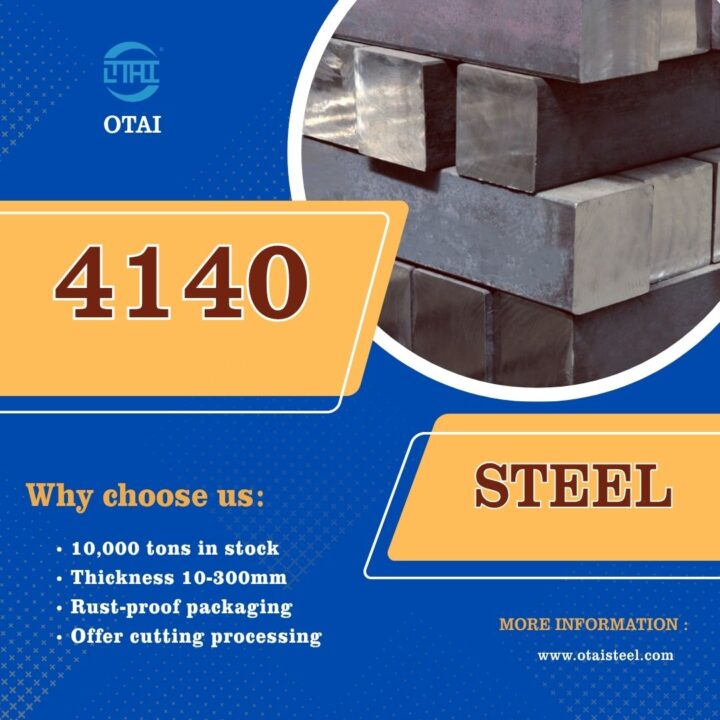
- 4140 stock availability: 4140 steel plate thickness from 4–380 mm, quenched and tempered 4140 plate from 13–200 mm, and 4140 round bar diameter from 14–500 mm, subject to current stock confirmation.
- Large inventory: More than 10,000 tons of steel stock across the company’s product range.
- Cutting capacity: 20 saw cutting machines support cutting services according to customer dimensions.
- Machining services: CNC machining, grinding, precision cutting, and customized size and tolerance support.
- One-stop service: Support for material selection, processing coordination, inspection, and export packaging.
- Quality assurance: Material testing, ultrasonic testing support, and third-party inspection arrangements according to order requirements.
- Export experience: Supplying international customers in more than 54 countries since 1999.
- Export packaging: Anti-rust protection, strapping, bundling, and wooden case packaging according to shipping requirements.
- Procurement support: Assistance with technical requirements, material documentation, and delivery arrangements for overseas buyers.
For buyers sourcing 4140 steel plate, OTAI provides product information and supply support through its 4140 alloy steel plate product page. Buyers should confirm the required product form, dimensions, delivery condition, and mechanical properties before placing an order.
❓ Frequently Asked Questions
1. What is the tensile strength of 4140 steel?
4140 steel does not have one fixed tensile-strength value. Annealed material is commonly referenced at approximately 655 MPa, while Q&T material may reach around 1,000 MPa or higher depending on its strength level, dimensions, and heat-treatment process. Buyers should check the applicable specification and actual MTC results.
2. Does heat treatment increase the tensile strength of 4140 steel?
Yes. Quenching can significantly increase hardness and tensile strength by forming a martensitic structure. Tempering then adjusts the properties by reducing brittleness and balancing strength with toughness. The final result depends on the complete heat-treatment cycle.
3. Does higher tempering temperature reduce 4140 tensile strength?
Generally, yes. Within a suitable tempering range, increasing the tempering temperature usually reduces tensile strength and hardness while improving ductility and toughness. However, the exact response depends on the material composition, section size, and process conditions.
4. Is Q&T 4140 stronger than annealed 4140?
Q&T 4140 generally has higher tensile and yield strength than annealed 4140. Annealed material, however, is usually easier to machine. The better choice depends on the component’s final mechanical requirements and manufacturing process.
5. How can buyers confirm the tensile strength of supplied 4140 steel?
Buyers should review the material test certificate and compare its tensile test results with the purchase specification. The certificate should identify the material, heat number, chemical analysis, delivery condition, and relevant mechanical test results. For critical applications, buyers can also arrange independent testing or third-party inspection.