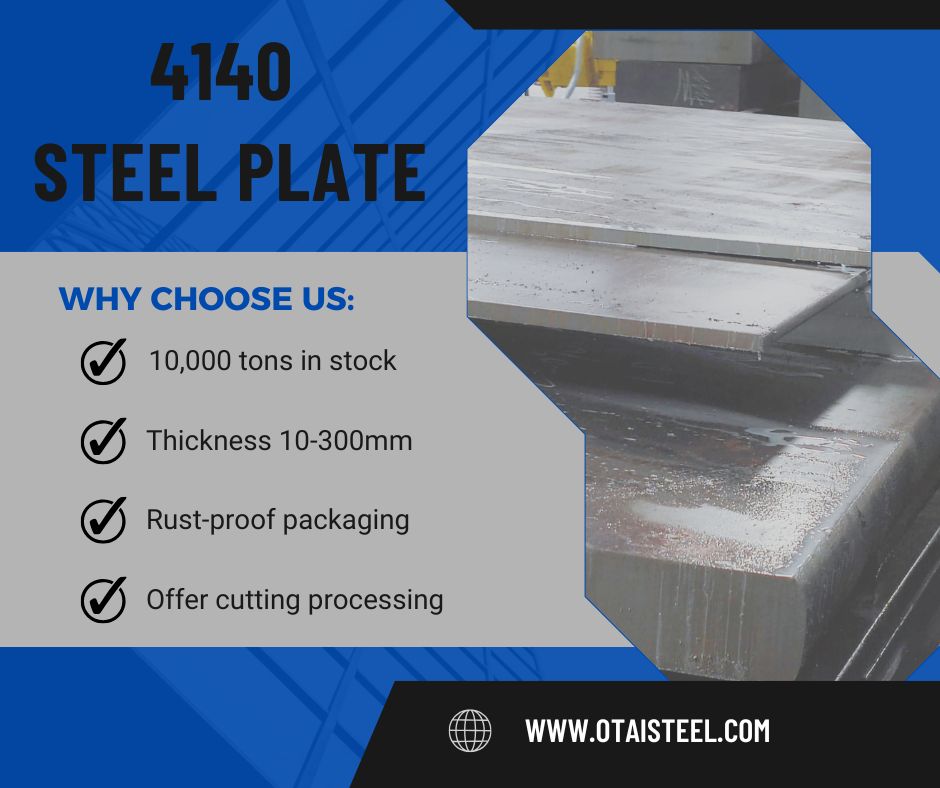
Skip to Content

Category Archives: Blog

4140 Steel Brinell Hardness: Know the Numbers Before You Machine or Heat Treat!

4140 Steel Brinell Hardness: Know the Numbers Before You Machine or Heat Treat!4140 Steel Brinell Hardness: Know the Numbers Before You Machine or Heat Treat!

If you’re working with 4140 alloy steel, chances are you’re dealing with heat treatment, machining, or quality control—and that means hardness matters a lot. One of the most common ways to evaluate it? The Brinell hardness test.

So let’s dive deep into the 4140 steel Brinell hardness range, what affects it, and how to choose the right condition for your application. 🧐📏


📌 What Is Brinell Hardness, and Why Use It for 4140?

The Brinell Hardness Number (BHN) measures the resistance of a material to indentation using a hardened steel or tungsten carbide ball. For steels like 4140, this test gives a reliable idea of surface hardness—especially when you want to compare heat-treated vs annealed conditions.

But here’s the catch: hardness values vary a lot depending on how the 4140 is processed.


📊 4140 Steel Hardness Chart (Brinell Values by Condition)

Here’s a helpful reference table showing typical Brinell hardness value for 4140 steel in different heat treatment conditions:

Condition Brinell Hardness (BHN) Notes
4140 Annealed Brinell Hardness 197 – 217 BHN Soft, machinable
Normalized 207 – 235 BHN Slightly stronger
Brinell hardness of quenched and tempered 4140 241 – 321 BHN Depends on tempering temperature
Induction Hardened Surface 450+ BHN (localized) Only surface, not core
Nitrided Surface Up to 600 HV (~55 HRC) Converted scale

So the 4140 steel Brinell hardness range is typically between 190 and 320 BHN, depending on treatment. Quenching and tempering give the best balance of strength and ductility.


🔥 Brinell Hardness of Quenched and Tempered 4140

When you Q&T (quench and temper) 4140, you supercharge its mechanical performance.

  • At low tempering temps (~400°C), hardness can reach 300–321 BHN

  • At high tempering temps (~650°C), you get ~240–270 BHN, but higher toughness

This sweet spot is what makes Q&T 4140 perfect for shafts, gears, and heavy-duty tools.

Real-life example? One of our clients in Vietnam used Q&T 4140 (280 BHN) for large drive axles. After 18 months, wear was still minimal—even under heavy torque and cyclic load.


🧊 What About Annealed 4140?

In its annealed state, 4140 steel Brinell hardness is around 197–217 BHN. This is soft enough for easy cutting and shaping, which is why it’s often preferred before machining.

Pro Tip: If you plan to machine and then harden later—start with 4140 annealed Brinell hardness stock. It’ll save your tooling and time! 🧰⏱️


🤔 Brinell vs Rockwell: What’s the Difference?

We get this question a lot: “What’s the difference between Brinell and Rockwell hardness in 4140 steel?”

Here’s a quick breakdown:

Feature Brinell Hardness (BHN) Rockwell Hardness (HRC)
Indenter Type Ball (10mm) Cone (diamond)
Load Heavy (500–3000 kgf) Lighter (60–150 kgf)
Surface vs Bulk Good for bulk readings Good for surface hardness
Conversion 197 BHN ≈ 91 HRB 321 BHN ≈ ~35 HRC

Both are useful—but Brinell is preferred for checking forged or thick sections, while Rockwell is often used for surface readings on thinner parts or hardened zones.


🛠️ How to Increase Brinell Hardness of 4140 Steel

Want harder 4140? Here’s how to do it:

  • 🔥 Quenching and Tempering: Ideal for through-hardening while preserving ductility.

  • Induction Hardening: Hardens only the surface (~450+ BHN) while keeping the core tough.

  • 🧪 Nitriding: Adds a super-hard outer shell without distortion—especially useful for wear parts.

Always remember: heat treatment changes everything—mechanical properties, cost, and machinability.


🌍 Real-World Applications by Hardness Range

BHN Range Application
190–220 Machined parts, fixtures
220–270 Shafts, connecting rods
270–320 Gears, drive axles, wear plates
400+ Induction hardened pins, cams

🧠 FAQs – 4140 Steel Brinell Hardness

Q1: What is the maximum Brinell hardness of 4140 steel?
👉 Typically ~320 BHN after Q&T. Higher values are possible with surface hardening.

Q2: Can I use Rockwell instead of Brinell for 4140?
👉 Yes, but make sure to use the proper conversion chart. They serve different testing needs.

Q3: Is Brinell hardness affected by steel size or shape?
👉 Only slightly—Brinell is great for large sections. For thin or small parts, use Rockwell.

Q4: Can I request specific hardness when buying 4140?
👉 Absolutely. At Otai, we supply 4140 in various conditions—just tell us your spec.


🏭 Why Otai Is Your Best Source for 4140 Steel

At Otai Special Steel, we don’t just stock 4140—we help you choose the right hardness level for your project. Whether you need annealed, Q&T, or pre-machined bars, we’ve got it covered:

  • Over 10,000 tons of inventory
  • Thickness from 6mm to 300mm
  • Cut-to-length and heat treatment services
  • Hardness testing (BHN, HRC) available
  • SGS/third-party inspection support
  • Export to 50+ countries, including EU and US markets
  • Trusted by Thyssenkrupp, Borealis, Schlumberger and more

📧 Email us: jack@otaisteel.com
📱 WhatsApp: +8676923190193

💬 Ready to choose the perfect hardness for your 4140 steel? Contact us now—we’ll help you decide based on your use case, load conditions, and machining needs.
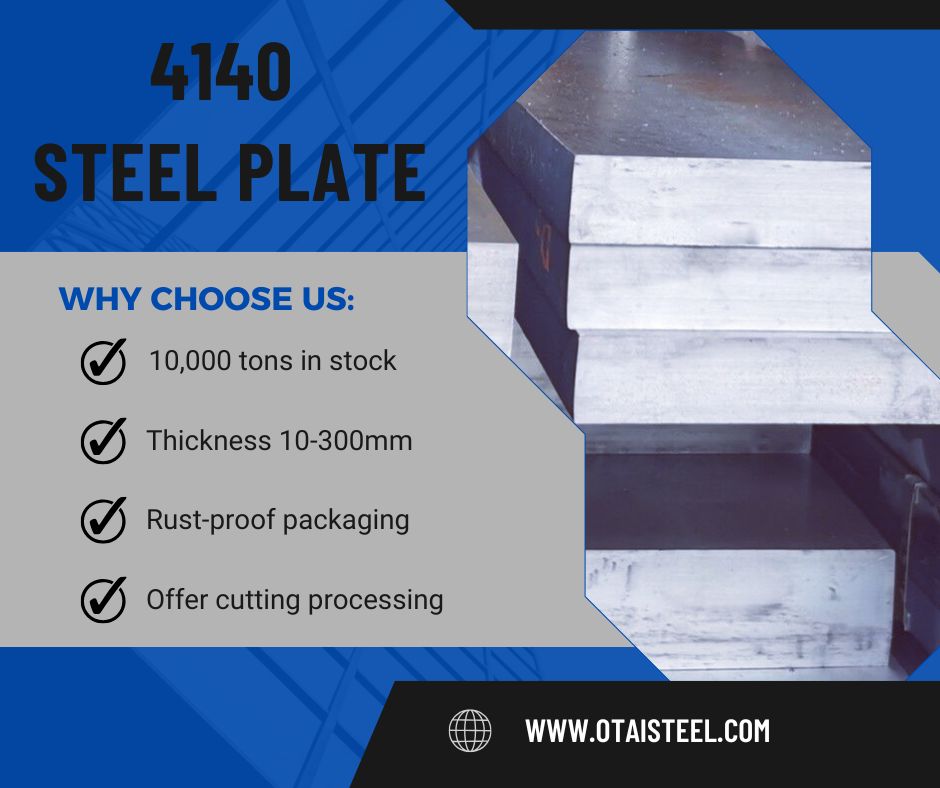
0 0 Continue Reading →

4140 Steel Corrosion: What You Need to Know

4140 Steel Corrosion: What You Need to Know4140 Steel Corrosion: What You Need to Know to Protect Your Parts
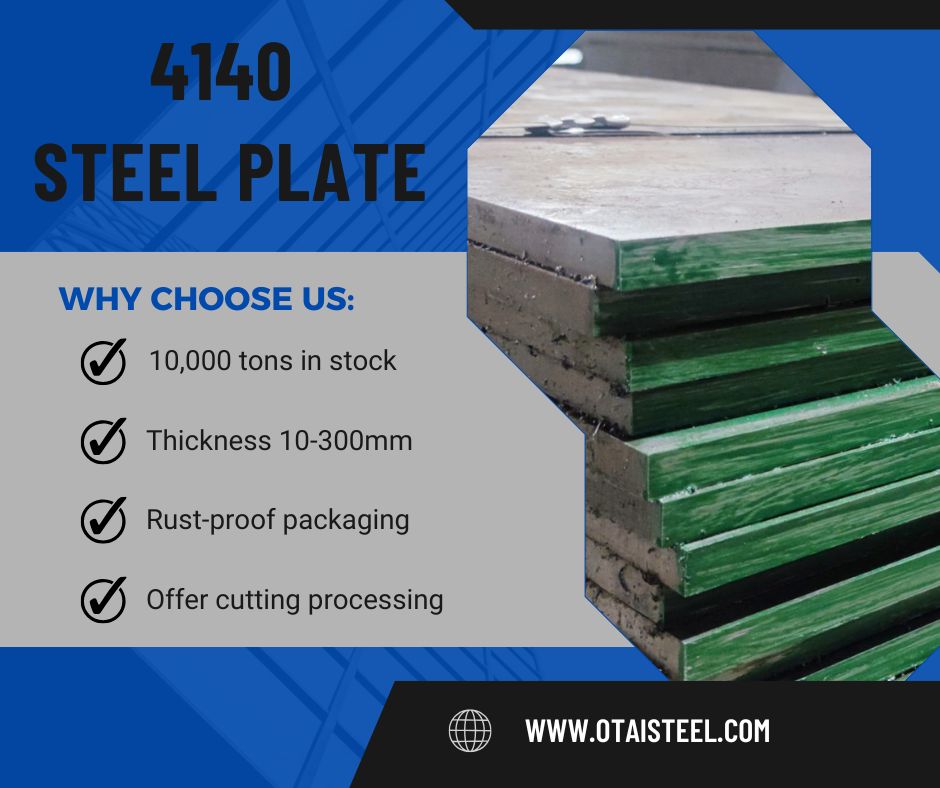
If you’re working with 4140 steel, you probably already love its strength and toughness. But here’s the kicker — like many alloy steels, 4140 steel corrosion can be a real challenge if you don’t know how to handle it. So, what exactly is the corrosion resistance of 4140 alloy, and how can you keep your components safe and long-lasting? Let’s dive in! 🌊


⚙️ What Is the Corrosion Behavior of 4140 Steel?

4140 is a chromium-molybdenum alloy steel prized for its mechanical properties, but it isn’t stainless. The corrosion behavior of 4140 steel in different environments varies widely depending on humidity, temperature, and exposure to chemicals.

  • In dry air or indoor environments, corrosion is usually slow and limited to surface rust.

  • In wet or salty conditions, such as marine or coastal areas, corrosion accelerates quickly.

  • Exposure to acids or alkaline chemicals can cause pitting or localized corrosion.

Understanding the 4140 steel oxidation process is key. When exposed to moisture and oxygen, the steel’s surface forms iron oxide—commonly called rust—that gradually eats away at the metal.


🛑 How Fast Does 4140 Steel Corrode?

The 4140 steel corrosion rate isn’t fixed. It depends on the environment and protective measures taken. In a humid outdoor environment, untreated 4140 steel can develop rust in just days or weeks.

For example:

Environment Estimated Corrosion Rate
Dry indoor < 0.01 mm/year
Coastal (salt spray) 0.05 – 0.2 mm/year
Industrial (acidic rain) 0.1 – 0.3 mm/year

Left unprotected, this corrosion weakens parts, causes surface roughness, and may affect the effects of corrosion on 4140 steel mechanical properties, including fatigue life and tensile strength.


🛡️ How to Prevent Corrosion on 4140 Steel

The good news? There are plenty of ways to boost the corrosion resistance of 4140 steel and keep your parts in top shape:

1. Surface Treatments

Applying a protective coating can drastically reduce corrosion:

  • Black oxide coating: Forms a thin, corrosion-resistant layer.

  • Phosphate coating: Offers rust resistance and better paint adhesion.

  • Nitriding: Hardens the surface and provides some corrosion protection.

  • Painting or powder coating: Creates a physical barrier against moisture.

2. Protective Oils and Greases

For parts stored or operating in humid conditions, regular application of oils or anti-rust greases can slow down oxidation.

3. Cathodic Protection

In highly corrosive environments, sacrificial anodes or impressed current systems can protect steel by redirecting corrosive reactions.

4. Material Selection and Design

Sometimes, selecting a stainless steel or adding protective design features like drainage holes can reduce corrosion risks.


🔬 Effects of Corrosion on 4140 Steel Mechanical Properties

Corrosion doesn’t just look bad — it can seriously compromise performance:

  • Loss of cross-sectional area: Rust eats into metal, reducing strength.

  • Surface pitting: Creates stress concentration points that lead to cracks.

  • Reduced fatigue life: Corrosion fatigue accelerates failure under cyclic loads.

  • Impact on hardness: Corrosion can affect the surface hardness, leading to wear issues.

Understanding these effects of corrosion on 4140 steel mechanical properties helps in planning maintenance and protective measures.


🌍 Real-World Applications: Corrosion Challenges and Solutions

  • Automotive shafts and gears: Often exposed to moisture and salts; black oxide and nitriding are common protections.

  • Oil & gas drilling equipment: Faces acidic and salty environments; heavy-duty coatings and cathodic protection are critical.

  • Heavy machinery parts: Stored outdoors, need regular rust prevention oils and protective paints.


💡 Summary: Best 4140 Steel Corrosion Protection Methods

Method Pros Cons
Black Oxide Coating Inexpensive, improves appearance Limited protection in harsh environments
Phosphate Coating Good base for paint Needs top coating for full protection
Nitriding Hard surface + corrosion resistance Higher cost, complex process
Painting/Powder Coating Excellent barrier Requires proper surface prep
Oil/Grease Application Easy, good for storage Requires frequent reapplication
Cathodic Protection Effective in harsh environments Complex setup and maintenance

🏭 Why Choose Otai Steel for Your 4140 Steel Needs?

At Otai Steel, we don’t just sell steel—we provide solutions. Here’s why customers trust us for 4140 steel corrosion protection and supply:

  • Large inventory of 4140 steel with various surface finishes
  • Expertise in custom heat treatments including nitriding and black oxide
  • Quality assurance: full chemical and mechanical testing
  • Tailored solutions for corrosion protection based on your environment
  • Fast global delivery and excellent customer service

📧 Email: jack@otaisteel.com
📱 WhatsApp: +8676923190193


❓ FAQs – 4140 Steel Corrosion

Q1: Is 4140 alloy corrosion resistant?
A: It has moderate corrosion resistance but is not stainless steel. Protection is usually needed.

Q2: How can I protect 4140 steel from rust?
A: Use surface treatments like black oxide, painting, or nitriding, and apply oils in humid conditions.

Q3: Does corrosion affect 4140 steel strength?
A: Yes, rust reduces cross-sectional area and fatigue life, weakening the material.

Q4: Can heat treatment improve corrosion resistance?
A: Heat treatment mainly improves strength and hardness; nitriding adds surface corrosion resistance.

Q5: How fast does 4140 steel rust outdoors?
A: It varies, but without protection, rust can start in days in humid or coastal environments.

0 0 Continue Reading →

Forged 4140 Steel Properties: What Makes It So Reliable?

Forged 4140 Steel Properties: What Makes It So Reliable?Forged 4140 Steel Properties: What Makes It So Reliable?
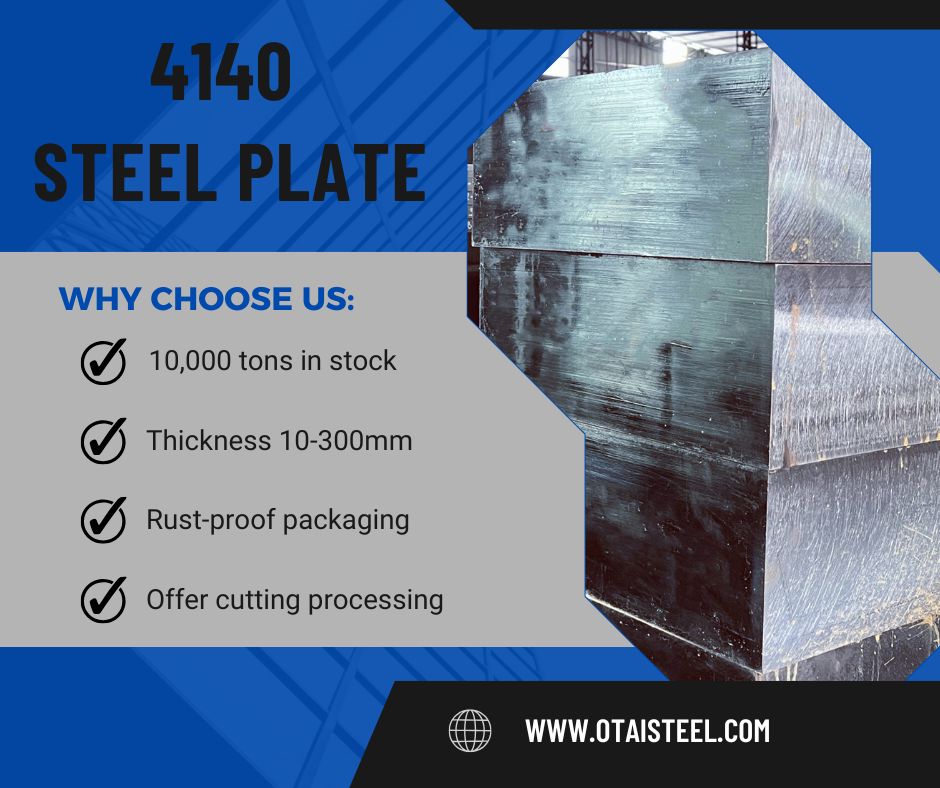
If you’re dealing with high-performance parts or demanding industrial applications, chances are you’ve heard about forged 4140 steel. But what exactly are the mechanical properties of forged 4140 steel that make it a top choice? And how does it compare to other steel forms?

Let’s dive deep into the world of forged 4140 steel and uncover its chemistry, strength, toughness, and why it’s trusted worldwide. 🌍


🔥 What Is Forged 4140 Steel?

4140 steel is a chromium-molybdenum alloy steel known for its excellent balance of strength, toughness, and wear resistance. When forged, this steel undergoes a controlled shaping process involving heat and pressure, which refines its grain structure and enhances key properties.

Compared to cast or machined 4140 steel, forging improves the internal consistency and mechanical behavior, making it ideal for parts that face extreme loads and fatigue cycles.


🧪 Chemical Composition of Forged 4140 Steel

Understanding the chemical composition of forged 4140 steel helps explain its outstanding characteristics. The typical composition includes:

Element Percentage Range (%)
Carbon (C) 0.38 – 0.43
Chromium (Cr) 0.80 – 1.10
Molybdenum (Mo) 0.15 – 0.25
Manganese (Mn) 0.75 – 1.00
Silicon (Si) 0.15 – 0.35
Phosphorus (P) ≤ 0.035
Sulfur (S) ≤ 0.04

This alloying mix provides forged 4140 steel with excellent hardenability and resistance to wear and fatigue.


💪 Mechanical Properties of Forged 4140 Steel

Let’s get to the heart of it — the mechanical properties of forged 4140 steel that engineers rely on every day.

Property Typical Value
Tensile Strength 90,000 – 110,000 psi (620 – 760 MPa)
Yield Strength 60,000 – 85,000 psi (415 – 590 MPa)
Elongation (%) 20 – 25
Hardness (HRC) 28 – 32 (after heat treatment)
Impact Toughness High, excellent toughness especially after tempering
Fatigue Resistance Superior due to refined grain structure

Because of the forging process, the grain flow follows the part shape, reducing internal defects and increasing resistance to cracking and fatigue — a big plus for components under cyclic stress.


🔥 Heat Treatment for Forged 4140 Steel

To maximize forged 4140 steel tensile strength and toughness, heat treatment is key. The common processes include:

  • Annealing: Softens steel for easier machining.

  • Quenching and Tempering (Q&T): Provides a balance of hardness and toughness. Typical tempering temperatures range from 400°C to 650°C.

  • Nitriding: Surface hardening method that increases wear resistance without affecting core toughness.

Proper heat treatment helps achieve consistent hardness (28-32 HRC) and forged 4140 steel fatigue resistance, making parts last longer in service.


⚔️ Forged 4140 Steel vs Cast 4140 Steel: What’s the Difference?

When comparing forged 4140 steel vs cast 4140 steel, forging generally wins in:

  • Strength: Forged parts have better mechanical strength.

  • Toughness: Forging refines the grain structure, improving impact toughness.

  • Fatigue life: Forged components resist cracking and failure better under cyclic loads.

  • Reliability: Lower porosity and internal defects.

Casting can be more economical for complex shapes but often compromises the structural integrity, especially for high-stress applications.


🌍 Applications of Forged 4140 Steel

Thanks to its combination of strength, toughness, and fatigue resistance, forged 4140 steel is widely used in:

  • Automotive: crankshafts, gears, axles

  • Aerospace: landing gear components, structural parts

  • Oil & Gas: drill collars, valves

  • Heavy Machinery: pins, couplings, shafts

  • Defense: firearm parts, armored vehicle components

Its versatility across industries stems from its ability to perform reliably under harsh conditions.


🎯 Advantages of Forged 4140 Steel

  • Superior Strength and Toughness: Thanks to forging and proper heat treatment.

  • Excellent Fatigue Resistance: Ideal for cyclic loading conditions.

  • Improved Grain Structure: Provides consistent mechanical properties throughout the part.

  • Better Machinability: When annealed or normalized before machining.

  • Customizable Heat Treatment: For tailored hardness and wear resistance.

  • Cost-Effective: More durable parts reduce downtime and replacement costs.


🏭 Why Otai Steel Is Your Go-To for Forged 4140 Steel

At Otai Special Steel, we understand the critical role forged 4140 steel plays in your manufacturing or repair process. That’s why we offer:

  • Massive inventory: over 10,000 tons of 4140 steel available
  • Precision cutting and customized dimensions (6mm–300mm thickness)
  • Heat treatment options: annealed, Q&T, nitrided
  • Full chemical and mechanical testing for guaranteed quality
  • Support with technical consultation on forging and heat treatment
  • Global shipping and trusted by major clients like Thyssenkrupp, Borealis, and Schlumberger

📧 jack@otaisteel.com
📱 WhatsApp: +8676923190193


❓ FAQs About Forged 4140 Steel Properties

Q1: What makes forged 4140 steel stronger than other forms?
A: The forging process refines grain structure and reduces defects, improving strength and toughness.

Q2: Can forged 4140 steel be heat treated multiple times?
A: Yes, but careful control of heat cycles is necessary to maintain optimal properties.

Q3: Is forged 4140 steel good for high fatigue applications?
A: Absolutely. Its fatigue resistance is one of its key advantages.

Q4: How does forging affect machinability?
A: Forged 4140 steel is easier to machine when annealed or normalized.

Q5: What industries commonly use forged 4140 steel?
A: Automotive, aerospace, oil & gas, heavy machinery, and defense sectors.

0 0 Continue Reading →

4140 Steel Grade Equivalent – Global Cross Reference You Can Trust
4140 Steel Grade Equivalent - Global Cross Reference You Can Trust4140 Steel Grade Equivalent – Global Cross Reference You Can Trust

If you’re sourcing 4140 steel grade equivalent across different markets, you’ve probably hit a wall of confusing designations. Is EN19 the same as 4140? Can SCM440 or 42CrMo4 be substituted directly? 🤔

Don’t worry—we get this question all the time from engineers, buyers, and project managers who work with international suppliers.

Let’s walk you through it—clearly, practically, and with real engineering data. 🌍🛠️


📌 What Is AISI 4140?

AISI 4140 is a chromium-molybdenum alloy steel that’s well-known for:

  • High strength and wear resistance

  • Great hardenability (can be heat treated deeply)

  • Solid fatigue performance

  • Good machinability in pre-hardened or annealed states

It’s a favorite in sectors like:

🔧 Automotive: axles, crankshafts, steering knuckles
⛽ Oil & Gas: tool joints, drill collars
🚜 Machinery: pins, gears, shafts
🛡️ Defense & Aerospace: bolts, structural brackets, firing components

But if you’re working across borders, you may need to look up the 4140 steel equivalent in Europe, Asia, or other global markets.


🌐 Global Equivalents of 4140 Steel (by Standard)

Here’s a breakdown of 4140 steel equivalent standards used internationally:

🌎 Region / Standard Equivalent Grade Notes
USA (SAE/ASTM) AISI 4140 Base grade
Europe (EN) EN19 / 42CrMo4 Most common 4140 steel equivalent in Europe
Germany (DIN) 1.7225 / 42CrMo4 Precise DIN equivalent of 4140 steel
Japan (JIS) SCM440 JIS equivalent to 4140 steel
China (GB) 42CrMo Similar chemistry, often used interchangeably
India (IS) 40Cr4Mo3 / EN19 Popular 4140 steel equivalent in India
UK (BS) EN19 Very close in mechanical properties
France (AFNOR) 42CD4 Acceptable for most general use

💡 All of these materials fall into the Cr-Mo medium-carbon alloy steel family. They’re designed to balance strength, toughness, and heat treatability.


🔬 Mechanical Properties of 4140 and Its Equivalents

After proper heat treatment (typically quenched and tempered), these steels deliver impressive mechanical strength. Here’s a quick SAE 4140 steel grade comparison with global equivalents:

Grade UTS (MPa) YS (MPa) Hardness (HRC) Elongation (%)
AISI 4140 850–1000 ~655 28–32 ~25
EN19 / 42CrMo4 850–1000 ~650–700 28–32 ~20–22
SCM440 (JIS) 800–980 ~630 27–30 ~22
EN24 850–1000 ~740 30–36 ~16–18

📌 So what’s the deal with 4140 steel vs EN24? EN24 has a bit more nickel, which boosts its toughness and makes it more fatigue-resistant—ideal for aircraft-grade gear parts or racing components.


⚙️ Chemical Composition: How Close Are They Really?

Let’s compare chemical elements between 4140 and its top equivalents:

Element AISI 4140 EN19 (EN) SCM440 (JIS) 42CrMo4 (DIN)
Carbon (C) 0.38–0.43% 0.36–0.44% 0.38–0.43% 0.38–0.45%
Chromium 0.80–1.10% 0.90–1.20% 0.90–1.20% 0.90–1.20%
Molybdenum 0.15–0.25% 0.15–0.30% 0.15–0.30% 0.15–0.30%
Manganese 0.75–1.00% 0.50–0.80% 0.60–0.85% 0.60–0.90%

✅ Bottom line? These steels are nearly interchangeable in terms of chemistry and can be used in similar applications—once heat treated to matching conditions.


🛠️ Real-World Case: Switching from 4140 to EN19

A client in South Africa was building wear-resistant mold bases. They initially sourced AISI 4140 but switched to EN19 due to local availability.

We supplied EN19 plates normalized and UT-tested. The machining results were nearly identical. Their post-heat-treat hardness matched 4140 expectations—saving both lead time and cost. 💸


💬 Key Tip: Don’t Just Match Grades—Match Properties

If you’re comparing EN19 vs 4140 steel, remember:
Same grade name ≠ Same heat treatment or performance

Always check:

  • Tensile strength after heat treatment

  • Case hardening potential

  • Machinability (especially for pre-hardened stock)

  • Surface treatment compatibility (nitriding, black oxide, etc.)


🧠 Bonus Tip: 4140 vs 4340 vs 1045

Property 4140 4340 1045 (medium carbon)
Strength High Higher Moderate
Toughness High Very High Moderate
Weldability Fair Poor Good
Hardenability High Very High Low
Cost Medium High Low

4140 gives you the sweet spot between cost, strength, and versatility.


🏭 Why Choose Otai Steel for 4140 & Its Global Equivalents?

At Otai, we don’t just stock steel—we solve sourcing problems.

🔧 Whether you’re looking for 4140, EN19, SCM440, or DIN 42CrMo4, we deliver ready-to-machine solutions.

✨ Why Top Brands Trust Us:

  • 📦 10,000+ tons in stock – 6mm to 300mm thick

  • 🧪 Full mill certificates + optional 3rd-party inspections (SGS, BV)

  • 🔥 Heat-treated states: annealed, Q&T, normalized, or nitrided

  • 📐 Custom cutting, grinding, and finishing to drawing

  • 🌍 Exporting to 50+ countries – fast global delivery

  • 🤝 Partners include Thyssenkrupp, Borealis, Schlumberger

📧 jack@otaisteel.com
📱 WhatsApp: +8676923190193


❓FAQs – 4140 Steel Grade Equivalent

Q1: What is the closest European equivalent to AISI 4140?
👉 That would be EN19 / 42CrMo4, which are widely used across Europe.

Q2: Is EN19 interchangeable with AISI 4140?
✅ Yes, especially after matched heat treatment. They’re often cross-certified.

Q3: What is the JIS equivalent to 4140 steel?
🗾 That would be SCM440, used across Japan and Southeast Asia.

Q4: Can EN24 replace 4140?
🛠️ In high-performance parts, yes—but EN24 is tougher and harder, and may be overkill for general use.

Q5: Do you offer Q&T or annealed EN19/SCM440/42CrMo4?
💯 Absolutely! We supply all major 4140 steel grade equivalent types in your required condition.

0 0 Continue Reading →

4140 Steel Heat Treatment: Unlocking Strength, Toughness & Performance

4140 Steel Heat Treatment: Unlocking Strength, Toughness & Performance4140 Steel Heat Treatment: Unlocking Strength, Toughness & Performance
When it comes to 4140 steel heat treatment, getting it right is crucial. Whether you’re producing heavy-duty shafts, automotive parts, or industrial machinery components, the heat treatment process directly impacts your steel’s strength, hardness, and durability.

If you want to avoid costly rework or part failures, this guide will walk you through the key stages, temperatures, and real-world tips — all backed by industry experience.


🔍 What Is 4140 Steel Heat Treatment?

4140 steel heat treatment involves controlled heating and cooling cycles that change the steel’s internal structure, improving mechanical properties like hardness, tensile strength, and toughness.

Why heat treat?

  • To increase strength for demanding applications

  • To improve wear resistance and fatigue life

  • To optimize machinability during manufacturing

The main heat treatment steps are:

  1. Annealing – soften steel for machining or forming

  2. Normalizing – refine grain structure and improve toughness

  3. Quenching and tempering (Q&T) – harden the steel and then reduce brittleness

  4. Stress relieving – reduce residual stresses from welding or machining


🔥 Step 1: Annealing 4140 Steel for Machining Ease

When raw 4140 steel arrives, it’s often too hard to machine or bend easily. Annealing softens it by heating to around 840–860°C (1550–1580°F) and cooling slowly, often inside the furnace.

  • Annealed 4140 hardness drops to about 180 HB (Brinell), making it much easier to cut or bend.

  • This treatment promotes a fine pearlite and ferrite microstructure, improving ductility.


🔧 Step 2: Normalizing for Uniform Grain and Toughness

Normalizing involves heating slightly above annealing temperatures (~870–920°C) and then air cooling.

  • Results in a more uniform grain size and slightly higher hardness (~220 HB)

  • Often used before further heat treatment to reduce internal stresses


⚡ Step 3: Quenching and Tempering — The Core Strength Process

Quenching and tempering (Q&T) is the gold standard for 4140 steel’s final performance.

  • Quenching: Heat to 845–870°C, then rapidly cool in oil or water to produce hard but brittle martensite.

  • Tempering: Reheat quenched steel to 400–650°C to reduce brittleness and enhance toughness.

Tempering Temp (°C) Hardness (HRC) Typical Uses
400 40–45 Heavy-duty shafts, gears
500 32–38 General structural parts
600 28–32 Parts requiring machinability

⚠️ Important: Choosing the right tempering temperature balances hardness and toughness—too low, and steel is brittle; too high, and you lose strength.


🧪 Heat Treatment Cycles & Times

Precise heat treatment cycles for 4140 steel vary by part size and application. Here’s a typical example:

Process Temp (°C) Soak Time Cooling
Austenitize 845–870 30–60 min per inch thick Oil or water quench
Temper 400–650 1–2 hours Air cool

Larger parts need longer soak times to ensure even temperature distribution.


⚙️ Real-World Impact: Properties After Heat Treatment

Property Annealed Normalized Q&T (450°C temper)
Tensile Strength ~655 MPa ~760 MPa 850–1000 MPa
Yield Strength ~415 MPa ~620 MPa 655–830 MPa
Hardness (HRC) 15–18 18–22 32–40
Elongation (%) ~25% ~22% 20%
Impact Toughness Moderate Good High

🛠️ Practical Tips for Your 4140 Heat Treatment Success

  • Use oil quenching over water for thicker parts to reduce cracking risk.

  • For complex or welded components, consider stress relief annealing at 600°C for 1-2 hours.

  • Always perform hardness and microstructure tests post-treatment to ensure quality.

  • If machinability is a priority, anneal first, then do final Q&T after machining.

  • Avoid overheating during tempering—maintain precise temperature control.


🌎 Why Choose Otai Steel for 4140 Heat Treatment?

We don’t just supply steel—we provide solutions:

  • Over 10,000 tons of 4140 steel stock from 6mm to 300mm thickness
  • Customized annealed, normalized, or Q&T conditions per your needs
  • Precision cutting, grinding, and surface treatment services (nitriding, black oxide)
  • Full testing reports: chemical composition, hardness, UT inspection
  • Trusted by global leaders like Thyssenkrupp, Borealis, Schlumberger
  • Fast global shipping and expert consultation

❓ FAQs — 4140 Steel Heat Treatment

Q1: What temperature should I anneal 4140 steel?
Typically 840–860°C, slow furnace cooling.

Q2: How hard is 4140 after quench and temper?
Usually between 28–40 HRC depending on tempering temperature.

Q3: Can I heat treat 4140 steel myself?
With proper equipment and process control, yes—but it’s recommended to use professional services.

Q4: What’s the difference between normalizing and annealing 4140?
Annealing softens the steel more with slow cooling; normalizing refines grain structure with air cooling.

Q5: Does heat treatment affect corrosion resistance?
No significant effect; 4140 is not stainless, so consider coatings or plating for corrosion protection.


📩 Need help choosing the right 4140 steel heat treatment process for your project?
Get expert advice and fast quotes anytime:
📧 jack@otaisteel.com
📱 WhatsApp: +8676923190193

0 0 Continue Reading →

Can You Bend 4140 Steel: A Straight Answer With Smart Tips

Can You Bend 4140 Steel: A Straight Answer With Smart TipsCan You Bend 4140 Steel: A Straight Answer With Smart Tips
Thinking about bending 4140 steel? You’re not alone. Every month, we hear from engineers, metal fabricators, and machinists asking the same thing:

Can I bend 4140 steel without cracking it?
“Should I do it cold or hot?”
“What if it’s already been heat treated?”

Let’s break it all down—clearly, practically, and with real-world advice from the shop floor and heat treatment labs.


📌 What Makes 4140 Steel Tough to Bend?

4140 is a chromium-molybdenum alloy steel, engineered for strength, hardenability, and wear resistance. But that strength can become a problem when you try to bend it—especially after hardening.

Here’s what you need to know:

  • In its annealed or normalized state, 4140 can be cold formed—though it’s tougher than mild steel.

  • Once heat treated (Q&T), its yield strength increases, but ductility drops.

  • Trying to bend hardened 4140 without heat? Risky. It may crack, craze, or snap.

👉 That’s why understanding how to bend 4140 steel properly is critical to avoid costly part failures.


🔥 Bending 4140 Steel: Cold vs Hot Forming

Let’s compare the two major options:

Method Recommended Condition Risk Level Notes
Cold Bending Annealed or Normalized ⚠️ Moderate Needs large bend radius; risk increases with thickness
Hot Bending Quenched & Tempered (Q&T) ✅ Low Heat to ~1650°F (900°C), bend, then re-temper
Warm Bending As-rolled / Normalized ⚠️ Medium Heated to ~1000–1200°F to improve ductility slightly

So if you’re asking:
👉 Can you bend 4140 steel after heat treatment?
Yes, but only if you heat it again before bending, and apply a proper post-bend heat treatment.


📐 Minimum Bend Radius Guidelines

The minimum bend radius (MBR) is crucial to prevent cracking. Here’s a general guide for different 4140 conditions:

Condition Recommended MBR (x material thickness) Notes
Annealed / As Rolled 2.5–3.0× Best for basic cold bending
Normalized 4140 steel 3.0–4.0× Slightly stiffer, needs wider radius
4140 Q&T (28–32 HRC) 4.0–6.0× Requires hot forming
Q&T + Nitrided Surface Avoid bending Surface layer is brittle

💡 Tip: When in doubt, increase the bend radius and preheat thicker sections—especially above 25mm.


⚙️ Real-World Example – Oil & Gas Coupling Project

One of our clients in Abu Dhabi needed custom U-shaped 4140 components for high-pressure couplings. Their material was Q&T 4140, HRC 32.

🔧 First trial: cold forming – ❌ Result: internal micro-cracks
🔥 Second trial: hot bending at 870°C + post-tempering – ✅
🔁 They now standardize all 4140 forming using that method. No more cracking, and parts passed ultrasonic inspection.


🧠 Key Things to Know Before You Bend 4140

Here’s what we advise clients who ask can you bend hardened 4140 steel:

  1. Never bend hardened 4140 cold unless you’re ready to sacrifice the part.

  2. Always consider re-heat treatment after hot bending to restore strength and toughness.

  3. Avoid bending nitrided or surface-treated parts—they will crack.

  4. Use stress relief annealing (~600°C for 1 hour per inch) after cold forming to avoid residual stresses.

  5. Ensure your bend tooling is matched to the bend radius and material thickness.


🆚 4140 vs Other Steels: Bending Behavior

Material Ease of Bending After Hardening Notes
Mild Steel ✅ Easy ❌ Low strength Best for cold forming and prototyping
1045 Carbon ⚠️ Moderate ⚠️ Moderate Cracks under tight bends when hardened
4140 Alloy ⚠️ Moderate ❌ Hot bend only Requires correct technique
4340 Alloy ❌ Difficult ❌ Needs high temp Higher strength but low ductility

📌 So while 4140 steel bending strength is higher than 1045, it requires more expertise to form safely.


🛠️ Can You Anneal 4140 for Bending?

Yes—and many shops do this before forming. Here’s how:

🔁 Annealing Cycle for 4140:

  • Heat to 1550°F (840°C)

  • Hold for 1 hour per inch of thickness

  • Cool slowly (in furnace or sand bed)

This increases ductility and makes bending 4140 steel cold much safer.


🏭 Why Otai is Your Best Partner for 4140 Bending Projects

We supply cut-to-length 4140 bar stock ready for whatever forming method you use—and we’ll help you choose the best condition.

🎯 Otai Special Steel Advantage:

  • ✅ 10,000+ tons 4140 steel in stock (6mm–300mm thick)

  • ✅ Supply in annealed, normalized, or Q&T state

  • ✅ Precision cut to size for bending jobs

  • ✅ Support with how to bend 4140 steel properly

  • ✅ Optional heat treatment & surface finish (nitriding, black oxide)

  • ✅ Export to 50+ countries, SGS/BV inspection available

  • ✅ Long-term partners: Thyssenkrupp, Borealis, Schlumberger

📧 jack@otaisteel.com
📱 WhatsApp: +8676923190193


❓ FAQs – Can You Bend 4140 Steel?

Q1: Can I bend 4140 flat bar cold?
Yes, if it’s annealed or normalized, and not too thick.

Q2: Can quenched and tempered 4140 steel be bent?
Yes, but only if hot bent, followed by post-bend heat treatment.

Q3: Will bending weaken 4140?
If done correctly and followed by stress-relief or tempering—no. Otherwise, it may cause internal damage.

Q4: What happens if I bend nitrided 4140?
The brittle surface will crack. Always bend first, then nitrided.

Q5: Do you offer bent or pre-formed 4140 steel?
We can supply pre-machined or pre-heat-treated bars, and advise on forming. Bending services available through our partner shops.

0 0 Continue Reading →

4140 Steel Yield Strength KSI: How Strong is Strong Enough?

4140 Steel Yield Strength KSI: How Strong is Strong Enough?4140 Steel Yield Strength KSI: How Strong is Strong Enough?
If you’re designing heavy-duty shafts, gears, or hydraulic parts, you’re probably asking:

💭 “What’s the yield strength of 4140 steel in ksi?”
💭 “Will it bend under pressure—or hold up like a champ?”
💭 “How does heat treatment affect the strength?”

Let’s cut through the noise and look at real data, practical insights, and what you really need to know before choosing 4140 alloy steel for your next high-stress project.


📐 What is Yield Strength, and Why KSI?

Yield strength is the stress level at which a material starts to deform permanently.
Measured in KSI (kilopounds per square inch), it tells you how much pressure 4140 can take before bending out of shape.

Why it matters:

  • It’s the real-world limit before failure begins.

  • It determines whether your shaft bends or survives under repeated loads.

  • It’s critical for engineering safety and material selection.

👉 So when we talk about the yield strength of 4140 steel bar stock, we’re talking about whether your part lives—or fails.


📊 Mechanical Properties: 4140 Steel Yield Strength in KSI

Here’s a detailed table comparing 4140 steel mechanical properties in ksi under different heat treatments:

Heat Treatment Condition Yield Strength (ksi) Tensile Strength (ksi) Hardness (HRC)
Annealed / As Rolled 60–75 95–110 ~18–22
Normalized 4140 steel 75–85 110–125 ~22–26
4140 Q&T at 28–32 HRC 95–115 140–160 28–32
Q&T at 35–40 HRC 120–140 160–180 35–40
Q&T + Nitrided Surface Core same as Q&T Surface: 58–65

As shown, the typical yield strength of 4140 steel varies based on hardness—but can exceed 140 ksi with proper heat treatment.


⚙️ Tensile vs Yield: What’s More Important?

Engineers often confuse tensile strength and yield strength.

  • Yield strength tells you when a part starts to bend permanently

  • Tensile strength tells you when a part breaks completely

For most structural parts, shafts, and pressurized components, yield is the real safety threshold.

💡 That’s why many customers specifically request yield strength of 4140 in quenched and tempered condition—it gives predictable performance.


🔧 Applications That Rely on 4140’s KSI Strength

4140 alloy steel is used in everything from oilfield equipment to defense systems.

Here’s where 4140 steel yield strength in ksi makes a difference:

Industry Typical Parts Recommended Yield (ksi)
Automotive Axles, crankshafts 100–130
Oil & Gas Drill collars, tool joints 110–140
Aerospace Mounting brackets, arms 90–115
Agriculture PTO shafts, couplings 85–120
Industrial Mold plates, machine bases 75–100
Defense Gun mounts, breech mechanisms 120–150

We often help customers optimize ksi levels for fatigue resistance, toughness, or machining ease.


🧪 Heat Treatment Changes Everything

4140 steel mechanical properties in ksi can’t be discussed without talking about heat treatment.

  • Annealed 4140 is soft and easier to machine—but not strong enough for heavy stress.

  • Q&T 4140 steel boosts yield strength significantly—up to 140–150 ksi depending on hardness.

  • Nitriding can be applied after Q&T to create a wear-resistant shell while preserving a ductile core.

💬 For high shock or cyclical load applications, we usually recommend Q&T 4140 at HRC 32–36 for optimal yield and toughness balance.


🛠️ Real Case: Gear Shaft for Offshore Rig (Singapore)

One of our clients in Singapore needed to replace 200 mm diameter gear shafts used in deep-water rigs. They were previously using 1045 and experiencing bending under repeated torque.

We suggested 4140 Q&T at 32 HRC, with certified yield strength above 130 ksi.

📈 Results after 9 months:

  • No deformation observed

  • Gear teeth remained perfectly aligned

  • Saved ~20% downtime compared to prior material

Now they’ve standardized their shafts with Otai-supplied 4140 Q&T bar stock 💪


🚛 Why Choose Otai for 4140 Steel?

When it comes to sourcing yield-strength-certified 4140 steel, we go beyond just selling metal:

  • Over 10,000 tons of 4140 in stock year-round
  • Delivered in as-rolled, normalized, Q&T, or custom hardness
  • Cut-to-length service with tight tolerances
  • All bars UT-tested and chemically certified
  • Optional nitriding, black oxide, or surface prep
  • Global shipping with SGS or customer-inspected shipments
  • Clients include Thyssenkrupp, Borealis, Schlumberger

📩 jack@otaisteel.com
📱 WhatsApp: +8676923190193

We’re your one-stop shop for steel that performs—not just looks good on paper.


🙋 FAQs – 4140 Steel Yield Strength KSI

Q1: What is the yield strength of 4140 steel Q&T at 32 HRC?
👉 Typically 120–130 ksi, depending on cross-section and heat treatment precision.

Q2: Is 4140 stronger than 1045?
Yes. In Q&T condition, 4140 can have double the yield strength of 1045 carbon steel.

Q3: How do I test the actual ksi rating of 4140 alloy steel?
Ask your supplier for mill test reports (MTR) showing tensile and yield values. At Otai, we provide this by default.

Q4: Can you control the hardness to hit a target ksi range?
Yes! We offer heat treatment to match your required yield strength, from 85 to 150 ksi.

Q5: Is higher ksi always better?
Not always. Over-hardened 4140 can become brittle. You need the right balance of yield strength and toughness.

0 0 Continue Reading →

4140 Steel Machinability: What You Need to Know Before You Cut

4140 Steel Machinability: What You Need to Know Before You Cut4140 Steel Machinability: What You Need to Know Before You Cut
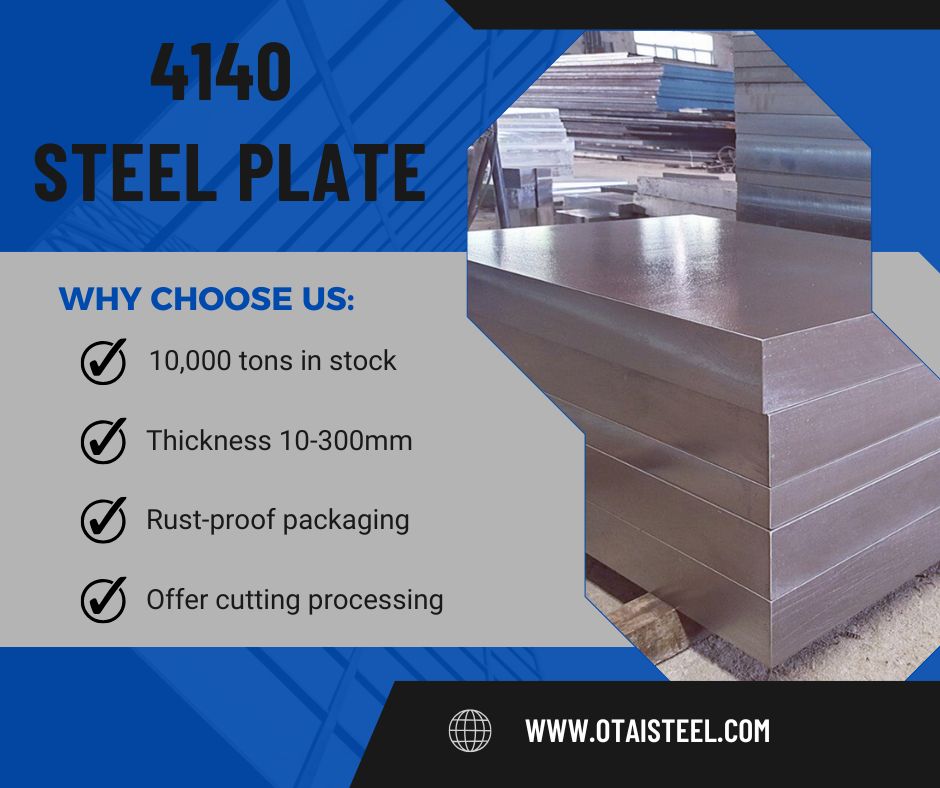
If you’re working in a machine shop or sourcing materials for precision parts, you’ve probably asked yourself:

“How machinable is 4140 steel?”
“Can I machine it in hardened condition?”
“Will it wear down my tools too fast?”

You’re not alone. At Otai, we get these questions all the time from CNC shops, gear manufacturers, and toolmakers. So here’s a straight answer—based on real-world experience, not just textbook specs.

Let’s dive into the machinability of 4140 steel, and how to get the best out of it.


🔧 What Is 4140 Steel?

Before we talk about cutting tools and feed rates, let’s recap what makes 4140 alloy steel so popular in machining industries:

  • A chromium-molybdenum low-alloy steel

  • Used for shafts, gears, bolts, mold bases, and die blocks

  • Available in annealed, normalized, or quenched & tempered (Q&T) conditions

  • Pre-hard 4140 (HRC 28–32) is especially popular for tooling parts

In short, it’s tough, strong, and heat treatable—but how easy is it to machine?


⚙️ Is 4140 Steel Easy to Machine?

The answer:
Moderately easy—if you use the right tools and settings. 🛠️

Compared to mild steels like 1018 or 1045, 4140 steel machinability rating is around 55% in annealed form. It’s harder, slightly more “gummy” at low speeds, and can be tool-wearing when not properly managed.

Still, it’s miles ahead of harder grades like tool steels or stainless.


📊 Machinability Comparison Table

Material Condition Machinability Rating* Notes
1018 Carbon Steel Annealed 100% (baseline) Very easy to cut
1045 Carbon Steel Annealed 65% Free-cutting, low tool wear
4140 Alloy Steel Annealed 55% Moderate—watch feed & temp
4140 Alloy Steel Q&T (HRC 28–32) 45–50% Cleaner chips, better finish
4140 Alloy Steel Q&T (HRC 38–42) 30–35% Carbide tools a must
H13 Tool Steel Annealed 25–30% Very tough to machine

* According to SAE J300 & internal Otai client data


🛠️ Pro Tips: How to Improve Machining Performance

If you’re planning to machine 4140 prehard steel, here are some tips based on industry best practices and what our clients tell us works best:

🔪 1. Use Coated Carbide Inserts

Prefer TiAlN or TiCN coatings. These reduce wear and allow higher cutting speeds, especially when roughing.

🌀 2. Optimize Your Speeds & Feeds

  • For roughing, try 70–100 SFM (21–30 m/min)

  • For finishing, 100–140 SFM (30–42 m/min)

  • Keep feed rate moderate: 0.15–0.3 mm/rev

  • Avoid low speeds—they cause built-up edge and dull tools faster

💦 3. Flood It with Coolant

Use high-pressure coolant to flush chips and control cutting temperature. Overheating leads to premature tool failure.

🔄 4. Plan Pre-Hard Machining Steps

Machine all features (slots, threads, bores) before nitriding or further hardening. After 40+ HRC, only grinding or EDM will work.

🔍 5. Monitor Tool Wear

Tool wear increases sharply with improper setup. Watch for:

  • Flank wear on inserts

  • Chip color turning blue or black (too hot)

  • Chatter during contour cutting (loose setup)


🧪 Annealed vs Quenched & Tempered: What Works Best?

Condition Machinability Surface Finish Tool Life Chip Control
Annealed Easier Fair Medium Gummy chips
Q&T (28–32 HRC) Moderate Excellent Longer Clean breaks
Q&T (38–42 HRC) Tougher Good Shorter Needs sharp inserts

🧠 Expert Tip: For CNC turning or high-precision milling, most shops prefer 4140 Q&T around HRC 30—less gummy, better dimensional accuracy.


🏭 Real Case: CNC Gear Hub Production in Poland

A customer in Poland was making 4140 Q&T gear hubs with both inner spline and outer flanges.

Initial setup used generic carbide tools with medium feed. They faced:

  • 🔧 Short tool life

  • 🌀 Poor chip evacuation

  • ⏱️ High cycle time

After consulting with our team, they upgraded to multi-layer TiAlN inserts and adjusted the feed and coolant flow.

Outcome:

  • Tool change interval increased by 40%

  • Surface finish improved to Ra 1.0–1.2

  • Machining time per part reduced by 23%

🎉 Sometimes, better machining starts with better material + process matching.


🧰 Recommended Applications for 4140 in Machining

🔩 4140 round bar for gear manufacturing
🛠️ 4140 for CNC shafts & custom bushings
🧰 4140 alloy steel for mold bases
🚜 4140 Q&T blanks for agricultural tools
⚙️ 4140 in hydraulic piston rods and drive components

These are high-stress parts where machinability + strength really matter.


🏭 Why Otai Steel Is CNC Shops’ Favorite

Whether you’re roughing annealed bar or finishing Q&T shafts, we help you get it right—fast.

✅ 10,000+ tons of 4140 alloy steel in stock
📦 Available in annealed, Q&T, or normalized conditions
📐 Precision cut-to-length & grinding service
🧪 Full UT and chemical test reports with every order
📞 Expert suggestions for the best 4140 condition for your machining setup
🌍 Fast global shipping to 30+ countries
🛠️ Pre-machined or nitriding-ready parts available on request

📧 jack@otaisteel.com
📱 WhatsApp: +8676923190193

Need 4140 steel for gear hubs, shafts, or fixtures?
Let us recommend the perfect machinable grade based on your drawings!


💬 FAQs – 4140 Steel Machinability

Q1: Can I machine 4140 in hardened condition (HRC 40+)?
Yes, but only with CBN or ceramic tools. Most shops prefer to machine before final hardening.

Q2: Which is easier to cut: 4140 vs 1045 steel?
1045 is easier to machine, but 4140 is stronger and more wear-resistant—especially after Q&T.

Q3: Can I machine after nitriding?
No. Once nitrided, 4140 is too hard (HRC 60–70) for normal cutting. Only grinding or EDM is effective.

Q4: Does heat treatment affect machinability?
Absolutely. 4140 Q&T (HRC 28–32) machines cleaner than annealed due to chip control.

Q5: What is the best cutting tool for 4140 steel?
Coated carbide inserts (like TiAlN) offer the best performance for most Q&T jobs.

Q6: Can you supply pre-machined 4140 steel blanks?
Yes! We offer pre-cut, rough milled, and semi-finished 4140 parts ready for finish machining.

0 0 Continue Reading →

Nitriding 4140 Steel: What to Expect

Nitriding 4140 Steel: What to ExpectNitriding 4140 Steel: What to Expect
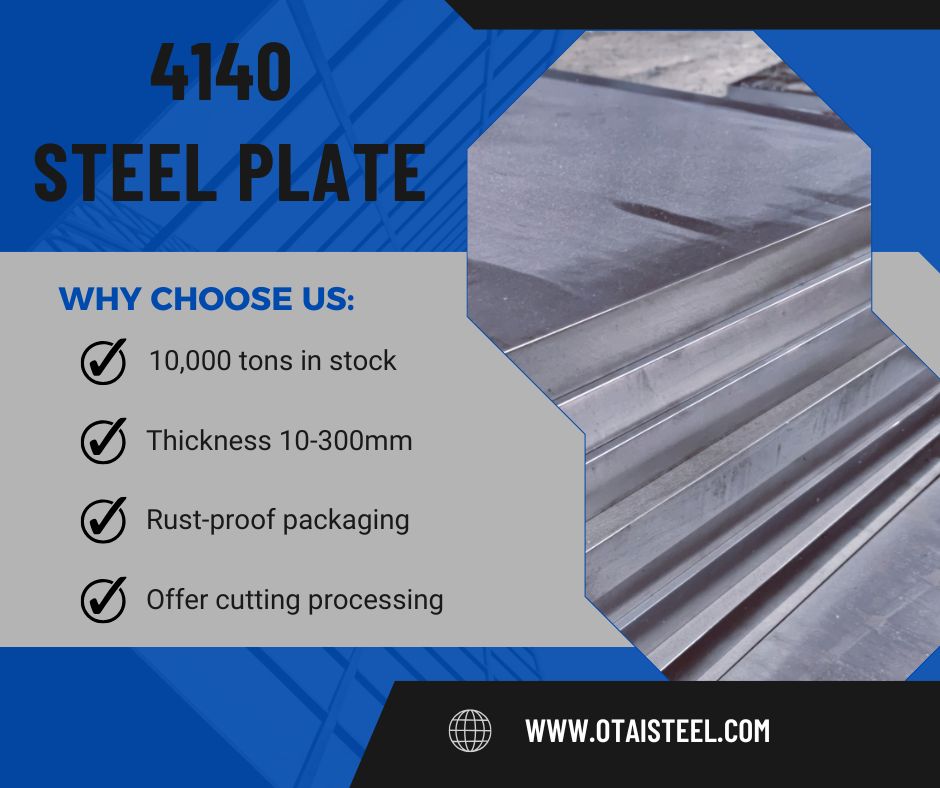
When you’re working with 4140 steel, you’re already using one of the most trusted alloy steels for strength and toughness. But if your parts face continuous wear, frequent friction, or fatigue loading, the real magic comes with one process:

👉 Nitriding.

It’s the go-to heat treatment to create ultra-hard surfaces without sacrificing the toughness of your core material. But how does it actually work for 4140? What nitriding method is best? And when should you consider it over other treatments?

Let’s break it all down with practical insight, real data, and a touch of steel shop wisdom. 🔍


🧬 What Is Nitriding and Why It Works So Well on 4140

Nitriding is a low-temperature thermochemical heat treatment. Nitrogen is introduced to the surface of the steel, where it reacts with alloying elements (like chromium, molybdenum, and vanadium) to form hard nitrides.

✅ The result:

  • Super-hard surface layer (up to 70 HRC)

  • Outstanding wear and fatigue resistance

  • No distortion, since there’s no phase transformation like in quenching

For 4140 steel, which already contains the right alloying elements, nitriding is an ideal surface treatment.


🔬 How Nitriding Changes 4140 Steel

Property Before Nitriding (Q&T) After Nitriding
Surface Hardness HRC 28–32 HRC 60–70
Core Hardness HRC 28–32 Unchanged
Wear Resistance Moderate Excellent
Fatigue Resistance Good Greatly Improved
Case Depth N/A 0.3–0.7 mm typical
Machinability (Post-Treat) High Difficult (after)
Distortion Risk Medium (Q&T) Very Low (nitriding)

👉 Important Note: Nitriding doesn’t soften or harden the core. That’s why pre-hardening (Q&T) is strongly recommended before nitriding 4140 steel.


🧪 Surface Microstructure: What’s Actually Happening?

When nitriding 4140 steel, the outermost layer forms compound and diffusion zones:

  1. Compound Layer (White Layer)

    • 10–30 μm thick

    • Very hard, but can be brittle

    • Excellent for wear protection

  2. Diffusion Zone

    • Extends 0.3–0.7 mm

    • Gradual hardness drop-off

    • Crucial for supporting the surface and resisting fatigue

For critical parts, many clients request controlled nitriding to limit or remove the compound layer (via polishing or post-grind), balancing wear resistance with fatigue toughness.


⚙️ Common Nitriding Methods for 4140 Steel

Method Temp Range Control Hardness Notes
Gas Nitriding 🌫️ 500–530°C Good HRC 60–65 Most common; cost-effective
Plasma Nitriding 450–550°C Excellent HRC 60–70 Precise, low distortion, eco-friendly
Salt Bath Nitriding 🧪 540–590°C Fair HRC 58–64 Fast, but messy and toxic

🔍 At Otai, we most commonly process gas nitrided 4140 steel, but we can support plasma nitriding requests through partner facilities.


🏗️ Real-World Applications of Nitrided 4140

🔩 Shafts and Spindles
Rotating equipment that needs both toughness and wear protection.

🧰 Mold Cavities and Bases
Where galling, abrasion, and repeated cycling are issues.

🚜 Hydraulic Piston Rods
Exposed to dust, pressure, and sliding movement.

⚙️ Gears and Couplings
That require fatigue resistance and dimension control.

✈️ Aerospace and Racing
Where distortion is unacceptable, and stress cycles are endless.


🔧 Customer Story: Saving a Gear Manufacturer from Failure

One of our clients in Italy was producing large 4140 gear blanks for wind turbine gearboxes. They were facing premature wear at the tooth roots after just 2 months in operation.

👉 We recommended switching from Q&T only to Q&T + gas nitriding with a controlled 0.5mm case depth.

🔩 Outcome:

  • Wear life increased by over 400%

  • No distortion after nitriding

  • Surface hardness improved from HRC 30 → HRC 66

The client now uses nitriding as a standard step in all gear-related production.


📋 Tips for Best Nitriding Results

  • Always Q&T 4140 before nitriding
    Nitriding builds on an already hardened base. Don’t skip this step!

  • Machine before nitriding
    After nitriding, surface becomes too hard to cut or drill.

  • Polish the surface to Ra ≤ 1.6 µm for best case uniformity.

  • Avoid decarburized or scaled surfaces—clean metal is key.


🏭 Why Engineers Trust Otai for Nitriding-Ready 4140

With 25+ years in the steel industry, Otai doesn’t just deliver steel—we deliver reliability. Whether you need raw bars, pre-cut blocks, or nitriding-ready blanks, we’ve got you covered:

10,000+ tons of inventory, including 4140 Q&T and annealed
🧪 UT-tested, with full chemical and mechanical certificates
✂️ Custom cut-to-size service down to ±0.05 mm tolerance
🔥 In-house Q&T, partnered nitriding options available
📦 Rust-proof bundles and export-grade packaging
📋 Third-party inspection (SGS, BV) upon request
🌍 Customers in over 30+ countries—including Thyssenkrupp, Schlumberger, Borealis

📧 jack@otaisteel.com
📱 WhatsApp: +8676923190193

Send us your part drawings or specs—we’ll suggest the best nitriding solution for your needs!


❓ FAQs – Nitriding 4140 Steel

Q1: Do I need to heat treat 4140 before nitriding?
Yes. For optimal results, always Q&T to HRC 28–32 before nitriding.

Q2: How long does nitriding take?
6 to 90+ hours depending on case depth and method. Most standard parts take 20–40 hours.

Q3: Can I grind the nitrided surface?
Light grinding is possible—but avoid removing the hardened layer unless absolutely necessary.

Q4: What’s the best method: gas or plasma nitriding?
For most industrial parts, gas nitriding is cost-effective and reliable. Use plasma for ultra-precision needs.

Q5: Can you supply nitrided 4140 to my exact dimensions?
Yes! We offer full machining + nitriding service for made-to-spec blanks or shafts.

0 0 Continue Reading →

Normalizing 4140 Steel: When and Why

Normalizing 4140 Steel: When and WhyNormalizing 4140 Steel: When and Why

Is normalizing really necessary for 4140 steel?

If you’ve ever worked with 4140 alloy steel, especially after forging or heavy machining, you’ve probably wondered:

“Should I normalize this before quenching?”
“Will normalizing improve my machining tolerances?”
“Isn’t it just an extra step?”

You’re not alone—we get these questions from buyers and engineers every week.

The truth is, normalizing 4140 steel is one of the most underrated heat treatments, especially if you’re aiming for dimensional stability, improved machinability, or preparing for quench-and-temper hardening.

Let’s break down exactly what it is, how it works, and why it could save your project from costly distortions or inconsistent performance.


🌡️ What Is Normalizing (And What Makes It Different)?

Normalizing is a heat treatment process that brings steel to its austenitizing temperature—typically 870–925°C (1600–1700°F) for 4140 steel—followed by air cooling in still air.

Unlike annealing (slow furnace cooling), normalizing cools the steel faster, resulting in:

  • A finer grain structure

  • A slight increase in hardness and strength

  • Better microstructural uniformity

👨‍🏭 It’s often used as an intermediate step to improve how the steel responds in the next heat treatment phase (like quenching or nitriding).


🧪 What Does Normalizing Actually Do to 4140?

Here’s what’s happening inside the material:

  • 🌾 Refines coarse grains left behind from hot rolling or forging

  • 🔄 Equalizes grain size across the entire cross-section, especially in thicker sections

  • 🧘‍♂️ Relieves internal stresses introduced during cold working, machining, or welding

  • 🧼 “Cleans up” the microstructure for better predictability in hardness or toughness

For 4140—which already contains chromium and molybdenum to boost strength—normalizing ensures those elements are evenly distributed, so you don’t get hard and soft spots later on.


📊 4140 Steel Heat Treatment Comparison Table

Let’s see how normalizing stacks up next to other common treatments:

🔧 Treatment Cooling Method Hardness (HB) Machinability Main Use
Annealing Furnace cool 160–197 Excellent Softening for cold forming, max ductility
Normalizing Still air cool 197–235 Very good Refinement + stress relief
Quenching + Tempering Oil + furnace 280–360 (HRC 28–40) Fair to poor High strength, wear-resistant components
Nitriding Gas or plasma 900–1100 surface HV Good (post-machining) High surface hardness, fatigue resistance

Pro tip: Want good machinability now and high strength later? Normalize first, machine, then quench and temper.


🔩 When You Should Normalize 4140 Steel (and When You Shouldn’t)

Normalize If:

  • Your parts are forged, hot rolled, or welded

  • You’re seeing warping, twist, or distortion during machining

  • You’re planning to quench and temper but need consistent results

  • You want to ensure grain refinement across thick cross-sections

  • You’re nitriding and want a clean, stable base material

🚫 Skip It If:

  • You’re buying pre-hardened 4140 QT (quench + tempered) and don’t plan to re-heat treat

  • Your application doesn’t demand tight tolerances or surface finishes

  • You’re using 4140 in low-stress, low-precision parts


⚙️ Real-World Example: Why a Client in Europe Normalized First

One of our clients in Germany produces large hydraulic piston rods from forged 4140. Initially, they went straight from forging to machining and quenching—but experienced uneven hardness and cracks in final inspection.

We recommended a normalizing step after forging, followed by rough machining, and then quench + temper.

✅ Result:

  • 30% reduction in machining scrap

  • More consistent hardness (±2 HRC)

  • Better fatigue life in long-term tests


🔬 Normalizing Process for 4140 Steel (Step-by-Step)

Here’s what we typically do in our in-house heat treatment:

  1. Heat to 870–925°C (depending on section size)

  2. Hold 30–90 minutes, depending on thickness (usually 1 min/mm)

  3. Cool in still air to room temperature

  4. Test microstructure and hardness to confirm refinement

Optional: Add shot blasting or pickling afterward for a clean surface before machining.


🏭 Why Choose Otai Steel for Normalized 4140?

With Otai, you don’t just get steel—you get precision, speed, and peace of mind. 💼

Here’s what makes us different:

  • 🏗️ 10,000+ tons of 4140 and alloy stock, always available

  • 📏 Thickness range from 6mm to 300mm, cut-to-size

  • 🔥 In-house normalizing, Q+T, and nitriding services

  • 🧪 Includes full testing: UT, composition, hardness

  • 📦 Export packaging in rust-proof bundles or wooden crates

  • ✅ Trusted by Thyssenkrupp, Borealis, Schlumberger

  • ✈️ Fast delivery across Europe, Americas, Asia, Middle East

📧 Email: jack@otaisteel.com
📱 WhatsApp: +8676923190193

Want a fast quote or custom heat treatment suggestion? Just send us your specs or drawings—let’s get started!


💬 FAQs – Normalizing 4140 Steel

Q1: Does normalizing change the mechanical properties of 4140?
Yes—slightly higher hardness and yield strength compared to annealed, but not as much as Q+T.

Q2: Can I machine 4140 right after normalizing?
Yes! It’s one of the best states for machining—clean, stable, and not too hard.

Q3: What’s better: normalizing or annealing?
Depends on your goal. Annealing = maximum softness. Normalizing = strength + uniformity.

Q4: Can I get 4140 normalized and pre-cut?
Absolutely. We can cut to size and deliver normalized blanks ready for your machines.

Q5: How long does normalizing take?
Heating + soaking + cooling = typically 2–4 hours depending on size. We offer quick turnaround.

0 0 Continue Reading →

What’s the Deal with 4140 Steel Black Oxide?
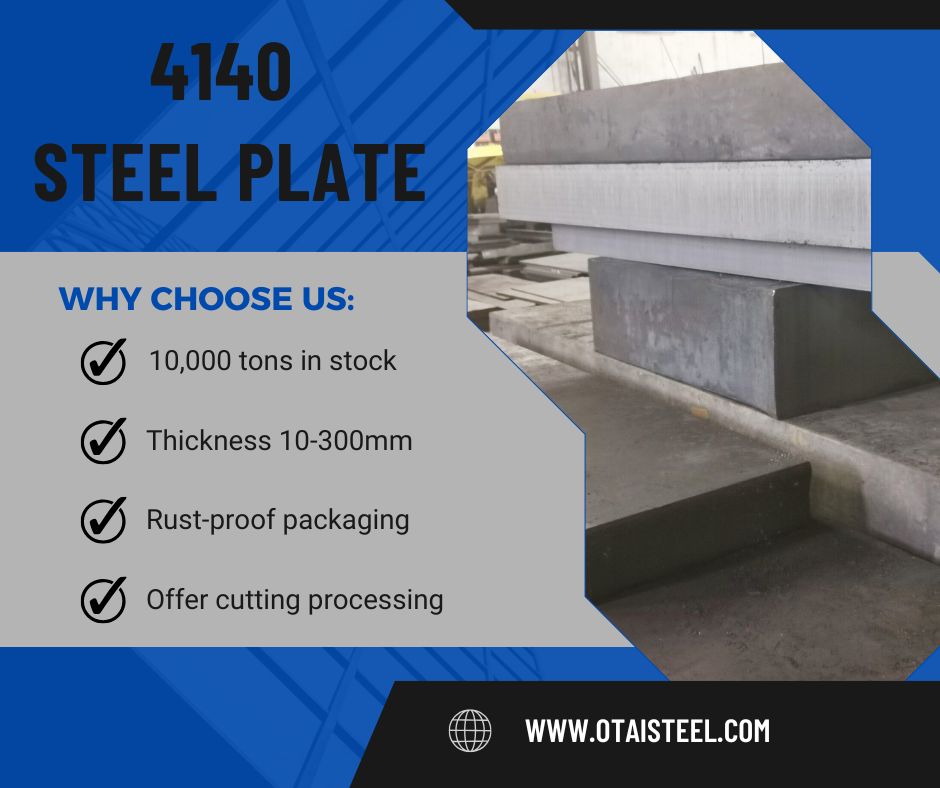
What’s the Deal with 4140 Steel Black Oxide?What’s the Deal with 4140 Steel Black Oxide?

If you’re working with 4140 alloy steel, chances are you already love its strength, toughness, and heat-treatability. But did you know that applying a black oxide finish can make it even better?

Whether you’re building high-load shafts, firearm components, or custom bolts, 4140 steel black oxide offers the perfect combo of performance, protection, and appearance—without sacrificing precision. 🎯

Let’s dive into the real-world value of black oxide on 4140—and whether it’s right for your next job.


🌑 What Is Black Oxide Coating on 4140 Steel?

Black oxide is a chemical conversion coating—not a paint or plating. It reacts with the steel’s surface to form a dark, magnetite (Fe₃O₄) layer that’s:

  • ⚫ Only about 1 micron thick (no dimensional change!)

  • 🛡️ Corrosion-resistant when sealed with oil or wax

  • ⚙️ Low-friction and ideal for parts that slide or rotate

  • ✨ Aesthetic and professional looking

Unlike zinc plating or phosphating, black oxide doesn’t build up or flake off. It’s fully integrated into the steel surface—making it a favorite for high-precision machined parts.


🔍 Why Black Oxide Works Especially Well on 4140

4140 steel already has a tough, wear-resistant structure, thanks to its chromium and molybdenum alloy content. Adding a black oxide finish enhances that by:

  • 🧲 Improving oil retention — the porous finish soaks up lubricants

  • 💪 Boosting surface durability — helps resist galling and micro-wear

  • 🖤 Reducing glare — ideal for optical and firearm components

  • 🧼 Preventing rust in indoor and moderately humid environments

  • 💸 Keeping costs low — far more affordable than plating or nitriding

👉 And because 4140 is often used in parts that require heat treating, black oxide is a smart follow-up finish—it won’t crack, peel, or interfere with the heat treatment you’ve already done.


📊 4140 Steel With vs. Without Black Oxide

Attribute 4140 Steel (Raw) 4140 Steel (Black Oxide)
Appearance Dull silver/gray Sleek matte black 🖤
Corrosion Resistance Fair Good (with post-seal)
Surface Lubricity Moderate Excellent 🛢️
Dimensional Impact None None
Heat Resistance High High (no flaking)
Cost Base price Slight increase (cost-effective)
Common Use Cases Machined parts Precision + exposed components

⚠️ Common Misconceptions About 4140 Steel Black Oxide

Let’s bust a few myths before we go further:

“Black oxide makes 4140 stronger.”
Not quite. It doesn’t improve core strength—it enhances surface performance.

“It’s just for looks.”
Nope. While it does look great, black oxide also reduces wear and slows down corrosion in real industrial use.

“It’s too thin to help.”
That 1-micron layer can double or triple the lifespan of some parts—especially if combined with proper lubrication.


⚙️ Real-World Applications: Where This Finish Shines

💬 Client case:
One of our U.S. aerospace customers needed 4140 machined bushings that wouldn’t glare under inspection lights and wouldn’t corrode in warehouse storage. After switching to 4140 black oxide with oil seal, their parts stayed rust-free for over a year—and they loved the finish too.

Industry Common Black Oxide Parts
🚗 Automotive Axle pins, shifter forks, bolts
🛢️ Oil & Gas Drill collars, rod ends, control arms
🛠️ Industrial Shafts, couplings, bushing sleeves
🔫 Firearms & Defense Receivers, triggers, scope mounts
🧰 Custom Fabrication Fasteners, brackets, decorative fittings

🔧 How the Black Oxide Process Works on 4140 Steel

At Otai Special Steel, here’s what we do when you request black oxide:

  1. 🧽 Surface Preparation – We degrease and clean thoroughly—because black oxide can’t bond to dirty metal.

  2. 🔥 Chemical Conversion – Parts are dipped in a heated alkaline salt bath (~285°C) that chemically reacts with 4140 to form black magnetite.

  3. 💦 Water Rinse & 🛢️ Sealing – After rinsing, we soak the part in oil or wax to seal pores and boost corrosion resistance.

  4. 🔍 Final Inspection – Every part is checked for uniform color and proper finish before packing.

This entire process adds no measurable thickness—perfect for tight-tolerance parts like bushings, gears, or threaded shafts.


🏭 Why Choose Otai for 4140 Steel Black Oxide?

At Otai, we make it easy to get the right steel with the right finish—fast.
We’re not just a warehouse. We’re your precision steel partner. 👇

✨ What We Offer:

  • 10,000+ tons of alloy steel in stock

  • ✂️ Cut-to-size 4140 steel: 6mm–300mm thickness

  • 🔥 In-house quenching, tempering, and black oxide treatment

  • 🧪 Full testing: UT, hardness, chemical composition

  • 📦 Export-ready packaging: bundles or wooden crates

  • 📋 Optional third-party inspection (SGS, BV, etc.)

  • ✈️ Fast global delivery (3–5 days for stock items)

  • 💬 Engineering support & material advice

📧 jack@otaisteel.com
📱 WhatsApp: +8676923190193

Ask for a quote, share your drawing, or get a quick consult—we’ll reply same-day. 📩


💬 FAQs – 4140 Steel Black Oxide

Q1: Will black oxide affect my tolerances?
No. The layer is ultra-thin (~1 micron) and doesn’t alter critical dimensions.

Q2: Can I order pre-treated 4140 steel from Otai?
Yes! Just let us know your specs. We offer black oxide + heat-treated bars or blanks.

Q3: Is this coating enough for outdoor use?
With oil sealing, it handles mild outdoor exposure well. For marine or chemical use, consider zinc or phosphate alternatives.

Q4: What finish do I get—shiny or matte?
Matte black. It’s non-reflective, clean, and professional—great for exposed mechanical parts.

Q5: What’s the lead time?
For stocked sizes: typically 3–5 days after your PO. For processing + treatment: 7–12 days depending on batch size.

0 0 Continue Reading →

What’s the Carbon Content in 4140 Steel

What’s the Carbon Content in 4140 SteelWhat’s the Carbon Content in 4140 Steel

You’ve probably heard a lot about 4140 steel—it’s a go-to material in industries where strength and toughness are a must. But here’s the burning question: What’s the deal with carbon in 4140 steel? Why does it matter so much? 🤷‍♂️ Well, let’s break it down and find out how this small percentage of carbon can make a huge difference! 💥

🧐 So, What’s the Carbon Content in 4140 Steel?

Let’s cut to the chase: 4140 steel contains between 0.38% and 0.43% carbon. Sounds pretty specific, right? But here’s the kicker—this small amount of carbon is what gives 4140 the perfect balance of strength, toughness, and machinability. 😎

Too much carbon, and the steel becomes brittle. Too little, and it’s not strong enough. But 4140 steel? It’s just right—giving you hardness when you need it, and toughness to handle the pressure. 💪


🔥 Why Does Carbon Matter in 4140 Steel?

Think of carbon like the spice in a recipe—too much or too little can mess things up, but just the right amount brings everything together. 🍲 In 4140 steel, carbon plays a key role in giving the material strength and hardness, while still keeping it tough enough to avoid cracking under stress. 💥

Let’s break down how carbon affects 4140 steel:

Feature Low Carbon Steel 4140 Steel High Carbon Steel
Carbon Content < 0.30% 0.38% – 0.43% > 0.50%
Hardness Low Medium (28-32 HRC) High
Strength Low High (850-1000 MPa) Very High
Toughness High Good to Moderate Low
Machinability Very Easy Moderate Difficult
  • Strength: With its 0.38%-0.43% carbon, 4140 steel is strong enough to withstand heavy-duty tasks like automotive parts, gears, and machinery components. It’s like the unsung hero that holds everything together in the toughest conditions. ⚙️
  • Hardness: After heat treatment, 4140 steel reaches 28-32 HRC, making it resistant to wear but not overly brittle—so it can stand up to abrasion without cracking under pressure. 🔧
  • Toughness: It’s tough, but not indestructible. 4140 can handle the shock and impact that come with high-stress situations, making it ideal for parts like suspension components and drivetrain parts in the automotive industry. 🚗💨
  • Machinability: Here’s the best part—4140 steel is actually pretty easy to machine compared to some other alloys. It’s tough but still manageable with the right tools, making it great for custom parts and precision machining. 🔨

✨ Heat Treatment Magic: How Carbon Changes Everything

Here’s where the real transformation happens. When you add heat treatment to the mix, carbon content in 4140 steel takes it to the next level. 💥

  1. Quenching: The steel is heated to a high temperature and then cooled rapidly—this is where the carbon really shines. The steel becomes harder and more resistant to wear. ⚡
  2. Tempering: After quenching, 4140 steel is reheated to a lower temperature to reduce brittleness. This ensures the steel is strong but still tough enough to absorb shock without cracking. 💎

This is why 4140 is used in high-performance components that need to withstand the toughest conditions, like gears, axles, and drill collars in industries like automotive and oil & gas. 🌍


🤔 What Happens If You Add More Carbon?

Let’s talk about more carbon for a second—because, yes, more is not always better. Here’s what happens:

  • Too much carbon: The steel gets harder, but it also becomes more brittle and prone to cracking under impact. That’s why high-carbon steels are great for cutting tools or blades but not ideal for parts that undergo a lot of stress or impact. ⚔️
  • Too little carbon: The steel becomes softer and lacks the strength needed for demanding applications. 😕

4140 steel has the perfect amount of carbon, making it a goldilocks steel—not too hard, not too soft, just right for high-performance parts that need to last. 🎯


🌟 Where Does 4140 Steel Really Shine?

Thanks to its carbon content and versatility, 4140 steel is used across a wide range of industries. Here are just a few places where it truly shines:

Industry Applications
Automotive Drive shafts, suspension components, gears
Aerospace Aircraft parts, structural components
Oil & Gas Drill collars, pump shafts, tool joints
Industrial Machinery Hydraulic cylinders, machine tool components
Construction Heavy-duty machinery, lifting equipment

In the automotive world, 4140 steel is used for parts like drive shafts, gears, and axles that need to stand up to high levels of stress and wear. It’s like the unsung hero in your car’s drivetrain, helping you get from A to B without fail. 🚙💨

In oil and gas, where equipment is subjected to extreme conditions, 4140 steel is used in drill collars and tool joints. It’s tough enough to handle the intense pressures and abrasive materials encountered deep underground. ⛏️


😎 Why Choose Otai Steel for Your 4140 Steel Needs?

When it comes to 4140 steel, you want a supplier you can trust to deliver high-quality, reliable material that meets your exact needs. Here’s why Otai Special Steel is the best choice for your project:

  • Massive Stock: Over 10,000 tons of alloy steel in inventory—we’ve got what you need. 📦
  • Custom Sizes: Cut-to-size services available, tailored to your specific project requirements. 📏
  • Precision Heat Treatment: We provide custom heat treatment for enhanced steel performance. 🔥
  • Top-Notch Testing: UT testing and chemical composition testing ensure high-quality steel every time. 🧪
  • Fast Global Shipping: We ship worldwide with third-party inspections like SGS for peace of mind. ✈️
  • 25+ Years of Experience: Trusted by leading companies like Thyssenkrupp, Borealis, and Schlumberger. 🌏

At Otai, we don’t just supply steel; we provide solutions. Whether you need 4140 steel for a small project or large-scale production, we’re here to support you every step of the way. 😎

📧 Contact us for a quote: jack@otaisteel.com
📱 WhatsApp: +8676923190193


💬 FAQs – Carbon Content in 4140 Steel

1. What is the carbon content in 4140 steel?
4140 steel contains 0.38% to 0.43% carbon, giving it the perfect balance of strength, toughness, and machinability. 🔧

2. How does carbon affect 4140 steel?
Carbon enhances 4140 steel’s strength, hardness, and wear resistance, while ensuring it remains tough enough for high-stress applications. 💪

3. Is 4140 steel difficult to machine?
Not at all! While it’s tougher than low-carbon steels, 4140 steel is still relatively easy to machine, especially with proper heat treatment. 🛠️

4. Can you provide 4140 steel in custom sizes?
Absolutely! We offer cut-to-size, heat-treated, and machined 4140 steel to meet your exact specifications. 📏

0 0 Continue Reading →