Skip to Content

Category Archives: Blog

AISI 4140 Alloy Steel Data Sheet: What You Really Need to Know

AISI 4140 Alloy Steel Data Sheet: What You Really Need to KnowAISI 4140 Alloy Steel Data Sheet: What You Really Need to Know

If you’re looking for detailed technical information on AISI 4140 alloy steel, you’re in the right place.

Engineers, manufacturers, and procurement teams often reach out to us with questions like:

  • “What are the exact mechanical properties of 4140?”
  • “Can I use 4140 for heat-treated components?”
  • “Do you have a 4140 data sheet I can use for design?”

Here’s a full breakdown of the most important technical data—and how to use it for real-world applications.


What Is AISI 4140 Alloy Steel?

AISI 4140 is a chromium-molybdenum alloy steel known for its high tensile strength, good fatigue resistance, and excellent toughness. It belongs to the SAE-AISI steel family and is widely used in automotive, oil & gas, toolmaking, and heavy equipment manufacturing.

It’s one of the most popular grades in the 41xx series—and for good reason. You can machine it, heat treat it, and rely on it for demanding structural parts.


Mechanical Properties: AISI 4140 Alloy Steel (Heat Treated Condition)

Property Typical Value
Tensile Strength 850–1000 MPa
Yield Strength ~655 MPa
Elongation (% in 50 mm) ~25%
Hardness (HRC) 28–32 (quenched & tempered)
Impact Toughness (Charpy V) Excellent (at low temp)
Fatigue Strength Moderate to High
Modulus of Elasticity 205 GPa
Poisson’s Ratio 0.29
Density 7.85 g/cm³

Note: These values are typical for 4140 in the quenched and tempered condition. For annealed or normalized states, strength and hardness will be lower.


Chemical Composition of AISI 4140

Element Content (%)
Carbon (C) 0.38 – 0.43
Manganese (Mn) 0.75 – 1.00
Chromium (Cr) 0.80 – 1.10
Molybdenum (Mo) 0.15 – 0.25
Silicon (Si) 0.15 – 0.35
Sulfur (S) ≤ 0.040
Phosphorus (P) ≤ 0.035

This specific chemistry gives 4140 its hardenability, good wear resistance, and ability to perform well after heat treatment.


Heat Treatment Guidelines for 4140 Alloy Steel

One of the most important benefits of 4140 steel is its ability to respond to various heat treatments:

Process Typical Range / Notes
Annealing 800–850°C, slow cool in furnace
Normalizing 870–900°C, air cool
Quenching 830–870°C, oil or water quench
Tempering 400–650°C depending on required hardness
Nitriding (Optional) For surface hardness without distortion

You can achieve surface hardness around HRC 50–55 through nitriding, without affecting core ductility—ideal for wear-prone components like shafts or gears.


Machinability and Weldability

  • Machinability: Fair to good, especially in the annealed condition. In hardened condition, use carbide tools and lower speeds.
  • Weldability: Can be welded with proper preheating (150–260°C) and post-weld heat treatment to reduce cracking risk.

We often help clients with custom-cut 4140 steel that’s pre-machined and pre-heat-treated to save time and reduce costs in production.


Typical Applications of AISI 4140 Alloy Steel

Industry Application Examples
Automotive Drive shafts, crankshafts, steering knuckles
Oil & Gas Drill collars, mud motors, downhole tools
Tooling Molds, die holders, clamp blocks
Aerospace (non-flight) Ground support components
Machinery Gears, axles, tie rods, pins


Stock Sizes and Services from Otai Steel

We stock a wide range of AISI 4140 alloy steel plates and bars in the following formats:

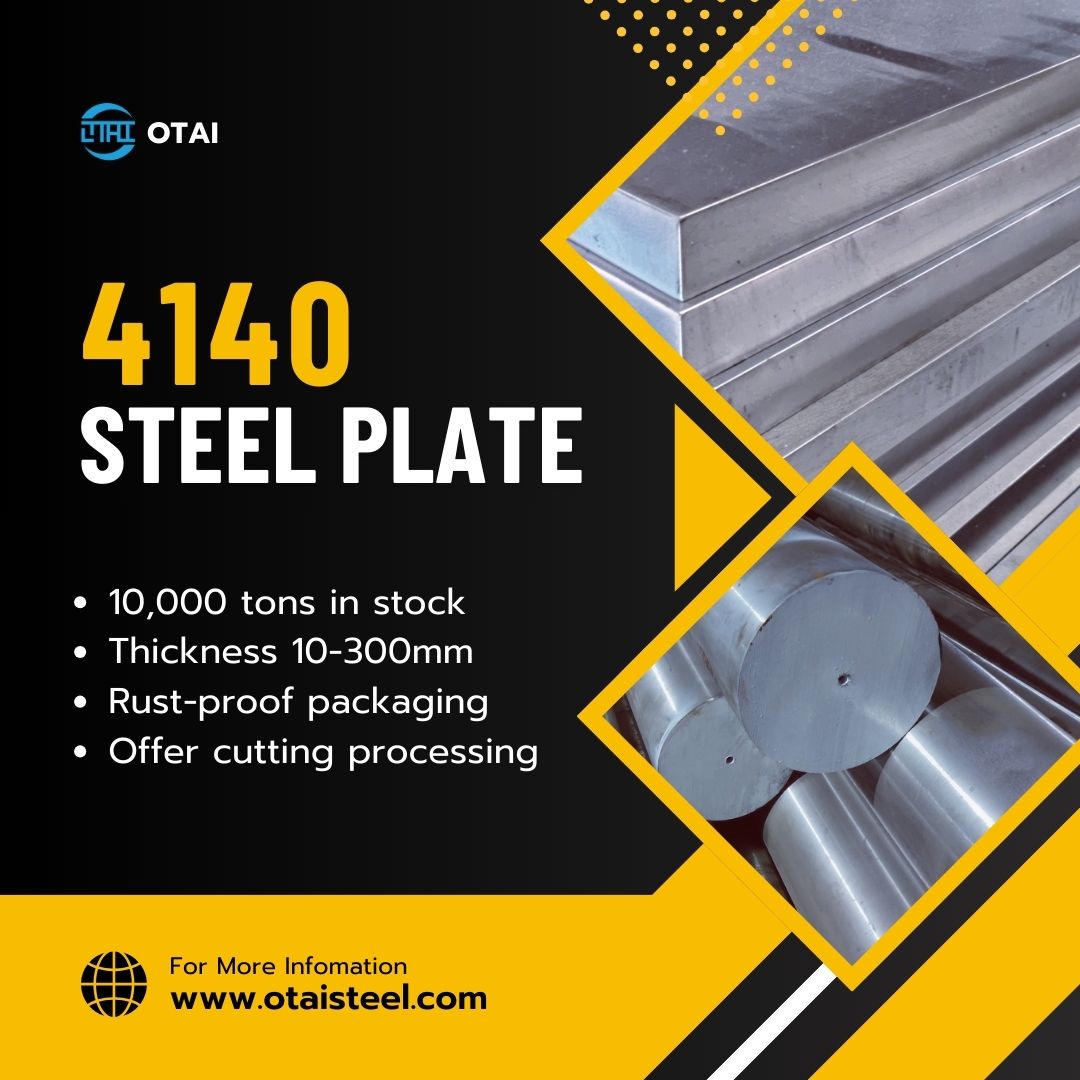
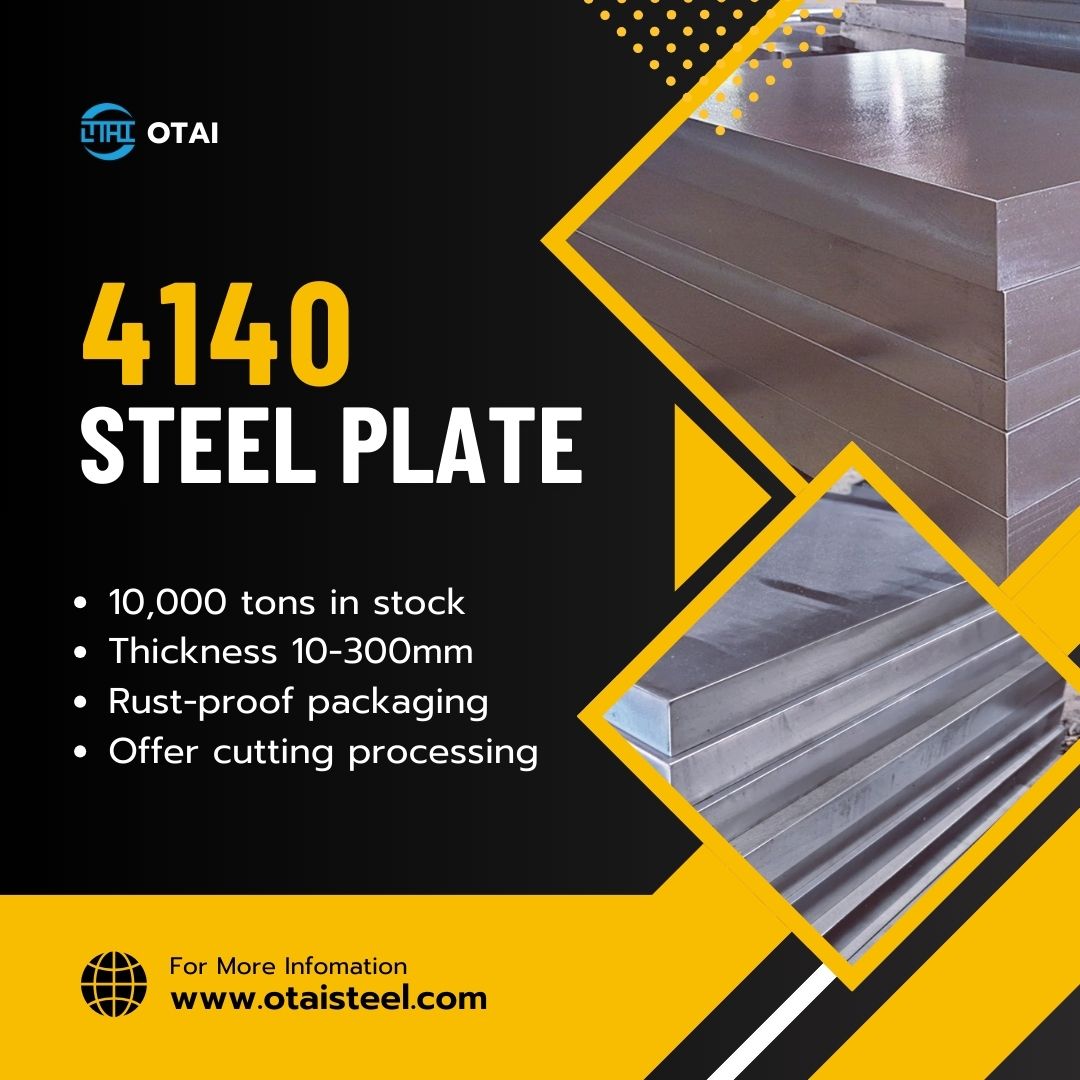
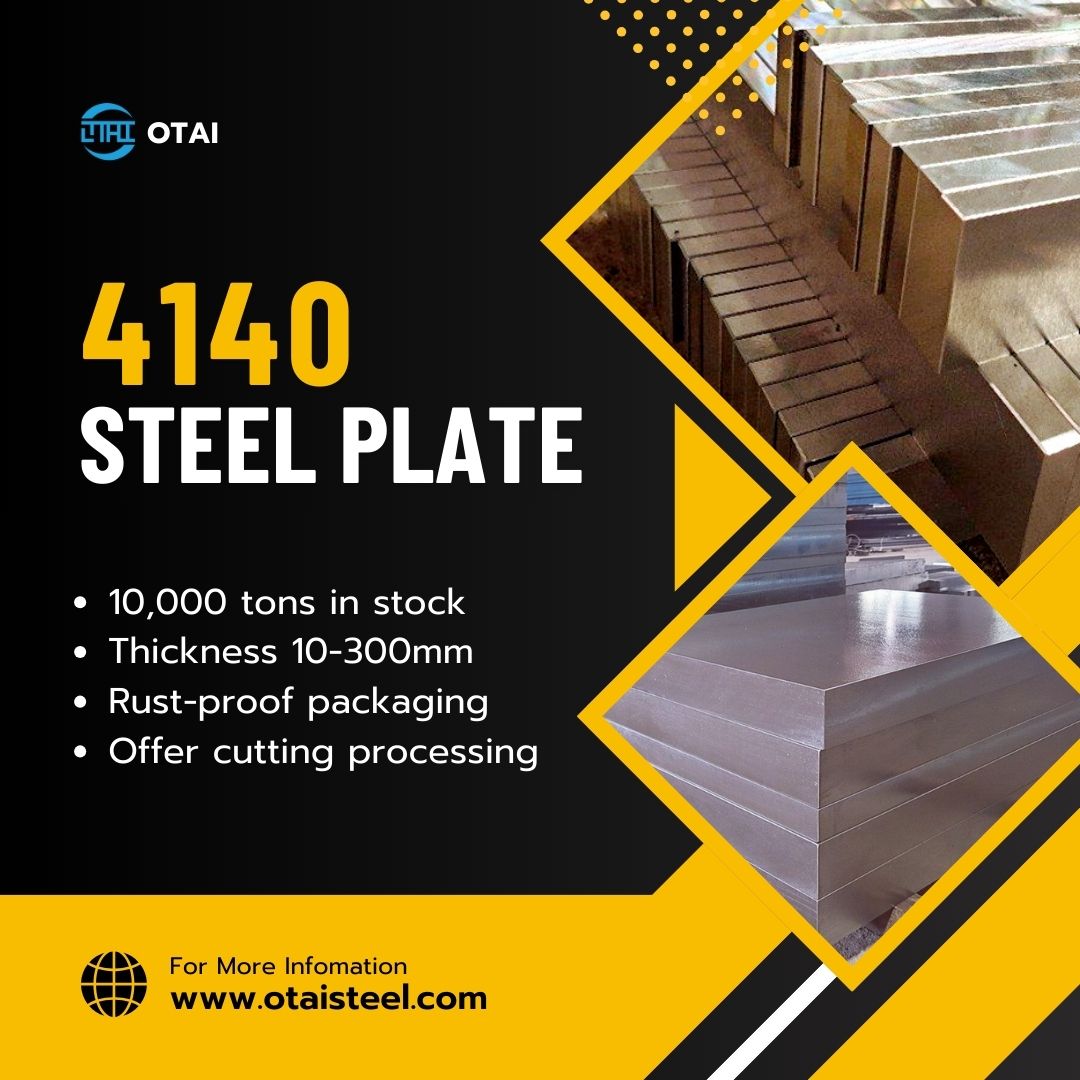
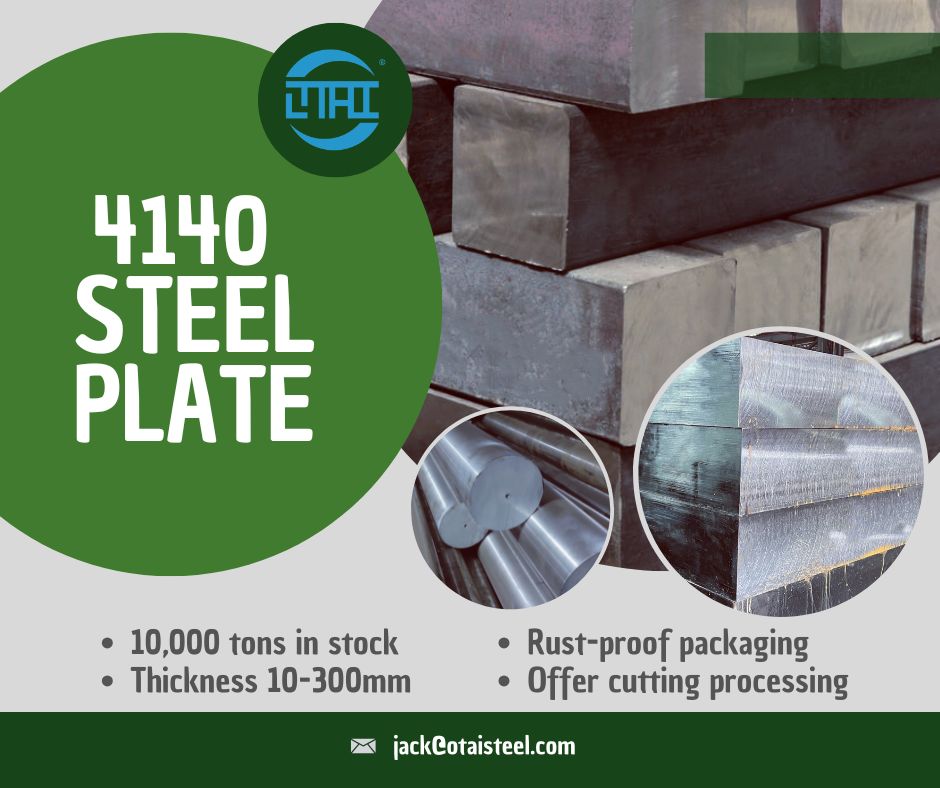
  • Plate Thickness: 6mm to 300mm
  • Round bar, flat bar, and block shapes
  • Cut-to-size service with tight tolerances
  • Optional heat treatment: annealed, quenched & tempered, or nitrided
  • UT tested, SGS third-party inspection available
  • Rust-proof packaging (wooden box or bundles)
  • Fast delivery from over 10,000 tons in inventory

Why Choose Otai Special Steel for 4140 Alloy Steel?

With over 25 years of experience, Otai Steel is your reliable sourcing partner for AISI 4140:

  • High inventory availability with mill-direct pricing
  • ISO-certified quality control and custom documentation
  • Engineering support to help match the right condition to your application

Need a Quote or Expert Advice?

We’re here to help. Whether you need technical clarification or a fast quote, our team is ready.

📧 jack@otaisteel.com
📱 WhatsApp: +8676923190193

Let us know your size, condition, and spec requirements, and we’ll recommend the best solution.


FAQs – AISI 4140 Alloy Steel Data Sheet

  1. Is AISI 4140 the same as SAE 4140 or EN19?
    Yes, they refer to the same base material. SAE 4140 is the U.S. designation; EN19 is the European equivalent.
  2. Can you provide 4140 with specific heat treatment?
    Yes. We offer Q&T, annealed, or nitrided conditions upon request.
  3. Do you offer third-party inspection or mill certs?
    Absolutely. We can provide SGS, BV, or customer-nominated inspection and full MTC.
  4. What’s the delivery time for 4140 steel?
    For stock sizes: usually 3–5 working days worldwide.
  5. Can I request a cut-to-size 4140 plate or block?
    Yes! We provide precision cut-to-size and grinding per your drawing.
0 0 Continue Reading →

4140 Steel vs 1045 Steel: What’s the Real Difference?

4140 Steel vs 1045 Steel: What’s the Real Difference?4140 Steel vs 1045 Steel: What’s the Real Difference?

Are 4140 Steel and 1045 Steel the Same Thing?

A lot of buyers, engineers, and manufacturers often ask:

  • “Is 4140 steel the same as 1045 steel?”

  • “Can I use 4140 steel instead of 1045 for my application?”

The short answer? No, they are not the same thing.

Here’s why:

4140 steel is a chromium-molybdenum alloy steel known for its excellent toughness, strength, and resistance to wear. It’s commonly used in demanding applications, such as heavy-duty machinery, automotive parts, and tools that require high performance.

1045 steel, on the other hand, is a medium carbon steel with higher carbon content than low-carbon steels but without any significant alloying elements like chromium or molybdenum. While it’s strong, it doesn’t have the same level of wear resistance or toughness as 4140.

Understanding these differences can help you make the right decision based on your specific project needs.


Mechanical Properties: 4140 Steel vs 1045 Steel

Let’s break down the key mechanical properties of 4140 steel and 1045 steel:

Property 4140 Steel 1045 Steel
Material Type Chromium-Molybdenum Alloy Steel Medium Carbon Steel
Tensile Strength (MPa) 850 – 1000 600 – 700
Yield Strength (MPa) ~655 ~450
Hardness (HRC) 28 – 32 170 – 190 (untreated)
Elongation (%) ~25 ~16
Heat Treatment Optional (QT or Annealed) Annealed
Cost Moderate Low

As you can see, 4140 steel is far stronger and tougher than 1045 steel, making it ideal for applications that require high strength and resistance to fatigue. On the other hand, 1045 steel is more affordable and easier to work with, making it suitable for less demanding applications.


Can You Use 4140 Steel Instead of 1045 Steel?

In some cases, 4140 steel can be used instead of 1045 steel, but it depends on the application.

  • Cost: 4140 steel is significantly more expensive than 1045 steel, and if your application doesn’t require the added strength and toughness of 4140, it might not be cost-effective to use it.

  • Machining: 4140 steel is harder and requires more advanced tools to machine, while 1045 steel is easier to machine and process, making it a better choice for projects that require quick turnaround times.

If you’re working on parts that don’t experience heavy loads, stress, or wear, 1045 steel will likely meet your needs at a much lower cost. But if your project requires parts that need higher strength or resistance to fatigue, 4140 steel is the superior option.


When to Choose 4140 Steel vs 1045 Steel

The choice between 4140 and 1045 really comes down to the application and performance requirements. Here’s a quick guide to help you decide:

Application Type Recommended Material Why?
Heavy-duty parts (shafts, gears) 4140 Steel High strength, toughness, and wear resistance
Medium load components (brackets, frames) 1045 Steel Cost-effective, easier to machine, good strength
Automotive parts (high-stress) 4140 Steel Better fatigue resistance, high tensile strength
Non-critical machinery parts 1045 Steel Good for general-purpose components
Industrial tools and machinery 4140 Steel Superior resistance to wear and fatigue

For instance, we helped a client in the automotive sector who initially used 1045 steel for suspension components. After experiencing some failures under heavy load, they switched to 4140 steel, and the performance drastically improved with fewer replacements.

However, for applications like simple brackets, 1045 steel is more than sufficient and more affordable.


Machinability and Heat Treatment: Key Differences

Both 4140 steel and 1045 steel have different machining characteristics:

  • 1045 steel is relatively easy to machine, even in its as-rolled or annealed state. It’s great for general machining applications and is often chosen for simple parts.

  • 4140 steel, being an alloy steel, is more challenging to machine. It requires more advanced tools and slower cutting speeds. However, when heat treated (quenched and tempered), it offers excellent mechanical properties that are worth the effort for high-performance parts.

Here’s a quick overview:

Feature 4140 Steel 1045 Steel
Machinability Moderate (requires advanced tools) Easy (can be machined with standard tools)
Heat Treatment Quenched and tempered, nitrided Annealed
Surface Hardness Depth Deep case hardening Shallow (surface hardened)
Tool Wear Moderate Low

If you’re working with small batches or need quick-turnaround parts, 1045 steel will be easier to handle. But for critical, high-load components that need precise machining, 4140 steel is the way to go.


Why Choose Otai Steel for 4140 and 1045 Steel?

Here’s why companies rely on Otai Steel for their steel material needs:

  • Large inventory — over 10,000 tons of steel available
  • Custom solutions — cut-to-size, heat treated, and finished to your exact specifications
  • Top-quality assurance — UT testing, chemical composition certifications
  • Fast shipping — quick delivery worldwide

We don’t just sell steel—we provide tailored solutions that meet your performance and budget requirements.


Ready to Choose the Right Steel?

If you’re stuck deciding between 4140 and 1045 steel, we can help.

Contact us today for a free material consultation or to get a quick quote.

📧 jack@otaisteel.com
📱 +8676923190193 (WhatsApp)


FAQs – 4140 Steel vs 1045 Steel:

  1. Can I use 4140 instead of 1045 for non-critical parts?
    Not necessary. 1045 steel is sufficient for low-stress parts and much more affordable than 4140.

  2. Is 4140 stronger than 1045?
    Yes, 4140 steel has much higher tensile strength and toughness compared to 1045 steel.

  3. Which steel is easier to machine?
    1045 steel is much easier to machine and process than 4140 steel.

  4. Do you offer 4140 and 1045 steel in custom sizes?
    Yes, we offer cut-to-size and heat-treated solutions for both 4140 and 1045 steel.

  5. How fast can I get my steel order?
    For in-stock materials, we can ship within 3-5 days worldwide.

0 0 Continue Reading →

4140 Steel vs 1020 Steel: What’s the Real Difference?

4140 Steel vs 1020 Steel: What’s the Real Difference?4140 Steel vs 1020 Steel: What’s the Real Difference?

Are 4140 Steel and 1020 Steel the Same Thing?

This is a question we frequently hear from buyers, engineers, and manufacturers:

  • “Is 4140 steel the same as 1020 steel?”

  • “Can I use 4140 steel instead of 1020 in my application?”

The simple answer? No, they’re not the same thing.

Here’s why:

4140 steel is an alloy steel containing chromium and molybdenum. It’s known for its excellent strength, toughness, and resistance to wear. It’s commonly used in structural, automotive, aerospace, and machinery applications where high performance is required.

On the other hand, 1020 steel is a low-carbon steel with minimal alloying elements. While it’s cost-effective and easy to machine, it doesn’t have the same strength or durability as 4140.

Understanding these differences is crucial to making the right choice for your project—whether you’re working on custom parts or mass production.


Mechanical Properties: 4140 Steel vs 1020 Steel

Let’s break down the key mechanical properties of 4140 and 1020 steel:

Property 4140 Steel 1020 Steel
Material Type Chromium-Molybdenum Alloy Steel Carbon Steel
Tensile Strength (MPa) 850 – 1000 400 – 470
Yield Strength (MPa) ~655 ~250
Hardness (HRC) 28 – 32 120 – 140 (untreated)
Elongation (%) ~25 ~28
Heat Treatment Optional (QT or Annealed) Annealed
Cost Moderate Low

As you can see, 4140 steel has superior tensile strength, yield strength, and overall toughness. It’s specifically designed to withstand heavy-duty stress, making it ideal for components like gears, shafts, and structural parts that require durability.

1020 steel, on the other hand, is a more basic material with much lower strength. It’s typically used for parts that don’t undergo extreme stress or require high fatigue resistance.


Can You Use 4140 Steel in Place of 1020 Steel?

In some cases, 4140 steel can be used instead of 1020, but it’s not always necessary, and here’s why:

  • Cost: 4140 steel is significantly more expensive than 1020 steel. If you don’t need the added strength and durability of 4140, using it might be overkill.

  • Machining: 4140 steel is harder to machine than 1020 and requires more advanced tools, while 1020 is much easier to work with.

For lighter-duty applications like brackets, support structures, and frames, 1020 steel will get the job done at a lower cost. But if you’re designing for components that will experience high stress, continuous loading, or fatigue, 4140 steel is the better choice.


When to Choose 4140 Steel vs 1020 Steel

Choosing the right material depends on the application and the performance requirements. Here’s a quick breakdown:

Application Type Recommended Material Why?
General structural parts 1020 Steel Cost-effective, easy to machine
Heavy-duty parts (shafts, gears) 4140 Steel Superior strength, toughness, and fatigue resistance
Machinery frames, supports 1020 Steel Ideal for non-critical parts
Automotive parts (high-load) 4140 Steel Better strength, wear resistance

For example, a client in the construction sector was using 1020 steel for heavy-duty machinery components. However, after experiencing frequent failures under load, they switched to 4140 steel, which significantly improved the lifespan of the parts.

In contrast, for simple support structures or non-critical parts, 1020 steel is often more than sufficient and offers a much lower cost.


Machinability and Heat Treatment: What You Need to Know

When it comes to machining and heat treatment, 4140 and 1020 have key differences.

  • 1020 steel is easy to machine, especially in its annealed state. It’s perfect for applications where complex machining isn’t needed.

  • 4140 steel, on the other hand, requires more precise tools and slower speeds for machining. It’s ideal for applications that demand precision and strength.

Here’s a quick comparison:

Feature 4140 Steel 1020 Steel
Machinability Moderate (requires more advanced equipment) Easy (can be machined with standard equipment)
Heat Treatment Quenched and tempered, nitrided Annealed
Surface Hardness Depth Deep case hardening Shallow (only surface hardened)
Tool Wear Moderate Low

If you’re working with small batches or need simple parts, 1020 steel will be easier and more cost-effective to machine. However, if you need components that can withstand heavy loads and harsh conditions, 4140 steel is the better option—just be prepared for more intensive machining.


Why Choose Otai Steel for 4140 and 1020 Steel?

Here’s why hundreds of companies trust Otai Steel for their steel material needs:

  • Over 10,000 tons in stock — always available when you need it
  • Custom solutions — cut-to-size, heat treated, and finished to your specs
  • Top-quality assurance — UT testing, chemical composition certification
  • Fast worldwide shipping — quick delivery to any location

We don’t just sell steel; we provide tailored solutions for your specific needs.


Ready to Choose the Right Steel?

If you’re stuck deciding between 4140 and 1020 steel, we’re here to help.

Contact us today for a free material consultation or a quick quote!

📧 jack@otaisteel.com
📱 +8676923190193 (WhatsApp)


FAQs – 4140 Steel vs 1020 Steel:

  1. Can I use 4140 instead of 1020 for general structural parts?
    Not recommended. 1020 steel is typically cheaper and easier to machine for low-stress parts.

  2. Is 4140 steel stronger than 1020 steel?
    Yes, 4140 steel has much higher tensile strength and toughness compared to 1020 steel.

  3. Which steel is easier to machine, 4140 or 1020?
    1020 steel is easier to machine due to its lower carbon content.

  4. Can I get 4140 or 1020 steel in custom sizes?
    Yes! We offer cut-to-size and heat-treated steel solutions.

  5. How fast can I receive my steel order?
    We can ship within 3-5 days for in-stock items, internationally.

0 0 Continue Reading →

4140 Steel vs 8620: Which One Should You Choose?

4140 Steel vs 8620: Which One Should You Choose?4140 Steel vs 8620: Which One Should You Choose?

What’s the Real Difference Between 4140 Steel and 8620 Steel?

If you’re looking to buy alloy steel, you’ve probably heard of both 4140 and 8620. They’re both popular choices, but they aren’t the same. So, what’s the real difference?

4140 is a chromium-molybdenum alloy steel known for its great strength and toughness. It has a medium carbon content, which helps it handle heavy loads and impacts. On the other hand, 8620 is a nickel-chromium-molybdenum alloy steel with lower carbon but is famous for its excellent case-hardening ability.

Put simply: 4140 is great for parts that need solid strength throughout, while 8620 shines when you need a tough core with a hard, wear-resistant surface.

This difference in chemical composition gives each steel unique traits, making them suitable for different jobs. If you want to dig deeper, comparing the chemical makeup of 4140 steel vs 8620 reveals these clear distinctions.


Comparing Mechanical Properties: Which One is Stronger?

When choosing between 4140 and 8620 steel, strength and hardness often top the list. Let’s check out a quick comparison:

Property 4140 Steel (Quenched & Tempered) 8620 Steel (Case Hardened)
Tensile Strength 850 – 1000 MPa 620 – 850 MPa
Yield Strength ~655 MPa ~380 MPa (core)
Hardness (HRC) 28 – 32 HRC 55 – 62 HRC (surface)
Toughness High Good (core)
Elongation ~25% ~15%

As you can see, 4140 steel is stronger overall in bulk, especially when fully heat treated. But 8620’s surface hardness can be much higher after carburizing, which is key for wear resistance on gears and shafts.

So, if you need solid strength inside and out, 4140 may be your pick. If you want a tough inner core with a hard, wear-resistant shell, 8620 is likely better.


Heat Treatment: How It Changes 4140 and 8620 Performance

Heat treatment plays a huge role in both steels’ performance.

  • 4140 steel usually undergoes quenching and tempering, which makes the whole piece strong and tough. This process helps 4140 steel maintain high tensile strength and durability throughout the material.

  • 8620 steel, however, shines with case hardening. This means it gets carburized—carbon is added to the surface—and then heat treated. The surface becomes very hard and wear-resistant, but the core stays tough and ductile.

This is why 8620 is common in applications where wear resistance on the surface is crucial but toughness inside is also needed.


Typical Applications: Where to Use 4140 and Where to Choose 8620

Choosing between 4140 and 8620 depends a lot on your application.

  • 4140 steel is often used for machine parts, shafts, gears, and tools where uniform strength and toughness are required. For example, heavy-duty shafts and automotive components benefit from 4140’s strength.

  • 8620 steel is widely chosen for gears, sprockets, and transmission parts where surface hardness prevents wear but the core needs to absorb shocks. Case hardened 8620 is standard for high-performance gearboxes.

For instance, one of our clients in the automotive industry uses 8620 steel for transmission gears to maximize wear life, while they prefer 4140 steel for crankshafts to handle high loads.


Cost and Availability: What Should You Expect?

Price matters, especially if you order large volumes.

Generally speaking:

Material Price Range Stock Availability at Otai
4140 Steel Moderate Large stock, thickness 6mm-300mm
8620 Steel Slightly higher Good stock, mainly medium thickness

4140 steel is usually more affordable and easier to find in a wide range of sizes. 8620, due to its special chemistry and processing, tends to be a bit pricier.

At Otai Steel, we keep over 10,000 tons of alloy steel inventory including both 4140 and 8620, ready for fast delivery and custom cutting.


Why Choose Otai Special Steel for Your 4140 and 8620 Steel Needs?

When you buy steel, quality and service matter a lot.

At Otai:

  • We offer source factory prices without middlemen.

  • Our stock covers thickness from 6mm up to 300mm in both 4140 and 8620 steels.

  • We provide precision cutting, heat treatment, and inspection services.

  • Each batch gets 100% ultrasonic testing and chemical analysis.

  • Packaging options include rust-proof wrapping and wooden crates.

  • We’ve supplied to global giants like Thyssenkrupp and Schlumberger for decades.

If you want strong, reliable steel for your next project—whether 4140 steel vs 8620 steel—contact us! We’ll help you pick the right grade and deliver on time.


FAQs about 4140 Steel vs 8620 Steel

1. What is the main difference between 4140 and 8620 steel?
4140 is a medium carbon alloy steel, great for uniform strength. 8620 is a low carbon alloy that can be case hardened for a hard surface and tough core.

2. Which steel is stronger, 4140 or 8620?
4140 is generally stronger overall, but 8620 has a harder surface after heat treatment.

3. Can I use 4140 steel instead of 8620 for gears?
It depends. 8620’s case hardening makes it better for wear resistance on gears.

4. Does Otai supply heat-treated 4140 and 8620?
Yes, we provide both raw and heat-treated materials per your specs.

5. What thickness ranges do you have for 4140 and 8620?
We stock 6mm to 300mm thicknesses for both grades, ready for cutting.


If you want to learn more or get a quote for 4140 steel vs 8620 steel, email me at jack@otaisteel.com or WhatsApp +8676923190193.

We’re here to help you get the best steel for your needs!

0 0 Continue Reading →

4140 Steel vs 9310: Which One Should You Really Choose?

4140 Steel vs 9310: Which One Should You Really Choose?4140 Steel vs 9310: Which One Should You Really Choose?

What’s the Real Difference Between 4140 and 9310 Steel?

If you’re stuck deciding between 4140 steel and 9310 steel, you’re not alone.

Every week, we get emails or WhatsApp messages from engineers and buyers asking this exact question. Especially people working on gears, shafts, or high-stress components—they all want to know:

  • “Which steel offers better strength?”
  • “Is 9310 worth the extra cost?”
  • “Can I just stick with 4140?”

So let’s break it down.
Both 4140 alloy steel and 9310 steel are popular in demanding industries. But they’re not the same, and choosing the wrong one could cost you time, money, or even performance.

Here’s what you need to know.


Mechanical Properties: 4140 Steel vs 9310 at a Glance

Let’s start with the numbers. Below is a direct comparison of their key mechanical properties:

Property 4140 Steel 9310 Steel
Type Chromium-Molybdenum Alloy Steel Nickel-Chromium-Molybdenum Steel
Tensile Strength (MPa) 850 – 1000 930 – 1080
Yield Strength (MPa) ~655 ~830
Elongation (%) ~25 ~18
Hardness (HRC, after treatment) 28 – 32 36 – 44
Fatigue Resistance Moderate Excellent
Toughness Good Very High
Cost Lower Higher

As you can see, 9310 steel outperforms 4140 in yield strength, toughness, and fatigue resistance. That’s why it’s used in aerospace gears and aircraft transmission systems.

But 4140 isn’t weak—it’s much cheaper, easier to machine, and available almost everywhere.


Which Performs Better Under Stress or Fatigue?

Let’s say you’re designing a heavy-duty gear or a high-load shaft.

If you expect continuous load, shock, and repeated fatigue, then 9310 is the better choice. It’s used by companies like Boeing and automotive racing teams for a reason. The high nickel content gives it excellent toughness and deeper case hardening.

We had a client in Turkey building industrial gearboxes. They first used 4140 but saw surface pitting and gear wear after a few months. After switching to 9310, the performance improved and downtime dropped to zero.

But here’s the catch—9310 is not always available in stock, and it can be 3 to 5 times more expensive than 4140.

For general shaft applications, support arms, fixtures, or mold bases, 4140 is often “good enough”—especially if it’s heat treated properly.


Machinability and Heat Treatment: Big Differences You Should Know

If you’ve ever worked with 9310, you’ll know—it’s harder to machine than 4140.

9310 steel needs more precise cutting tools, slower speeds, and coolant control. It’s great for finished, precision-machined parts, but definitely not beginner-friendly.

4140, on the other hand, is much easier to machine, even in its hardened form. That’s why many machine shops love it.

Here’s a quick overview:

Feature 4140 Steel 9310 Steel
Machinability Good (relatively easy) Poor to Fair
Heat Treat Options Annealed, QT, Nitrided Carburized + Hardened
Surface Hardness Depth Moderate Deep Case Hardening
Tool Wear During Cutting Low High

If you’re doing small batches or don’t have high-end equipment, 4140 is the safer bet.


Use Case Examples: Where Each Steel Shines

Still not sure which to pick? It helps to look at real-world applications.

Industry 4140 Applications 9310 Applications
Automotive Drive shafts, axles, spindles Racing gear sets, high-performance gears
Aerospace Brackets, fixtures, base plates Helicopter gears, aircraft transmission parts
Oil & Gas Drilling collars, tools Downhole gears, high-stress components
Industrial Machinery Mold bases, lifting arms Precision planetary gears
Defense Gun components, mounts Ballistic systems, advanced gear drives

So, if you’re building general mechanical parts, 4140 does the job and saves you cost.
But if you’re designing for mission-critical stress resistance, go with 9310.


Can 4140 Replace 9310? Or Vice Versa?

Now this is the golden question.

In some applications, yes, 4140 can replace 9310—if strength and fatigue life aren’t mission-critical. We’ve helped clients switch to 4140 in hydraulic cylinder parts and saved them 35% in raw material cost.

However, don’t try to substitute 4140 for 9310 in aerospace or racing gear sets. You’ll risk early failure, especially under repeated loading.

If you’re still unsure, we can help you decide. Just send your drawings or specs to jack@otaisteel.com or WhatsApp us at +8676923190193, and we’ll advise the best match.


Why Choose Otai Steel for 4140 or 9310 Supply?

Here’s why hundreds of companies trust us with their alloy steel sourcing:

  • Massive stock — over 10,000 tons in inventory
  • Thickness range from 6mm to 300mm, cut to your size
  • UT tested and chemically certified
  • Custom heat treatment and precision machining available
  • Rust-proof packaging with wooden boxes or bundles
  • 25+ years of experience with global clients
  • ✅ We supply to Thyssenkrupp, Borealis, Schlumberger, and many others
  • Fast shipping worldwide

We’re not just a steel trader—we’re your solution partner in steel.


Ready to Choose the Right Steel?

If you’re comparing 4140 and 9310 for your next project, don’t guess.

Contact us today for a free material consultation or a quick quote.

📧 jack@otaisteel.com
📱 +8676923190193 (WhatsApp)

We’ll help you make the right choice, and even suggest cutting, testing, or heat treating options to fit your needs.


FAQs: 4140 Steel vs 9310 – Answers to Common Questions

1. Can I use 4140 instead of 9310 in a gearbox?
If the gearbox is under high stress and long duty cycles, stick with 9310. For lighter loads, 4140 might work fine.

2. Is 9310 steel more expensive than 4140?
Yes—9310 can cost 3 to 5 times more, depending on availability and treatment requirements.

3. Which one is easier to machine, 4140 or 9310?
4140 is much easier to cut and machine. 9310 requires more precise equipment and slower speeds.

4. Can you supply both 4140 and 9310 in customized sizes?
Yes. At Otai, we offer cut-to-size service, down to exact tolerance as required.

5. How fast can I get the steel shipped?
For in-stock sizes, we can ship within 3-5 days internationally. Just share your needed specs.

0 0 Continue Reading →

4140 Steel Rust Prevention: What You Need to Know

4140 Steel Rust Prevention: What You Need to Know4140 Steel Rust Prevention: What You Need to Know

Hi everyone! If you’ve worked with steel, you’ve probably heard of 4140 steel. It’s like the Swiss Army Knife of steels—strong, versatile, and up to almost any task. But I’m often asked: Does this stuff rust? After all, rust is the bane of steel. If you’re not careful, it can have a huge impact on your performance. So, today we’re going to talk about this and see how to keep your 4140 steel in top condition.

**What is 4140 steel? **

4140 steel is a high-quality material known for its strength and durability. It contains a mix of carbon and other alloying elements that contribute to its tough properties. However, it is important to note that 4140 steel is not stainless steel. While stainless steel is naturally resistant to rust due to its chromium content, 4140 steel requires more care to prevent corrosion. Think of 4140 steel as a reliable, hard-working material—just be sure to maintain it properly to avoid rusting.

**Does 4140 steel rust? **

Yes, 4140 steel can rust. While it’s more durable than many other steels, it is still susceptible to rust if not properly protected. Unlike stainless steel, 4140 lacks a natural resistance to corrosion. However, don’t worry—there are several methods to prevent it from rusting.

**What factors affect the rust resistance of 4140 steel? **

The likelihood of 4140 steel rusting depends on several factors, with the environment being one of the most significant. Prolonged exposure to damp conditions increases the risk of rust. Additionally, chemicals, acids, and alkalis can speed up the corrosion process. The good news is that surface treatments can improve rust resistance. For instance, applying a zinc coating acts like a protective raincoat for the steel, effectively blocking moisture and air, and preventing rust.

**How ​​to effectively prevent 4140 steel from rusting? **

So, how to prevent 4140 steel from rusting? In addition to regular cleaning and keeping it dry, sometimes more professional protection methods are required. Zinc coating is a good choice, it can provide a strong protective film for steel, greatly reducing the possibility of rust. Hot-dip galvanizing is also a good choice, it is like a super strong protective cover for steel. And don’t forget the packaging! We have a special anti-rust packaging solution at OTAI, which can provide extra protection for your steel, like putting the steel in a “protective bubble”.

**Rust-proof success case: 4140 Steel Rust Prevention: What You Need to Know**

Let me share two real examples. A customer in the automotive industry once encountered rust problems on 4140 steel parts. We recommended them to carry out zinc coating treatment, and the results were very good. The parts no longer rusted and the service life was greatly extended. Another example comes from the agricultural field. A customer’s agricultural machinery equipment was also troubled by rust. We provided them with customized anti-rust packaging, which was also very effective and greatly improved the condition of their tools.

**Rust-proof comparison of 4140 steel and other steels**

Compared with other common steels, the rust-proof performance of 4140 steel is much better than that of 1045 steel. 1045 steel is just plain carbon steel, and it has a weak rust resistance. 4140 steel is a little less rust-resistant than stainless steel. Stainless steel is naturally very rust-resistant, but 4140 steel needs some extra help.

**Rust-Proofing Solutions from OTAI**

At OTAI, we understand the importance of keeping steel in great shape. To help our customers keep their steel in top shape, we offer custom rust-proofing packages and coatings. We have worked with many large companies and have earned the trust of our customers with our experience and professional services. Our goal is to help you effectively prevent steel from rusting and extend its service life.

**Conclusion: Choose the right steel to meet your needs**

In general, 4140 steel does rust, but with proper care and treatment, it can be kept in great shape. Whether you are working on automotive parts, agricultural equipment, or other applications, it is important to manage the rust protection of your steel. If you need a reliable partner to help you deal with rust protection, OTAI is here to support you. We have the experience, solutions, and confidence to keep your steel in top shape.

0 0 Continue Reading →

4140 Alloy Steel Core Applications

4140 Alloy Steel Core Applications4140 Alloy Steel Core Applications

Introduction

If you’ve been in manufacturing, you’ve likely encountered 4140 alloy steel. But what makes it stand out? This material is far from ordinary—it’s a versatile workhorse that powers numerous industries across the globe. From automotive to aerospace, construction to oil rigs, 4140 alloy steel is an essential part of modern engineering. In this article, we’ll dive into why this steel is a favorite of manufacturers and engineers alike, and why it should be on your radar.

The Core of 4140 Alloy Steel

4140 is more than just a technical term—it’s a symbol of strength, durability, and adaptability. This medium-carbon steel, enhanced with chromium and molybdenum, is designed to be incredibly tough, resistant to wear, and capable of hardening to meet the most demanding requirements. Often overlooked, it’s the reliable material that thrives in tough environments. Its exceptional performance comes from the meticulous care in its production process. Through precise heat treatments, such as quenching and tempering, 4140 strikes the perfect balance between hardness and toughness, allowing it to endure even the harshest conditions.

Where 4140 Alloy Steel Excels:4140 Alloy Steel Core Applications

**Automotive: The Power Behind Performance**

In the automotive industry, strength and lightness are essential. 4140 alloy steel provides the ideal balance between both. Whether used in axles, gears, or shafts, 4140 withstands the powerful forces at play in vehicle movement. Its unique mix of strength and lightweight properties makes it a key material for the drivetrain in high-performance vehicles. Without it, those powerful engines wouldn’t perform nearly as efficiently.

**Industrial Machinery: The Unsung Workhorse**

Industrial machinery runs under constant pressure. Gears and shafts face continuous wear as they operate around the clock. 4140 alloy steel is often the material of choice for these high-stress components, thanks to its resilience to both load-bearing and repetitive motion. A firsthand example I’ve seen involved a factory switching from traditional steel components to 4140. The result? Reduced breakdowns, less downtime, and a significant increase in productivity.

**Construction: Building for the Long Haul**

When it comes to construction, materials need to be as durable as they are strong. 4140 alloy steel answers the call, particularly for structural beams and supports. This steel is capable of handling immense weight and enduring harsh environmental conditions. I’ve seen this material in action during the construction of high-rise buildings where, years later, the support beams remain strong and dependable.

**Aerospace: Precision and Strength in the Skies**

Aerospace components require unmatched performance. 4140 alloy steel is used in parts such as aircraft landing gear, which must withstand high pressure, extreme temperatures, and immense forces. The reliability of 4140 ensures that planes stay safe, even under the most demanding conditions, making it a crucial part of the aerospace industry.

**Oil and Gas: Endurance in Extreme Conditions**

The oil and gas industry faces some of the harshest environments—corrosive chemicals, extreme temperatures, and high pressure. 4140 alloy steel thrives in these conditions, making it indispensable for drilling equipment and pipelines. I’ve witnessed its remarkable performance firsthand on oil rigs, where it holds up against the elements without fail, proving its reliability in the toughest situations.

Why Choose 4140 Alloy Steel?

Strength and durability are just the start. 4140 alloy steel is also highly cost-effective. While not the cheapest option, it delivers an outstanding balance of performance and value, so you won’t have to stretch your budget for long-lasting parts. Its machinability further adds to its appeal, making it a go-to for manufacturers. With the ability to be shaped with precision, it’s perfect for CNC machining, giving engineers the confidence to design complex parts without worrying about material failure.

Real-World Applications:4140 alloy steel uses

**Automotive Gear Manufacturing**

A few years ago, a leading automotive manufacturer faced frequent gear failures in their transmissions, leading to expensive repairs and downtime. By switching to 4140 alloy steel, they saw remarkable improvements—the gears became more durable, and the transmission’s overall efficiency saw a significant boost.

**Industrial Equipment**

A heavy machinery manufacturer was dealing with frequent equipment breakdowns, costing them time and money. After they switched to 4140 alloy steel for their gears and shafts, the results were evident immediately. The equipment saw fewer failures, longer-lasting components, and a boost in overall productivity.

**Construction Projects**

During the construction of a large commercial complex, a company opted for 4140 alloy steel to ensure the reliability of their structural beams. Despite heavy loads and challenging weather, the beams held firm. Even years later, the building still stands as a testament to the material’s durability.

Finding the Right Supplier

Selecting a dependable supplier for 4140 alloy steel is crucial. You need a partner who understands the material and guarantees consistent quality. At OTAI, we specialize in 4140 alloy steel uses, providing a wide range of inventory and custom services such as cutting and packaging. We’re more than just a supplier—we’re your trusted ally in ensuring your success.

Looking Ahead

4140 alloy steel has proven itself time and again as a reliable, high-performance material. As industries continue to advance, its demand will only grow. Whether you’re involved in automotive innovation, construction, aerospace, or oil and gas, 4140 alloy steel is a material you can rely on. It’s time to explore its full potential and see how it can support your projects.

0 0 Continue Reading →

Alloy 4140 Composition Details: Why They Matter

Alloy 4140 Composition Details: Why They MatterAlloy 4140 Composition Details: Why They Matter

Introduction to Alloy 4140 Composition

Alloy 4140, commonly referred to as chromoly steel, is widely used across multiple industries because of its superior mechanical properties. A solid understanding of its chemical composition is essential for engineers and manufacturers who depend on this material to create components that require both strength and durability.

Chemical Composition of Alloy 4140

The composition of Alloy 4140 is finely tuned to deliver excellent performance in demanding applications. Below are the key elements and their typical proportions:

  • Carbon (C): 0.38-0.43%
    Carbon is a crucial component of steel, enhancing the strength and hardness of Alloy 4140.
  • Manganese (Mn): 0.75-1.00%
    Manganese improves the material’s hardenability and strength, increasing its resistance to wear.
  • Chromium (Cr): 0.80-1.10%
    Chromium boosts the steel’s hardenability and resistance to corrosion. It also contributes to a finer grain structure, enhancing the overall toughness.
  • Molybdenum (Mo): 0.15-0.25%
    Molybdenum enhances the strength and toughness of the alloy, particularly at elevated temperatures.
  • Silicon (Si): 0.15-0.35%
    Silicon is used primarily for deoxidizing molten metal and improving overall strength.
  • Phosphorus (P): ≤0.035%
    Phosphorus is minimized to prevent brittleness in the final product.
  • Sulfur (S): ≤0.040%
    Sulfur is controlled to minimize hot shortness and enhance machinability.

How Composition Affects Properties

The careful balance of elements in Alloy 4140 leads to a unique set of characteristics that make it highly versatile for a range of applications:

  • Mechanical Properties
    Alloy 4140 offers a tensile strength of approximately 1020 MPa and a yield strength of around 655 MPa. It also demonstrates good elongation and a reduction in area, which enhances its ductility and suitability for various manufacturing processes.
  • Heat Treatment and Hardening
    Alloy 4140 responds well to heat treatment processes. Techniques like quenching and tempering can significantly improve its hardness, achieving a hardness level of up to 302 HB.

Real-World Case Study

A renowned automotive manufacturer successfully used Alloy 4140 for producing high-strength shafts in their vehicles. The composition of the alloy allowed these shafts to handle heavy loads and stress, which resulted in superior vehicle performance and extended durability.

Advantages of Understanding Alloy 4140 Composition

A thorough understanding of Alloy 4140’s chemical makeup brings several benefits:

  • Enhanced Product Performance
    By recognizing how each element affects the alloy’s properties, manufacturers can optimize the material for specific applications, ensuring better performance.
  • Cost Efficiency
    Properly managing the composition of Alloy 4140 can reduce material waste and enhance overall efficiency, which translates into cost savings.

Case Study: Cost Savings through Composition Optimization

One of our clients achieved considerable cost savings by optimizing the heat treatment process based on a detailed analysis of the alloy’s composition. This adjustment allowed them to meet the desired mechanical properties without incurring extra material costs.

Challenges and Considerations

While Alloy 4140 offers numerous benefits, it is not without challenges:

  • Variability in Composition
    Small variations in the chemical composition can impact the consistency of the final product. It’s crucial to maintain strict control over the alloy’s composition to ensure uniformity.
  • Quality Control and Testing
    Regular testing is essential to verify the composition and mechanical properties, ensuring that the material meets industry standards and performs reliably.

Case Study: Overcoming Composition Variability

One client encountered challenges with inconsistent hardness in their Alloy 4140 parts. After conducting thorough testing and quality checks, we pinpointed the issue and made adjustments to the production process, achieving uniform hardness across all components.

Conclusion

A deep understanding of Alloy 4140’s chemical composition is vital for optimizing its performance in various applications. By leveraging the specific properties of this alloy, manufacturers can create components that offer strength, durability, and resistance to wear, making it an ideal choice for industries such as automotive, aerospace, and oil and gas.

0 0 Continue Reading →

Alloy Steel 4140 UTS: Elements & Effects

Alloy Steel 4140 UTS: Elements & EffectsAlloy Steel 4140 UTS: Elements & Effects

Introduction to Elements Alloy 4140 steel

Alloy 4140, commonly referred to as chromoly steel, is widely used across multiple industries because of its superior mechanical properties. A solid understanding of its chemical composition is essential for engineers and manufacturers who depend on this material to create components that require both strength and durability.

Chemical Composition of Alloy 4140

The composition of Alloy 4140 is finely tuned to deliver excellent performance in demanding applications. Below are the key elements and their typical proportions:

  • Carbon (C): 0.38-0.43%
    Carbon is a crucial component of steel, enhancing the strength and hardness of Alloy 4140.
  • Manganese (Mn): 0.75-1.00%
    Manganese improves the material’s hardenability and strength, increasing its resistance to wear.
  • Chromium (Cr): 0.80-1.10%
    Chromium boosts the steel’s hardenability and resistance to corrosion. It also contributes to a finer grain structure, enhancing the overall toughness.
  • Molybdenum (Mo): 0.15-0.25%
    Molybdenum enhances the strength and toughness of the alloy, particularly at elevated temperatures.
  • Silicon (Si): 0.15-0.35%
    Silicon is used primarily for deoxidizing molten metal and improving overall strength.
  • Phosphorus (P): ≤0.035%
    Phosphorus is minimized to prevent brittleness in the final product.
  • Sulfur (S): ≤0.040%
    Sulfur is controlled to minimize hot shortness and enhance machinability.

How Composition Affects Properties

The careful balance of elements in alloy steel 4140 uts leads to a unique set of characteristics that make it highly versatile for a range of applications:

  • Mechanical Properties
    Alloy 4140 offers a tensile strength of approximately 1020 MPa and a yield strength of around 655 MPa. It also demonstrates good elongation and a reduction in area, which enhances its ductility and suitability for various manufacturing processes.
  • Heat Treatment and Hardening
    Alloy 4140 responds well to heat treatment processes. Techniques like quenching and tempering can significantly improve its hardness, achieving a hardness level of up to 302 HB.

Real-World Case Study

A renowned automotive manufacturer successfully used Alloy 4140 for producing high-strength shafts in their vehicles. The composition of the alloy allowed these shafts to handle heavy loads and stress, which resulted in superior vehicle performance and extended durability.

Advantages of Understanding Alloy 4140 Composition

A thorough understanding of Alloy 4140’s chemical makeup brings several benefits:

  • Enhanced Product Performance
    By recognizing how each element affects the alloy’s properties, manufacturers can optimize the material for specific applications, ensuring better performance.
  • Cost Efficiency
    Properly managing the composition of Alloy 4140 can reduce material waste and enhance overall efficiency, which translates into cost savings.

Case Study: Cost Savings through Composition Optimization

One of our clients achieved considerable cost savings by optimizing the heat treatment process based on a detailed analysis of the alloy’s composition. This adjustment allowed them to meet the desired mechanical properties without incurring extra material costs.

Challenges and Considerations

While Alloy 4140 offers numerous benefits, it is not without challenges:

  • Variability in Composition
    Small variations in the chemical composition can impact the consistency of the final product. It’s crucial to maintain strict control over the alloy’s composition to ensure uniformity.
  • Quality Control and Testing
    Regular testing is essential to verify the composition and mechanical properties, ensuring that the material meets industry standards and performs reliably.

Case Study: Overcoming Composition Variability

One client encountered challenges with inconsistent hardness in their Alloy 4140 parts. After conducting thorough testing and quality checks, we pinpointed the issue and made adjustments to the production process, achieving uniform hardness across all components.

Conclusion

A deep understanding of alloy steel 4140 uts’s chemical composition is vital for optimizing its performance in various applications. By leveraging the specific properties of this alloy, manufacturers can create components that offer strength, durability, and resistance to wear, making it an ideal choice for industries such as automotive, aerospace, and oil and gas.

0 0 Continue Reading →

4140 Steel Part Precision Machining

4140 Steel Part Precision Machining4140 Steel Part Precision Machining

In the intricate realm of metallurgy, 4140 steel distinguishes itself as an exceptionally versatile material, known for its durability and mild magnetic properties. The inquiry extends beyond simply determining if 4140 steel is magnetic. It involves exploring how we can effectively leverage these magnetic characteristics in industrial applications. At OTAI, we not only recognize these features but also embrace and incorporate them into our services with expertise.

The Magnetic Nature of 4140 Steel:

The magnetic properties of 4140 steel are rooted in its composition, particularly due to chromium, which has inherent magnetic tendencies. Yet, the narrative extends beyond its elements to how its magnetism develops. Processes like quenching and tempering enhance these magnetic qualities, tailoring them to meet specific application requirements.

Heat Treatment: Molding Magnetism:

Heat treatment is vital in defining the magnetic properties of 4140 steel. Quenching and tempering not only boost the steel’s strength but also refine its magnetic characteristics. These processes are not just routine; they are crucial for unlocking the steel’s full potential and aligning it with the exact requirements of its applications.

OTAI’s Stock: A Magnetic Appeal:

At OTAI, our inventory goes beyond being a mere assortment of materials; it reflects our dedication to providing a wide range of options. We maintain a substantial stock of 4140 steel, available in sizes from 10mm to 300mm. Ensuring that our clients can access the magnetic properties they require, precisely when they need them. Our inventory acts as a magnetic force, attracting clients with the promise of immediate and varied solutions.

Processing and Packaging: Mastering the Art:

Transforming raw material into a finished product is a process of revelation, and at OTAI, we excel in this transformation. Our cutting and processing services uncover the magnetic potential of the steel. We also package each piece of 4140 steel with care, ensuring it arrives ready for use, meticulously protected and presented.

Fortune 500 Endorsements:

  • A Mark of Excellence

Our reputation stems from both the superior quality of our products and our steadfast dedication to excellence. By supplying 4140 steel to Fortune 500 companies, OTAI showcases how our steel’s magnetic properties are a clear indicator of exceptional performance. Our clients rely on us for steel that meets the highest standards, a trust earned through consistent quality.

The 4140 Steel Part Precision Machining is more than just a feature; it represents a gateway to endless possibilities. At OTAI, we provide not just steel but a partnership grounded in understanding, availability, and an unyielding pursuit of quality. Our narrative is one of magnetism, reflected not only in the steel we offer but in the comprehensive solutions we deliver.

0 0 Continue Reading →

Maching 4140 Steel: From Forge to Precision

Maching 4140 Steel: From Forge to PrecisionMaching 4140 Steel: From Forge to Precision

In the annals of metallurgy, 4140 steel whispers tales of endurance and resilience. It’s not just a substance forged in the fiery pits of industry; it tells a story of strength and precision. The question isn’t whether one is machining 4140 Steel, but how one can etch its story into the annals of engineering excellence. At OTAI, we’re not just machinists; we’re storytellers, crafting the saga of 4140 steel with every turn and cut.

The Call of the Forge

Our story begins where all great tales do—in the heart of the forge. Here, 4140 steel is not merely heated; it’s awakened. The glow of the furnace is the dawn of its transformation, where temperatures dance around 1600°F to 1700°F, setting the stage for its metamorphosis.

The Dance of the Cutters

As the steel steps out of the forge, it meets the artisans of OTAI, whose hands guide the whirring blades of CNC machines. This is not labor but a dance—a ballet of bits and blades, where each movement aligns with the steel’s melody. The art of cutting transforms into a science, as the right tool meets the right material at the right moment.

The Alchemy of Tempering

Post the dance, the steel undergoes an alchemical rite—quenching and tempering. Here, the steel is not just hardened; it’s given a soul. The interplay of rapid cooling and controlled reheating imbues 4140 steel with a character that’s as complex as it is robust.

The Ritual of Quality

In the sanctum of quality, our inspectors scrutinize every piece that bears the OTAI mark with a watchful eye. Here, precision is not a number on a scale, but a standard of perfection. Each dimension, each surface is a verse in the poem of our commitment to excellence.

The Promise of Packaging

The journey of a piece of 4140 steel doesn’t end with its creation. At OTAI, we envelop every product with our packaging services, whether it’s the secure embrace of wooden crates or the protective armor of rust prevention. Our promise is not just in the steel, but in its safe passage to you.

The Legacy of Supply

Our inventory is not a stockpile, but a legacy—a testament to our readiness to serve. With 10,000 tons at our disposal. OTAI stands ready to meet the diverse needs of our clientele, from the bespoke precision of custom cutting to the tailored protection of specialized packaging.

The Pledge of OTAI

In the forge of OTAI, we don’t just machine 4140 steel; we celebrate it. It’s a pledge to our clients, a promise to the material itself, and a dedication to the art of precision. As we continue to write the chapters of our shared story, we invite you to join us in this odyssey, where every machined part is a milestone in the legacy of OTAI.

0 0 Continue Reading →

4140 Steel Plate Costing: Pricing Dynamics and Procurement Strategies

4140 Steel Plate Costing: Pricing Dynamics and Procurement Strategies4140 Steel Plate Costing: Pricing Dynamics and Procurement Strategies

Introduction

4140 steel plate, with its unique alloy composition, plays a crucial role in industries prioritizing strength and durability. Given its importance in manufacturing, fluctuations in its price can significantly affect project budgets. This article explores the complexities of 4140 steel plate pricing, providing insights for strategic procurement.

1. The Essence of 4140 Steel Plate

4140 steel plate is more than just a material; it’s a reliable solution for demanding applications. Its alloy characteristics offer a blend of strength, toughness, and hardness, making it perfect for heavy machinery, automotive components, and construction equipment. Grasping its composition is essential to understanding its market value.

2. Unraveling the Price Factors

The pricing of 4140 steel plate is influenced by several interconnected factors:

  • Metal Market Dynamics: Fluctuations in the global metal market directly impact raw material costs, affecting steel plate pricing.
  • Geopolitical Influences: International trade policies and relations can alter supply chains, leading to changes in steel prices.
  • Economic Indicators: Economic cycles—whether booms or recessions—affect the demand for 4140 steel plate, influencing its cost.
  • Production Costs: Innovations in manufacturing can create efficiencies, potentially lowering the price of 4140 steel plate.

3. Price Trends and Predictions

The cost of 4140 steel plate is dynamic, shaped by market conditions. By examining historical data alongside current trends, we can forecast price movements, offering valuable guidance for budgeting and purchasing decisions.

4. Strategic Procurement in a Dynamic Market

Effective procurement of 4140 steel plate goes beyond mere purchasing; it involves smart strategies. This includes price comparisons, evaluating packaging service costs, and recognizing the long-term value of contracts.

Case Study: Mastering the Art of Procurement

Let’s explore a real-world example where a company utilized market insights to gain a competitive advantage in procuring 4140 steel plate, showcasing how information can drive cost-effective decisions.

How much does 4140 steel cost?

The Costing of 4140 steel plate reflects a complex interplay of supply, demand, and global influences. To navigate this landscape successfully, businesses must understand these factors and remain adaptable. By staying informed and applying strategic procurement practices, they can reduce risks and optimize costs.

0 0 Continue Reading →