Does Heat Treatment Change the Density of 4140 Steel?
📑 Table of Contents
- 🔍 Does Heat Treatment Change 4140 Steel Density?
- 📏 Typical Density of 4140 Steel
- 🔥 How Different Heat Treatments Affect 4140 Steel
- ⚙️ Why Microstructure and Volume Matter
- 🧮 Calculating 4140 Steel Weight Before and After Heat Treatment
- 📐 Density, Dimensional Changes, and Machining Tolerances
- 🛒 What Buyers Should Check When Purchasing Heat-Treated 4140 Steel
- 🏢 Otai Special Steel Supply Advantages
- ❓ Frequently Asked Questions
Does heat treatment change the density of 4140 steel? The practical answer is that heat treatment can change the steel’s microstructure and dimensions, but it does not normally require a different density value for routine engineering weight calculations. A widely used reference density for wrought AISI 4140 steel is 7.85 g/cm³, equivalent to approximately 7,850 kg/m³ or 0.284 lb/in³.
For industrial buyers, this distinction matters when estimating plate weight, comparing supplier quotations, calculating machining allowances, or checking shipping weights. Quenching, tempering, and annealing can change hardness and mechanical properties, while dimensional changes during processing may affect the final measured weight. Understanding these effects helps buyers distinguish a genuine material issue from normal manufacturing variation.
🔍 Does Heat Treatment Change 4140 Steel Density?
Heat treatment changes the internal structure of AISI 4140 alloy steel. Depending on the process, the steel may develop different proportions of ferrite, pearlite, bainite, martensite, or tempered martensite. These structural changes influence hardness, strength, toughness, and residual stress.
However, a change in microstructure does not mean that the steel’s density changes dramatically. For most industrial calculations, buyers and engineers can continue using the standard reference density of approximately 7.85 g/cm³ for 4140 steel in different conventional supply conditions.
Density and hardness are different properties
Density describes mass per unit volume. Hardness describes resistance to localized indentation or deformation. A quenched-and-tempered 4140 component can be much harder and stronger than an annealed component, yet both can use the same approximate density for theoretical weight estimation.
For example, a supplier may offer annealed 4140 plate and quenched-and-tempered 4140 plate. Their hardness and mechanical properties may differ considerably. Nevertheless, the density used to estimate their theoretical mass remains approximately the same.
Why can measured weight still change?
Although the reference density stays broadly consistent, the final dimensions can change during heat treatment. Thermal expansion, cooling, phase transformation, distortion, and subsequent machining can affect the component’s volume and measured mass.
Scale formation or material removal may also affect the final weight. Therefore, when a heat-treated part weighs differently from its calculated value, investigate its actual dimensions and processing history before assuming that its density has changed significantly.
📏 Typical Density of 4140 Steel
AISI 4140 is a chromium-molybdenum alloy steel used in industrial components that require a combination of strength, toughness, and heat-treatment capability. Its density is close to that of many other conventional low-alloy steels.
| Measurement unit | Typical reference value | Common use |
|---|---|---|
| g/cm³ | 7.85 | Engineering calculations and material data sheets |
| kg/m³ | 7,850 | Metric mass and volume calculations |
| lb/in³ | 0.284 | Imperial engineering calculations |
| lb/ft³ | Approximately 490 | Bulk weight estimation |
These figures are standard engineering reference values, not a guarantee of the exact measured density of every heat, product form, or processing condition. For routine purchasing and weight estimation, 7.85 g/cm³ is generally suitable. Precision applications may require measurements based on the actual material and specified test method.
How density relates to chemical composition
The density of 4140 steel reflects its iron-based composition and alloying elements, particularly chromium and molybdenum. Small variations in the concentrations of these elements within the permitted specification range do not normally justify changing the standard density used for everyday weight calculations.
However, density should not be used as a substitute for chemical analysis. Two steel grades can have similar densities while having different alloy compositions, hardenability, or mechanical properties. To verify that a material is 4140, buyers should check the grade identification, applicable specification, and material test certificate rather than relying on a weight calculation.
Reference density versus measured density
A reference density simplifies estimating and quotation work. A measured density, by contrast, is determined from a specific specimen using an appropriate measurement method. The result can depend on specimen condition, measurement accuracy, temperature, and the presence of surface scale or coatings.
For standard steel plate purchasing, the reference value is usually sufficient for estimating theoretical mass. Actual delivery weight may differ because of dimensional tolerances, cutting allowances, surface condition, and the weighing method.
🔥 How Different Heat Treatments Affect 4140 Steel
Different heat-treatment processes produce different microstructures and mechanical properties. Their effects on dimensions and volume depend on the starting condition, heating and cooling cycles, component geometry, and process control.
Annealing
Annealing generally aims to soften the steel or improve its workability by applying a controlled heating and cooling cycle. Depending on the procedure, the resulting structure may contain ferrite and carbide phases in a form that supports machining or further processing.
Annealing does not normally require a new density value for routine calculations. However, a component may change dimensions slightly during heating and cooling. Surface oxidation can also occur if the process atmosphere does not adequately protect the steel.
Normalizing
Normalizing involves heating the steel into an appropriate transformation range and then cooling it, commonly in air under controlled conditions. It is used to develop a more uniform microstructure and to adjust mechanical properties.
The resulting strength and hardness may differ from those of annealed 4140. Even so, the conventional density reference remains approximately 7.85 g/cm³. If a normalized part is measured after processing, use its actual dimensions to calculate the theoretical mass as accurately as possible.
Quenching and tempering
Quenching rapidly cools heated steel to develop a hardened structure, while tempering subsequently adjusts the balance between hardness, strength, and toughness. This treatment is common for 4140 components that must withstand substantial mechanical loads.
The transformation associated with quenching can produce local volume changes and residual stresses. As a result, a component may distort or move slightly from its original dimensions. Tempering can further affect dimensional stability, depending on the material and process.
These effects matter for precision parts, but they do not normally require buyers to substitute a substantially different density value when estimating the mass of conventional 4140 steel.
Induction hardening
Induction hardening heats selected surface regions rapidly and then cools them to produce a hardened layer. The core may retain a different microstructure and hardness from the surface.
Because the treatment affects only selected regions, the component does not become a different bulk material. For routine weight calculations, the standard density remains a useful approximation. Where dimensional tolerances are tight, however, buyers should confirm whether the supplier’s process includes distortion control and finish machining.
⚙️ Why Microstructure and Volume Matter
To understand the relationship between heat treatment and density, it helps to separate three concepts: microstructure, volume, and mass. They are related, but they do not change in the same way during processing.
Microstructure changes can affect volume
During heating and cooling, steel can undergo phase transformations. The crystal structure and arrangement of atoms change, which can cause local expansion or contraction. In quenched steel, these transformations may also generate residual stresses and dimensional movement.
The final effect depends on the thermal cycle, alloy composition, starting structure, cooling rate, and component geometry. A complex component may distort more than a simple plate because different sections cool at different rates.
Volume changes do not necessarily mean mass changes
Density is the mass divided by volume. If the mass stays constant while the volume changes slightly, the calculated density also changes slightly. In practical terms, however, the effect is generally small enough that engineers continue to use the standard density value for routine calculations.
Mass may change when processing removes or adds material. For example, grinding removes steel, oxidation can create surface scale, and protective coatings can add a small amount of mass. These are processing or surface-condition effects rather than evidence of a large intrinsic density change caused by heat treatment.
When does this distinction matter most?
For rough weight estimates and commercial quotations, a reference density is usually adequate. For close-tolerance components, precision assemblies, or investigations into dimensional instability, the actual geometry and process history become more important.
In those cases, inspect the part after heat treatment, measure critical dimensions, and confirm whether finish machining is required. If a design depends on a precise mass or volume, use verified measurements instead of relying exclusively on nominal dimensions and a reference density.
🧮 Calculating 4140 Steel Weight Before and After Heat Treatment
For purchasing, transport planning, and material cost estimation, theoretical weight is generally calculated from the material’s volume and reference density. Heat treatment does not normally require a different formula.
Weight calculation formula
For a rectangular steel plate with dimensions measured in millimeters, use:
Weight (kg) = Length (mm) × Width (mm) × Thickness (mm) × 7.85 ÷ 1,000,000
This formula assumes a density of 7.85 g/cm³ and uses nominal dimensions. It calculates theoretical mass rather than guaranteed delivery weight.
Worked example: 4140 steel plate
Consider a 4140 steel plate with the following nominal dimensions:
- Length: 2,000 mm
- Width: 1,000 mm
- Thickness: 20 mm
The theoretical weight is:
2,000 × 1,000 × 20 × 7.85 ÷ 1,000,000 = 314 kg
The estimated plate weight is therefore 314 kg before accounting for dimensional variation, cutting, machining, scale, or other factors.
Does the calculation change after quenching and tempering?
No different density value is normally needed for the same conventional 4140 plate. If the plate retains the same dimensions and no material is removed or added, the theoretical mass remains approximately 314 kg.
In real production, heat treatment may cause slight dimensional changes or distortion. If the plate is subsequently machined, the final mass will also decrease as material is removed. For a more accurate estimate, recalculate the volume using the measured final dimensions.
Why calculated and actual weights can differ
When the delivery weight differs from the theoretical figure, check these factors first:
- Actual thickness, width, and length versus nominal dimensions.
- Cutting allowance and material removed during machining.
- Distortion or dimensional changes after heat treatment.
- Surface scale, protective oil, or coating.
- Weighing accuracy and whether packaging is included.
For large orders, even small dimensional differences can affect the total weight. Buyers should agree on the applicable dimensional tolerances and the basis for commercial weight calculation before confirming the order.
📐 Density, Dimensional Changes, and Machining Tolerances
Although the standard density value remains useful after heat treatment, dimensional accuracy may become a major concern when 4140 steel is used for precision components. The required inspection method depends on the component’s function, drawing tolerances, and processing sequence.
Measure dimensions after heat treatment when required
For parts with tight tolerances, nominal pre-treatment dimensions may not represent the final geometry. Quenching can introduce distortion, while residual stresses may be released during later machining. These effects can influence flatness, straightness, diameter, and overall dimensions.
If the final part must meet close tolerances, the manufacturing plan should identify which dimensions require inspection after heat treatment and whether finish machining or grinding is necessary.
Do not use weight as the only acceptance criterion
A component can have the expected weight while still failing a critical dimensional tolerance. Conversely, a small weight difference does not automatically indicate an incorrect grade or a density problem.
Material acceptance should follow the requirements specified for the project. These may include dimensions, chemical composition, mechanical properties, hardness, surface quality, and traceability. Weight is useful for logistics and quantity checks, but it cannot replace these controls.
Plan machining allowance with the supplier
If a 4140 plate will undergo heat treatment and machining, define the required final dimensions and tolerances at the quotation stage. The supplier and processor can then determine whether additional machining allowance is needed to accommodate the planned sequence.
Also clarify whether the quoted dimensions refer to the as-supplied material or the finished component. This distinction helps prevent disputes over usable material quantity, machining cost, and final acceptance.
🛒 What Buyers Should Check When Purchasing Heat-Treated 4140 Steel
For industrial procurement, density is only one part of the material specification. The more important purchasing decision is whether the steel meets the required grade, dimensions, delivery condition, and performance criteria.
Confirm the grade and supply condition
Specify AISI/SAE 4140 and the applicable product specification. State whether you require annealed, normalized, quenched-and-tempered, or another agreed condition. These conditions can produce different hardness and mechanical properties even though the standard density reference remains broadly similar.
If the material must be supplied in a particular heat-treated condition, include the required mechanical properties and inspection criteria in the purchase order. Avoid relying on terms such as “heat-treated” alone, because they do not define a single universal hardness or strength level.
Check dimensions and stock availability
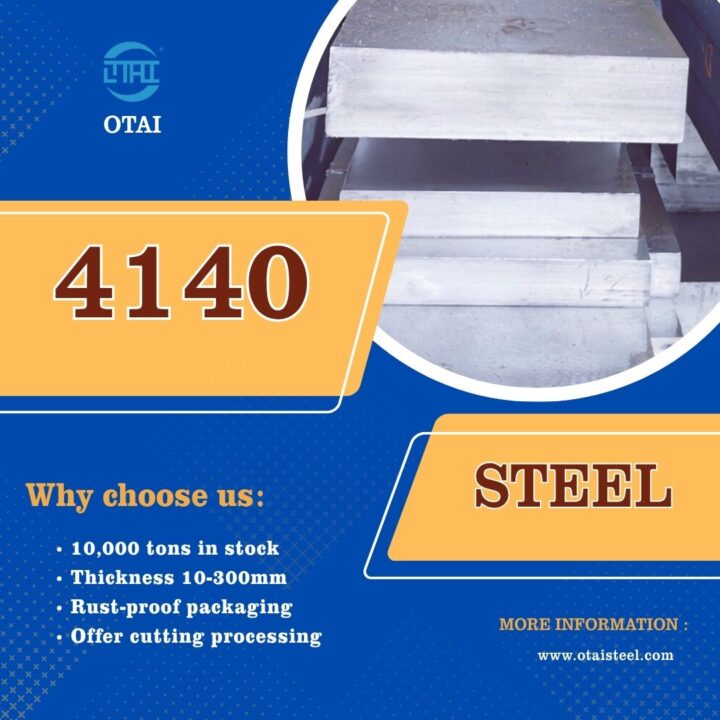
Otai lists 4140 steel plate in a thickness range of 4–380 mm and 4140 QT plate in a thickness range of 13–200 mm. These ranges provide a starting point for procurement planning, but availability can vary by thickness, quantity, condition, and current inventory.
Before placing an order, confirm the actual stock size, quantity, dimensional tolerances, and delivery condition. If the material requires cutting or machining, specify the finished dimensions and the acceptable tolerance for each critical feature.
Review documentation and traceability
Request the material test certificate and verify that the grade, heat number, chemical analysis, and required mechanical properties correspond to the material supplied. For critical applications, agree on any additional testing or third-party inspection before production or shipment.
Density alone cannot establish that a plate meets the required alloy specification. Chemical analysis and traceability are essential when confirming material identity and compliance.
Compare quotations on the same basis
When comparing suppliers, make sure the quotations cover the same grade, standard, thickness, condition, quantity, and inspection requirements. Differences in cutting, machining, packaging, certification, or transport can also affect the total landed cost.
For product information, visit Otai’s official 4140 alloy steel and steel plate page. Confirm current inventory, delivery condition, and project-specific technical requirements with the supplier before finalizing the order.
🏢 Otai Special Steel Supply Advantages
Otai Special Steel supplies alloy steels and tool steels to international industrial customers. For buyers sourcing 4140 steel, reviewing stock dimensions and processing requirements in advance can help align the material with the project’s manufacturing plan.
- 4140 plate stock range: 4–380 mm thickness. For 4140 QT plate, the listed range is 13–200 mm. Confirm actual dimensions, quantity, condition, and availability before ordering.
- International supply experience: Export experience covering more than 54 countries since 1999.
- Inventory capacity: More than 10,000 tonnes of steel across the company’s overall product range, subject to grade-specific availability.
- Cutting capability: 20 sawing machines to support material preparation and cut-to-size requirements.
- Additional processing: CNC machining and grinding options for orders that require further preparation.
- Custom dimensions: Support for discussing requested sizes and tolerances according to material availability and processing requirements.
- Quality documentation: Material certificates and traceability requirements can be discussed and agreed for the order.
- Additional inspection: Ultrasonic testing and third-party inspection can be arranged where applicable and agreed in advance.
- Export packaging: Options include strapping, wooden crates, and rust-prevention protection according to shipment requirements.
- Coordinated service: Material supply, cutting, and related processing requirements can be reviewed together during quotation.
When requesting a quotation, provide the grade, applicable specification, thickness, width, length, quantity, supply condition, and any required inspection documents. If the project includes heat treatment or tight dimensional tolerances, clarify the acceptance criteria before production.
❓ Frequently Asked Questions
1. Does heat treatment change the density of 4140 steel?
Heat treatment changes the microstructure and may cause small dimensional changes, but it does not normally require a different density value for routine engineering calculations. Approximately 7.85 g/cm³ remains a widely used reference for conventional 4140 steel.
2. What is the density of 4140 steel in kg/m³?
A common reference value is approximately 7,850 kg/m³, equivalent to 7.85 g/cm³ or 0.284 lb/in³. Use this value for ordinary theoretical weight calculations, while recognizing that actual weight depends on dimensions and processing.
3. Does quenched-and-tempered 4140 steel weigh more than annealed 4140?
Not necessarily. The two conditions can have different hardness and mechanical properties, but their theoretical weights are usually calculated using the same reference density. Actual measured weights can differ because of dimensional changes, scale, cutting, or machining.
4. Can I use 7.85 g/cm³ to calculate 4140 steel plate weight?
Yes. It is a commonly used reference value for estimating theoretical plate weight. Use the plate’s length, width, and thickness in the appropriate formula, then account for dimensional tolerances and any processing that changes the final geometry.
5. Can density confirm that a material is genuine AISI 4140?
No. Density is not a reliable standalone method for identifying the grade. Check the material test certificate, chemical composition, heat number, applicable specification, and required mechanical test results to verify compliance.