4140 Plate Suppliers: How to Compare Stock, Quality, and Service
📑 Table of Contents
- 🔎 What Makes a Reliable 4140 Plate Supplier?
- 📏 Compare 4140 Plate Stock and Available Sizes
- ⚙️ Confirm Grade, Standard, and Delivery Condition
- 🧪 Evaluate Material Quality and Inspection Documents
- ✂️ Check Cutting, Machining, and Customization Services
- 💰 Compare 4140 Plate Prices and Total Purchasing Costs
- 🚚 Assess Lead Time, Packaging, and Export Capability
- 📋 Supplier Comparison Checklist for Procurement Teams
- 🏭 Company Advantages
- ❓ Frequently Asked Questions
Choosing 4140 plate suppliers involves more than finding a company that lists AISI 4140 alloy steel. Industrial buyers also need to confirm available dimensions, delivery condition, material traceability, inspection requirements, processing capability, and shipping arrangements. Two suppliers may quote the same grade but offer different levels of service and different products.
For procurement teams sourcing 4140 steel plate for machinery, tooling, fixtures, and engineered components, a structured comparison can reduce purchasing risks and help control the cost of the finished part. This article explains how to assess stock, quality, service, and commercial terms before selecting a supplier.
🔎 What Makes a Reliable 4140 Plate Supplier?
A reliable 4140 plate supplier should be able to connect its material offering with your actual production requirements. A broad product catalog is useful, but it does not prove that the supplier can provide the exact thickness, condition, tolerance, documentation, and delivery schedule your project needs.
Look beyond the product listing
Start by checking whether the supplier regularly handles alloy steel plates and understands the requirements of industrial buyers. A specialist stockist may offer a wider selection of dimensions and faster access to standard sizes than a supplier that sources every order individually. A manufacturer or mill-direct supplier may offer advantages for large-volume orders or specific production requirements. The best choice depends on your quantity, schedule, technical specification, and required level of customization.
Ask each potential supplier to confirm the following points in writing:
- Whether the quoted product is AISI 4140 plate and which material standard applies.
- Whether the required thickness, width, length, and quantity are available.
- Whether the material is supplied as rolled, annealed, quenched and tempered, or in another specified condition.
- Which material test certificate and inspection documents accompany the shipment.
- Whether cutting, machining, dimensional inspection, or third-party inspection is available.
- How the supplier calculates lead time and handles packaging, export documentation, and delivery.
Distinguish stockists from manufacturers
These business models are not automatically better or worse than one another. A stockist may hold material in several thicknesses and provide cut-to-size service. A mill may be suitable for larger orders or requirements that need a specific production route. Some suppliers combine inventory, processing, and sourcing capabilities.
Rather than relying on a supplier’s business label, evaluate its actual inventory records, technical documentation, processing equipment, inspection arrangements, and ability to meet your order specification.
📏 Compare 4140 Plate Stock and Available Sizes
Stock availability is often one of the first factors buyers compare. It directly affects lead time, order flexibility, material utilization, and the amount of additional processing required before production can begin. However, a supplier’s published thickness range should not be interpreted as proof that every size is available for immediate shipment.
Confirm the complete dimensions
When requesting a quotation, specify thickness, width, length, quantity, and dimensional tolerances. Include any minimum machining allowance or final-part dimensions that could affect the cutting plan. A plate with the correct thickness may still be unsuitable if its width, length, or flatness does not meet the job requirements.
For example, a buyer who needs several small blanks may benefit from a supplier that can cut a larger plate into specified pieces. Another buyer may need full plates to optimize nesting or manufacture multiple components. These requirements can lead to different quotation prices and delivery schedules.
Ask for a current stock confirmation
Request confirmation of the actual stock dimensions, quantity, delivery condition, and expected dispatch date. If the supplier offers a stock list, check its date and ask whether the listed material remains available. A published range is useful for initial screening, while a current stock confirmation supports the purchasing decision.
| Item to confirm | Why it matters |
|---|---|
| Thickness | Determines suitability for the part and affects machining allowance. |
| Width and length | Influence cutting yield, material utilization, and handling. |
| Quantity and lot size | Helps establish whether the supplier can fulfill the full order from suitable material. |
| Delivery condition | Affects machining, heat treatment, hardness, and lead time. |
| Current stock status | Separates confirmed inventory from material that requires sourcing or production. |
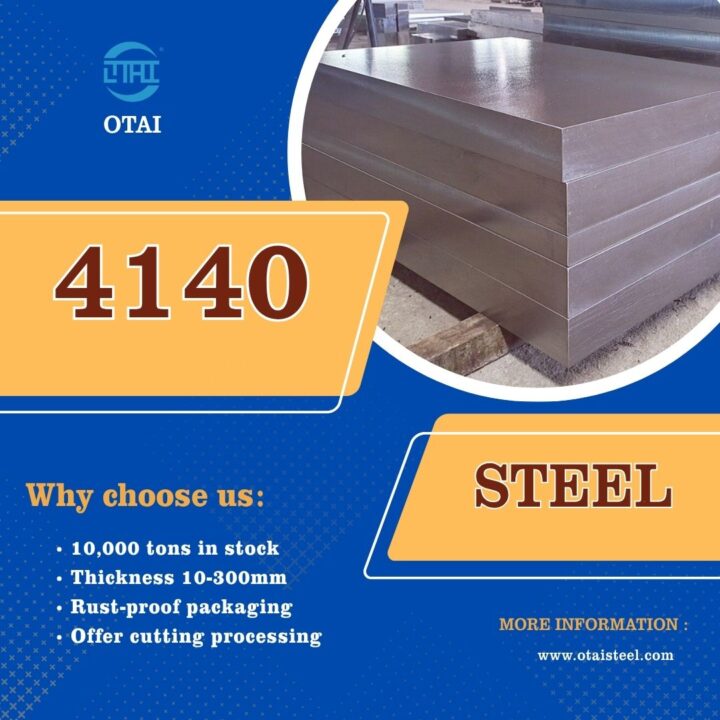
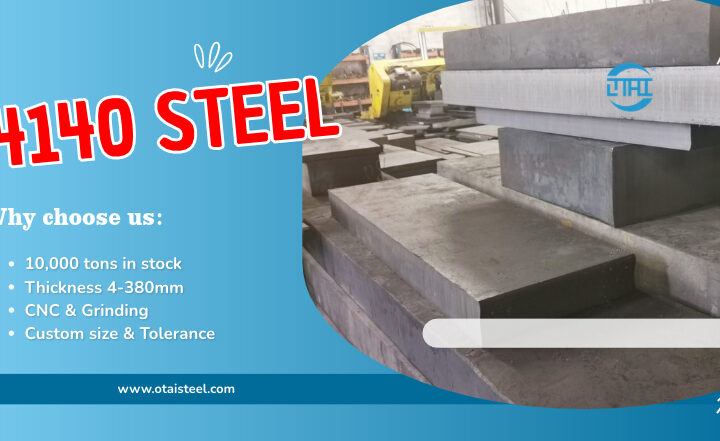
Otai’s stated supply range for 4140 / SCM440 / 42CrMo4 plate is 4–380 mm, with a separate stated range of 13–200 mm for 4140 quenched-and-tempered plate. Buyers should confirm the required dimensions, condition, quantity, and current availability before placing an order.
Review the product details on the official 4140 alloy steel plate product page and provide your exact requirements for a quotation.
⚙️ Confirm Grade, Standard, and Delivery Condition
AISI 4140 is a chromium-molybdenum alloy steel commonly selected for components that require a combination of strength, toughness, and wear resistance. Nevertheless, the grade designation alone does not define every property of the delivered plate. The applicable standard, product form, heat-treatment condition, dimensions, and agreed testing requirements also matter.
Check the material designation and standard
Ask the supplier to state the material designation and applicable standard on the quotation and material documentation. Buyers may encounter related designations such as 42CrMo4 and SCM440 when sourcing internationally. These grades are often considered counterparts to 4140, but their specifications are not automatically interchangeable in every purchasing situation.
Confirm the relevant chemical composition limits, mechanical-property requirements, product form, and acceptance criteria before approving a substitute. If the drawing or contract specifies AISI 4140 under a particular standard, do not accept a different designation solely because the supplier describes it as equivalent.
Select the right delivery condition
4140 plate may be supplied in different conditions, including as-rolled, annealed, normalized, or quenched and tempered, depending on the supplier’s offering and the applicable specification. These conditions can produce different hardness levels, machinability, strength, and downstream processing requirements.
| Delivery condition | Purchasing consideration |
|---|---|
| As-rolled | Confirm the actual hardness, dimensional condition, and whether further heat treatment is planned. |
| Annealed | May suit machining routes that benefit from a softer starting condition; confirm the required hardness range. |
| Normalized | Confirm the applicable treatment specification and required properties. |
| Quenched and tempered (Q+T) | Specify the required hardness or mechanical properties and confirm the test basis. |
Do not assume that every supplier’s Q+T plate has the same hardness or mechanical properties. Request the actual agreed delivery condition and test results for the material being offered. If your component will receive further heat treatment, discuss the manufacturing sequence with your engineering team before specifying the incoming condition.
🧪 Evaluate Material Quality and Inspection Documents
A competitive quotation is not enough if the supplier cannot demonstrate that the delivered material meets the purchase specification. Quality evaluation should cover material identity, traceability, test documentation, dimensional checks, and any additional inspection agreed before the order.
Review the material test certificate
Ask whether the supplier can provide a material test certificate (MTC) linked to the delivered material. Depending on the purchase specification and certificate type, the document may report heat chemistry, mechanical test results, heat-treatment condition, and other relevant information.
Review the certificate against the order rather than checking only the grade name. The material designation, heat or batch identification, dimensions or product details, and reported test results should be consistent with the contract requirements. Confirm how the supplier maintains traceability when it cuts a plate into smaller pieces.
Distinguish three types of chemistry data
Buyers may see chemical composition information in product catalogs, technical datasheets, and MTCs. These records serve different purposes:
- Standard composition limits: The specified ranges or maximum limits under the applicable material standard.
- Typical analysis: Representative values published by a supplier or mill. These are illustrative and do not replace the governing specification.
- Actual heat analysis: The reported chemistry for the specific heat of material supplied, as documented by the applicable certificate.
Do not compare a typical analysis from one supplier with an actual MTC from another as if they were equivalent records. For acceptance, follow the applicable purchase specification and the required documentation.
Agree on additional inspection before ordering
Some projects require ultrasonic testing, dimensional inspection, hardness testing, or third-party inspection. These services should be discussed before the quotation is finalized. Specify the inspection method, applicable acceptance criteria, reporting requirements, and whether the cost and lead time are included.
Not every 4140 plate order requires the same inspection scope. The correct level depends on the component’s function, drawing, industry requirements, and contractual obligations. A capable supplier should explain which checks it can perform directly and which require an external inspection provider.
✂️ Check Cutting, Machining, and Customization Services
The processing capability of a 4140 plate supplier can affect both production efficiency and total purchasing cost. If your factory needs blanks, milled surfaces, or specific tolerances, a supplier that provides suitable processing may reduce the number of handling steps between material receipt and machining.
Match the service to your drawing
Before requesting a processed plate, define the finished or intermediate dimensions and the tolerances that matter. For cut pieces, specify length, width, thickness, quantity, and whether edge condition or cutting allowance is important. For machined pieces, provide a drawing that identifies critical dimensions, surface requirements, datum features, and inspection points.
Ask the supplier to confirm which tolerances it can achieve for the requested dimensions and process. Do not assume that a saw-cut blank automatically meets the final machining tolerance or surface-finish requirement. Agree on the measurement method and acceptance criteria when precision is important.
Calculate material yield and downstream work
Cut-to-size service can reduce scrap and handling, but the best option depends on the component layout and processing route. Compare the price of full plate against the cost of cut blanks, including cutting fees, kerf loss, machining allowance, and any remaining material you can reuse.
For example, a buyer producing multiple identical components may benefit from a planned cutting layout. A project with a small number of complex parts may require more allowance for machining and dimensional correction. Ask the supplier to explain how it will process the material and what dimensions it will guarantee at delivery.
Also confirm whether the supplier can support additional services such as CNC machining, grinding, surface preparation, and custom packaging. These capabilities are useful only when they match the technical requirements and are clearly included in the quotation.
Keep the material specification consistent
Processing must not obscure the identity or delivery condition of the steel. Establish how the supplier will preserve heat or batch traceability after cutting and how it will identify each piece. If a certificate covers the parent plate, agree on the method used to link the cut pieces to that certificate.
💰 Compare 4140 Plate Prices and Total Purchasing Costs
Price comparison works best when every supplier quotes the same technical and commercial requirements. The lowest price per kilogram may not represent the lowest cost for the finished component if the material condition, available dimensions, processing scope, inspection documents, or delivery terms differ.
Request comparable quotations
Send the same inquiry to each supplier. Include the grade and standard, plate dimensions, quantity, delivery condition, tolerances, documentation, inspection requirements, and destination. Ask suppliers to identify any exclusions or assumptions that could change the final price.
| Cost element | Question for the supplier |
|---|---|
| Base material | Does the price cover the exact grade, dimensions, and condition requested? |
| Cutting and machining | Are processing, tolerances, and inspection included or charged separately? |
| Testing and documents | Are MTCs, additional testing, and third-party inspection included? |
| Packaging | Does the quotation include suitable rust protection and export packaging? |
| Freight and delivery | Which shipping terms apply, and what charges remain outside the quotation? |
| Lead time | Is the date based on confirmed stock, processing time, or new production? |
Look at the total landed cost
For international purchasing, the landed cost may include the material price, processing, packaging, freight, insurance, customs duties, and other destination-related charges. The exact calculation depends on the agreed delivery terms and the buyer’s responsibilities.
Consider the cost of delays as well. If material arrives in the wrong condition or without the required certificate, your team may face extra inspection, reprocessing, or production downtime. A supplier with clear technical communication and dependable documentation can reduce these risks, even if its initial quotation is not the lowest.
Ask how long the quotation remains valid and whether the supplier can reserve the confirmed material for an agreed period. Steel prices and stock positions can change, so obtain an updated quotation before placing a delayed order.
🚚 Assess Lead Time, Packaging, and Export Capability
For overseas buyers, supplier performance continues after the material passes inspection. The supplier must also prepare the order correctly, protect the steel during transit, provide the agreed documents, and coordinate shipment with the buyer or freight forwarder.
Separate stock availability from delivery time
A supplier may hold 4140 plate in stock but still need time for cutting, machining, inspection, packaging, and export preparation. Ask for a schedule that separates material availability from processing and dispatch. If your order contains several sizes or conditions, confirm whether the supplier can ship them together or whether partial deliveries are necessary.
Ask the supplier to identify any steps that depend on outside service providers. Third-party testing, special heat treatment, or complex machining can affect the schedule. The quotation should make these dependencies clear rather than giving a general lead time without explaining its basis.
Check packaging and material identification
Steel plate packaging should suit the dimensions, weight, transport method, and destination. Discuss rust-prevention measures, bundling or strapping, lifting points where relevant, and whether wooden crates or other protective packaging are required. Confirm that packaging can withstand the expected handling and transport conditions.
Material identification also matters. Agree on how the supplier will mark or label the pieces and how those markings relate to the packing list and material certificate. For cut-to-size orders, ensure the identification method preserves traceability without interfering with the intended application.
Confirm export documents and communication
Before releasing the order, agree on the documents required for customs clearance, receiving inspection, and internal quality records. Depending on the transaction, these may include the commercial invoice, packing list, transport documents, and material test certificate. Confirm responsibilities for freight, insurance, customs formalities, and delivery under the agreed Incoterms.
A supplier experienced in international trade should be able to explain its documentation process and communicate changes promptly. Ask who will handle order updates and how the supplier will report problems involving stock, processing, or shipment.
📋 Supplier Comparison Checklist for Procurement Teams
Use a consistent checklist when comparing 4140 plate suppliers. This helps purchasing, engineering, and quality teams review the same requirements before they approve a quotation. It also makes gaps easier to identify when a supplier offers a lower price but leaves important items unconfirmed.
Compare the same requirements side by side
| Evaluation area | Evidence to request |
|---|---|
| Stock | Current stock confirmation showing dimensions, quantity, and condition. |
| Specification | Written confirmation of grade, standard, product form, and delivery condition. |
| Quality | Sample MTC or confirmation of certificate content, traceability, and required tests. |
| Processing | Defined cutting or machining scope, tolerances, and inspection arrangements. |
| Commercial terms | Itemized quotation, payment terms, validity, and stated exclusions. |
| Delivery | Dispatch schedule, packaging details, shipping terms, and export documentation. |
| Communication | Clear answers to technical questions and a named contact for order coordination. |
Send a complete inquiry
A well-prepared inquiry helps suppliers respond accurately and reduces the number of quotation revisions. You can adapt the following template for your purchasing team:
Subject: RFQ for AISI 4140 Steel Plate
- Grade and applicable standard: AISI 4140 / [required standard]
- Dimensions: [thickness × width × length]
- Quantity: [pieces or total weight]
- Delivery condition: [as-rolled, annealed, Q+T, or other requirement]
- Hardness or mechanical properties: [required values and test basis, if applicable]
- Cutting or machining: [required dimensions and tolerances]
- Documentation: [MTC, traceability, inspection, or other requirements]
- Destination and delivery terms: [destination and preferred Incoterm]
- Required delivery date: [date]
Please confirm current stock availability, quotation validity, processing charges, lead time, packaging, and any exclusions from your offer.
Review the responses with engineering and quality personnel before approving the purchase. If a supplier proposes an alternative grade or condition, obtain technical approval and update the purchase specification before placing the order.
🏭 Company Advantages
- 4140 plate supply range: Otai’s stated range for 4140 / SCM440 / 42CrMo4 plate is 4–380 mm, while 4140 quenched-and-tempered plate has a stated range of 13–200 mm. Confirm the exact dimensions, condition, quantity, and current stock before ordering.
- Large inventory capacity: More than 10,000 tons of steel inventory supports a broad range of industrial sourcing requirements. Specific 4140 stock positions remain subject to confirmation.
- Cutting and processing: 20 saw-cutting machines, CNC machining, grinding, and customized cutting services can support buyers who need more than full-size plates.
- Technical coordination: The team can discuss dimensional tolerances, delivery conditions, material documentation, and agreed inspection requirements before shipment.
- Quality support: Material test certificates and traceability can be coordinated according to the purchase requirements. Ultrasonic testing and third-party inspection can be discussed when specified and agreed.
- Export experience: Otai has supplied international customers in more than 54 countries since 1999, with packaging and shipping coordination for overseas orders.
- One-stop service: Material supply, cutting, machining, packaging, and related service coordination can help buyers reduce the number of suppliers involved in a project.
To discuss your requirements, visit the official 4140 steel plate product page and submit the required dimensions, condition, quantity, and documentation needs.
❓ Frequently Asked Questions
1. What should I compare when choosing 4140 plate suppliers?
Compare confirmed stock, dimensions, delivery condition, applicable material standard, MTC and traceability, processing capability, inspection options, total cost, and lead time. Use the same written specification for every quotation so that you compare equivalent products and services.
2. What thicknesses of 4140 steel plate can Otai supply?
Otai’s stated supply range for 4140 / SCM440 / 42CrMo4 plate is 4–380 mm. The stated range for 4140 quenched-and-tempered plate is 13–200 mm. These ranges do not guarantee that every thickness, width, length, and condition is immediately available. Confirm the current stock position for your exact requirements.
3. Should I buy annealed or quenched-and-tempered 4140 plate?
The choice depends on your manufacturing route and required properties. Annealed material may suit machining before a later heat-treatment stage, while Q+T material is supplied in a hardened and tempered condition. Specify the required hardness or mechanical properties, and confirm that the supplier can document the agreed condition.
4. Which quality documents should I request from a 4140 plate supplier?
Request the material test certificate and confirm its relationship to the supplied heat or batch. Depending on your specification, you may also need dimensional inspection records, hardness or mechanical test results, ultrasonic testing, or third-party inspection reports. Define these requirements before the supplier issues its quotation.
5. How can I compare 4140 plate prices accurately?
Ask each supplier to quote the same grade, standard, dimensions, quantity, delivery condition, tolerances, documentation, and processing scope. Then compare the total cost, including cutting, machining, packaging, inspection, freight, and other charges under the agreed delivery terms. Confirm stock and lead time in writing before placing the order.